





The Shared Destiny of Dogecoin and Litecoin: Inside the Mechanics and Legacy of Merged Mining
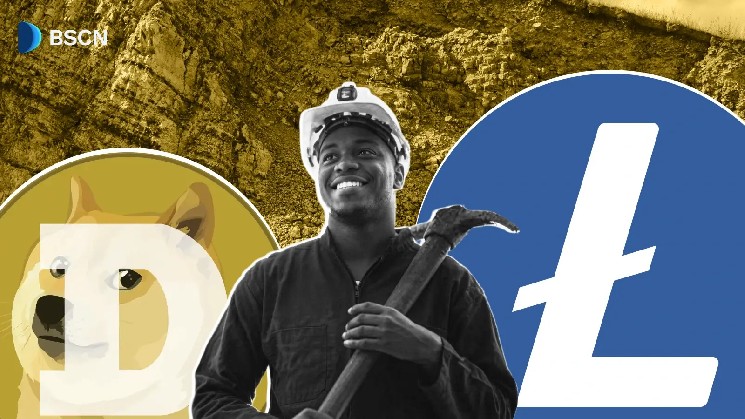
In the highly competitive world of decentralized networks, proof-of-work mining often is viewed as a zero-sum struggle for computational supremacy. Yet, beneath the surface of the Scrypt mining ecosystem lies one of the most successful cooperative arrangements in blockchain history: the merged mining of Dogecoin and Litecoin. This mechanical alliance enables miners to submit a single proof-of-work calculation to both blockchains simultaneously, earning dual rewards in both digital currencies without consuming a single extra watt of electricity or requiring additional specialized hardware. Operating through a technically elegant protocol known as Auxiliary Proof-of-Work (AuxPoW), which Dogecoin adopted in August 2014, this system has quietly redefined security and economic sustainability for both networks. Today, data indicates that upward of 70 percent of Dogecoin’s total hashpower is derived directly from merged mining with Litecoin, cementing this technological marriage as the primary defense mechanism securing the Dogecoin network.
Why Do Dogecoin and Litecoin Work Together?
+————————————————————-+
| Scrypt Cryptographic Engine |
| |
| +———————+ +———————+ |
| | Litecoin | | Dogecoin | |
| | (Parent Chain) | | (Auxiliary Chain) | |
| +———-+———-+ +———-+———-+ |
+————–|——————————-|————–+
/
/
v v
+———————————+
| Shared Scrypt ASIC Miner |
| “One Hash, Two Blockchains” |
+———————————+
To understand why these two distinct digital assets share an infrastructure, one must examine their underlying cryptographic engine: the Scrypt algorithm. Created as an alternative to Bitcoin’s SHA-256, Scrypt was engineered to be intentionally memory-intensive, initially resisting the centralization of mining by keeping consumer-grade hardware competitive. Because both Litecoin and Dogecoin utilize this exact hashing algorithm, they speak the same mathematical language. When an ASIC miner generates a hash to solve a Litecoin block, that identical calculation can satisfy Dogecoin’s proof-of-work protocols, provided the hash value meets Dogecoin’s difficulty target. This compatibility is no historical accident; Dogecoin was launched in December 2013 as a direct software fork of Lucky Coin, which itself was a fork of Litecoin. This shared lineage meant their mining equipment and developer ecosystems overlapped from the very beginning. To use a practical analogy, it is the computational equivalent of a graduate student submitting a single comprehensive research paper to two separate academic journals that follow identical formatting and peer-review guidelines—the physical research is performed only once, but academic credit and publication rights are granted by both entities.
What Is AuxPoW and How Does It Actually Work?
At the heart of this cooperative model is a protocol called Auxiliary Proof-of-Work, or AuxPoW. In this hierarchical relationship, one blockchain is designated as the “parent” chain (Litecoin) while the other serves as the “auxiliary” chain (Dogecoin). The technical magic of AuxPoW is that it allows the auxiliary chain to run alongside the parent chain without requiring the parent to modify its code or even acknowledge the other’s existence. The operational steps of this process are highly systematic:
- Transaction Assembly: The miner starts by constructing a block of valid transactions for both networks.
- Coinbase Embedding: The cryptographic hash of the Dogecoin block header is embedded directly inside the “coinbase field” of the parent Litecoin block.
- Targeted Hashing: The miner’s Scrypt ASIC machines hash repeatedly to find a solutions that satisfies Litecoin’s difficulty target.
- Dual Validation: If a generated hash meets the Litecoin difficulty target, a new LTC block is successfully minted. If that same cryptographic hash also meets Dogecoin’s—usually lower—difficulty threshold, a valid DOGE block is discovered simultaneously.
- Simultaneous Submission: The completed proofs are broadcast to both peer-to-peer networks, allowing each blockchain to process its transactions and update its ledger independently.
- Dual Asset Distribution: Both blockchains release their respective reward payouts to the miner’s designated wallet addresses.
Importantly, this process requires no structural awareness from the native Litecoin code; all block coordination is handled automatically at the mining pool level or via customized mining software. This design ensures that Litecoin maintains its established operations while acting as an anchor of security for its auxiliary partner.
August 2014: The Existential Crisis That Rescued Dogecoin from Extinction
   Hashrate Trend Following August 2014 Hard Fork

   Hashrate
   (PH/s)
     ^                                    *  (After AuxPoW Integration)
     |                                   *
     |                                  *
     |                                 *
     |                                *
     |                               *
     |   * * *                      *
     |  *     *                    *
     | *       * (Before AuxPoW)  *
     +----------------------------------------------------> Time
                  August 2014 (Block 371,337)
To appreciate why Dogecoin’s developers took the unprecedented step of altering their consensus mechanism to include AuxPoW, one must revisit the volatile market dynamics of mid-2014. During its inaugural year, Dogecoin’s block reward schedule was designed to decay rapidly, which severely depleted the financial incentives for dedicated pools to secure its network. This situation led to high numbers of opportunistic miners “hash-hopping”—switching their computing power back and forth between Litecoin and Dogecoin depending on minute-by-minute trading profitability. This constant shifting of resources caused Dogecoin’s network stability to fluctuate wildly, rendering it highly vulnerable to a 51% exploit, where a malicious miner or coalition could hijack enough hashrate to alter historical transaction records.
Recognizing this existential danger, Dogecoin’s lead developers executed a hard fork at block 371,337 to integrate AuxPoW. The defensive transformation was immediate and profound: within thirty days of the hard fork, Dogecoin’s hashrate and mining difficulty surged by over 1,500 percent as large, institutional Litecoin mining pools began forwarding their spare hashing proofs to Dogecoin. Since that pivotal transition, the hashrates of both networks have maintained a correlation coefficient of roughly 0.95, rising and falling in lockstep as a unified cryptographic system.
The Economics of Double Loot: Mining Revenue, ASICs, and Power Margin Optimization
For commercial mining institutions and hobbyists alike, the primary driver for executing merged mining is the direct impact it has on operational profitability. Under current protocols, Dogecoin issues a fixed reward of 10,000 DOGE for every block mined, with a target block time of approximately 60 seconds. With DOGE maintaining market values between $0.084 and $0.09 in early June 2026, these steady block rewards provide a reliable revenue buffer on top of standard Litecoin yields. While Litecoin operates on a deflationary halving schedule that systematically reduces block emissions over time, Dogecoin’s stable emission model provides predictable cash flow.
+—————————————————————–+
| Scrypt ASIC Merged Mining Yield |
| |
| [ Litecoin Revenue Base ] ====> (Covers baseline power bills) |
| + |
| [ AuxPoW Dogecoin Yield ] ====> (Adds 20% to 30% bonus) |
| |
| * Net Result: Zero marginal power cost for secondary revenue |
+—————————————————————–+
Mining pool evaluations demonstrate that miners who activate Litecoin-Dogecoin merged mining can capture an estimated 20% to 30% increase in daily revenue without drawing a single extra kilowatt of electricity. In an industry where razor-thin margins are dictated by local electricity rates, this bonus can mean the difference between a highly profitable data center and an unprofitable one. It is therefore no surprise that modern hardware manufacturers design Scrypt ASICs specifically for this dual-reward environment. Hardware options like the Bitmain Antminer L9 and the Goldshell DG Max are engineered from the silicon up to maximize the processing of Scrypt hashes for dual-mining configurations, while major pools like ViaBTC, F2Pool, and Prohashing handle all AuxPoW coordination behind the scenes, paying out dual assets with zero manual setup required by the end user.
The Security-Centralization Conundrum: Balancing Fortified Hashrates with Pool Monopoly Risks
While merged mining provides undeniable economic and defense advantages, it also introduces certain structural trade-offs that are widely debated among network architects. On the plus side, the sheer scale of the unified mining pool network has elevated the thermodynamic security of both chains to historical heights. In mid-2026, Dogecoin’s average network hashrate has stabilized in a highly secure channel between 2.7 and 3.4 PH/s (petahashes per second), after peaking at an all-time high of 8.72 PH/s in February 2026. This monumental wall of computational power makes any attempt at a 51% attack on either blockchain prohibitively expensive, requiring billions of dollars in hardware acquisition and energy costs.
However, this elevated security comes at the expense of distribution diversity. Because modern merged mining is highly automated, a significant portion of the total hashpower is routed through a handful of large, centralized mining pools. This concentration has historically raised eyebrows within the decentralization community; for example, data shows that F2Pool once controlled over 33% of the total block generation for Dogecoin over extended intervals, even crossing the critical 50% majority threshold at various points in late 2016. Should a single pool gain a permanent majority, it presents systemic risks of transaction censorship or double-spending, indicating that the community must remain vigilant in monitoring the balance of power across major cryptographic pools.
Architectural Blueprint: How Modern Miners Power Up the Dual-Reward Engine
For operators looking to enter the Scrypt mining space, initiating merged mining requires no specialized hardware beyond standard Scrypt-compatible ASICs. The process is straightforward:
[ Scrypt ASIC Hardware ] —> [ Multi-Asset Mining Pool ] —> [ Dual Wallets (LTC + DOGE) ]
- Hardware Selection: Operators must deploy an ASIC specifically designed for the Scrypt hashing algorithm, such as the Bitmain Antminer L7 or the newly integrated Antminer L9. Traditional GPU or CPU mining is no longer economically viable due to the high network difficulty.
- Pool Registration: Miners must choose a mining pool that natively supports AuxPoW, such as ViaBTC, F2Pool, or Prohashing. These platforms do not require separate configurations for each blockchain; they present a single connection endpoint.
- Firmware Configuration: The miner directs their ASIC hardware to the pool’s server addresses using standard stratum protocol settings.
- Address Binding: Within the mining pool’s portal interface, the operator binds their independent Litecoin and Dogecoin payout addresses.
- Automated Distribution: As work is performed, the pool automatically credits the miner’s accounts with both LTC and DOGE proportioned to their contributed hashpower.
For advanced operators who prefer self-custody and complete ledger independence, running a private node utilizing mining engines like CGMiner or EasyMiner also allows for solo merged mining, ensuring that the legacy of this cooperative, energy-efficient consensus mechanism continues to thrive in the modern proof-of-work landscape.