







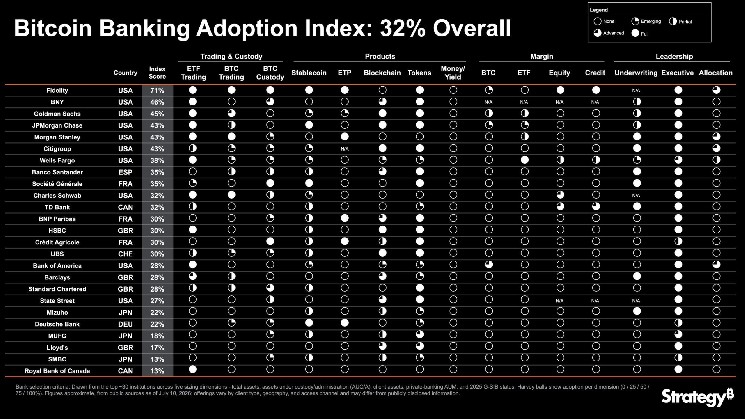
Institutional Evolution: Decoding the Strategic Shift Behind the 32% Bitcoin Banking Adoption Index
The global financial landscape is experiencing a subtle yet profound paradigm shift, as traditional banking giants move beyond cautious skepticism into the realm of digital asset integration. This evolution was recently quantified by Strategy Inc. (Nasdaq: MSTR), which unveiled its inaugural “Bitcoin Banking Adoption Index.” Promoted by Chief Executive Officer Phong Le, the newly minted index offers a data-driven benchmark, placing current collective adoption across major global financial institutions at 32%. While a score of under one-third highlights that the traditional banking sector remains in the nascent stages of cryptocurrency integration, the index underscores a critical narrative: Wall Street is no longer merely watching from the sidelines. Instead, premier financial institutions are actively constructing the plumbing required to support a decentralized economy, signaling that digital assets are becoming an permanent fixture of modern corporate finance.
              =========================================
              GLOBAL BITCOIN BANKING ADOPTION SPECTRUM
              =========================================
[0%] [32%] [71%] [100%]
—|————————————-|———————|——-|—
None Index Fidelity Full
Average (Leader)
To establish this 32% baseline, Strategy Inc. employed a multidimensional scorecard designed to look past marketing rhetoric and evaluate concrete operational capabilities. The index systematically cross-references institutional participation across several core operational verticals: spot trading, secure custody solutions, structured yield products, tokenization initiatives, margin lending, underwriting activities, and direct corporate treasury allocations. Using a classic consultative scorecard methodology—Harvey balls representing empty, partially filled, and fully saturated circles—the framework evaluates approximately 30 of the world’s most critical financial organizations. These institutions were meticulously curated based on stringent metrics, including total assets under management (AUM), assets under custody (AUC), private-banking reach, and their official designation as Global Systemically Important Banks (G-SIBs). The resulting diagnostic tool provides a standardized lens through which market analysts can evaluate how effectively legacy capital is interfacing with blockchain technology.
   ===============================================================
                   INDEX MEASUREMENT FRAMEWORK
   ===============================================================
   [ Custody Services ]   --> Secure storage & key management
   [ Asset Tokenization]  --> On-chain real-world assets (RWA)
   [ Treasury Portfolios] --> Direct corporate balance sheet allocation
   [ Exchange Products ]  --> Spot ETFs & structured trading vehicles
   ===============================================================
The distribution of scores across the index reveals a highly polarized playing field, dominated by a few early-moving pioneers while the majority of peers lag behind. Leading the pack by a wide margin is Boston-based asset management giant Fidelity Investments, scoring an industry-topping 71% adoption rate. This dominant position is a direct result of Fidelity’s decade-long commitment to the digital asset ecosystem, executed through its specialized subsidiary, Fidelity Digital Assets, and bolstered by the massive capital inflows into its spot Bitcoin ETF, the Fidelity Wise Origin Bitcoin Fund (NYSE Arca: FBTC). Following Fidelity is custody titan BNY (formerly BNY Mellon) at 46%, and investment banking powerhouse Goldman Sachs at 45%. BNY’s second-place finish highlights the critical importance of institutional-grade tri-party custody and fund administration services in the crypto space, while Goldman’s position reflects its active involvement in digital asset derivatives, structured notes, and tokenized liquidity networks.
        ====================================================
                    LEADERBOARD LEAGUE TABLE
        ====================================================
        Rank  Institution       Adoption Score  Primary Driver
        ----------------------------------------------------
         1.   Fidelity               71%        FBTC & Custody
         2.   BNY                    46%        Institutional AUC
         3.   Goldman Sachs          45%        Derivatives & Margin
        ----------------------------------------------------
         *    Index Average          32%        Baseline standard
        ====================================================
This stark contrast between frontrunners like Fidelity and the rest of the financial pack highlights the regulatory and operational hurdles that continue to divide the banking sector. While agile asset managers and specialized custodians have successfully carved out profitable niches in digital asset servicing, many traditional commercial banks remain constrained by stringent regulatory capital requirements, compliance mandates, and historic risk aversion. For these institutions, the path to adoption is blocked by complex liquid asset requirements, international Basel III banking guidelines, and local supervisory frameworks that penalize holding digital assets on balance sheets. Consequently, many institutions find themselves stuck in the lower percentiles of the index, limited to exploratory proofs-of-concept or indirect exposure through client wealth management channels rather than engaging in direct market-making or balance sheet ownership.
Traditional Banking Core Intermediary Layer Digital Asset Class
┌──────────────────────┐ ┌────────────────────┐ ┌─────────────────┐
│ • Compliance Engine │ ──────────> │ • Spot/Future ETFs │ ──────> │ • Bitcoin │
│ • Basel III Capital │ │ • Custodied Assets │ │ • Stablecoins │
│ • Custody Framework │ │ • Tokenized Cash │ │ • Tokenized RWAs│
└──────────────────────┘ └────────────────────┘ └─────────────────┘
Recognizing that a single percentage score cannot capture the vast complexities of global finance, industry experts emphasize that the long-term credibility of Strategy Inc.’s index depends on the transparency of its underlying methodology. CEO Phong Le has acknowledged this need for analytical rigor, stating that the organization plans to release detailed weightings, criteria, and regular updates, while inviting peer institutions to submit corrections based on public disclosures. This collaborative feedback loop is essential for refining the tool. Without a standardized, peer-reviewed methodology, any indexing effort risks being viewed as a subjective marketing exercise rather than an objective academic benchmark. For the index to earn enduring authority among institutional investors, it must clearly define what constitutes “adoption”—differentiating between a bank simply approving an ETF for wealthy clients versus building native blockchain infrastructure.
Looking ahead, the evolution of this index will likely mirror the broader maturation of the digital asset market itself. As global regulatory bodies establish clearer frameworks for stablecoins, tokenized deposits, and digital securities, the criteria for “full implementation” will naturally expand. Future iterations of the index will need to track not just whether a bank offers basic bitcoin custody, but how deeply blockchain technology is integrated into its core clearing, settlement, and payment infrastructures. Ultimately, Strategy Inc.’s 32% adoption benchmark serves as a crucial historical milestone. It marks the moment when institutional cryptocurrency adoption transitioned from an experimental trend into a measurable corporate strategy, providing a clear roadmap for the inevitable integration of legacy finance and digital assets.