



Headline: Nasdaq’s 23-Hour Trading Day Is Here: What It Means for Investors and Markets
Subheadline: The exchange’s “Always-On” plan will shave the daily break to just one hour, pushing U.S. equity markets closer to a 24/7 world — and sparking a new era of opportunities and risks.
Paragraph 1: The Dawn of a Nearly Nonstop Market
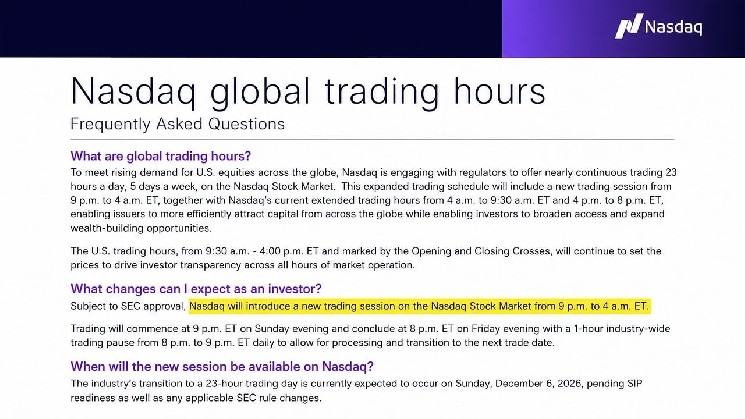
In a move that will forever change how Americans think about the stock market’s daily rhythm, Nasdaq has unveiled plans to keep its doors open for 23 hours a day, five days a week, leaving only a single hour for settlement and rest. The new overnight session, which will run from 9 PM to 4 AM Eastern Time, is slated to launch on December 6, 2026. This means that from Sunday at 9 PM through Friday at 8 PM, trading will be virtually uninterrupted, with only a one-hour pause between 8 PM and 9 PM ET each evening — a brief window Nasdaq says is necessary for processing and transitioning to the next trading date. The announcement sent ripples through the financial world, signaling that the days of the traditional 9-to-4 market may soon be as antiquated as the ticker tape. For the approximately 60% of American adults who own stocks, either directly or through retirement accounts, this shift represents more than just a scheduling change; it’s a fundamental rewriting of the rules that have governed capital markets for over two centuries.
The exchange operator, which also runs the tech-heavy Nasdaq Composite, has been a pioneer in electronic trading since its founding in 1971, but this latest initiative is arguably its most radical yet. By extending the trading day to the brink of around-the-clock activity, Nasdaq is responding to a demand from a new generation of traders who have grown accustomed to the always-available nature of cryptocurrencies and foreign markets. “We are excited to be leading the transition to a new operating model,” said Adena Friedman, Nasdaq’s chair and CEO, during an April earnings call with investors. She emphasized that the exchange is working to ensure that the consolidated tape and market data will be fully operational during the extended hours, creating what she described as a “lit market environment 23/5.” The message is clear: the financial world is becoming increasingly borderless, and if U.S. markets don’t evolve to meet the moment, they risk being left behind.
Paragraph 2: The Nuts and Bolts of the “Always-On” Initiative
To be clear, the core trading session that has defined Wall Street for generations—the 9:30 AM to 4 PM ET window—will remain untouched and will continue to serve as the baseline for official closing prices, a critical anchor for everything from index funds to derivatives. However, the introduction of the overnight session is a massive logistical undertaking. The proposal, branded under the “Always-On” initiative, has already received preliminary approval from the Securities and Exchange Commission (SEC) in the second quarter of 2026. Yet, the December 6 timeline is conditional upon two final pieces of the puzzle. The first is an additional SEC sign-off on specific safeguards designed for the overnight session, including the implementation of static price bands that would automatically reject orders placed outside of predefined limits. The second is a confirmation that the securities information processor—the shared infrastructure responsible for consolidating trade data across all exchanges—is fully prepared to operate around the clock. In effect, the entire market plumbing must be ready for a world where the taps are turned off for only one hour a day.
For traders eager to participate in this brave new world, there will be significant changes at the front end. The typical order entry ports that connect brokers to the exchange will need to be upgraded, and Nasdaq has already indicated that certain complex order types will not be available during the extended hours due to the inherent risks involved. This is a clear acknowledgment that the afternoon and overnight hours, when liquidity is expected to be thinner, require a cautious approach. Law firm Alston & Bird has already issued an advisory to its listed-company clients, warning them to brace for heightened volatility and reduced liquidity during these off-peak hours. The firm also flagged a less obvious but equally concerning consequence: the shortened maintenance window could compress the time companies have to process corporate actions, such as stock splits or dividend declarations. They recommended that companies “carefully reconsider” the timing of earnings releases and material announcements, as an unprepared company could find its stock swinging wildly in an environment with no safety net.
Paragraph 3: The Competitive Arms Race for the Night Owl Investor
The move is not happening in a vacuum. It is the latest salvo in a high-stakes arms race among exchanges to own the trading day—and now the trading night. Nasdaq’s current schedule, which runs from 4 AM to 8 PM ET, already captures a significant amount of pre-market and after-hours activity, but the company has seen how much untapped demand exists beyond that. Approximately 2% of total trading volume currently occurs outside the regular 9:30 AM to 4 PM session, a number that, while small, represents billions of dollars in daily volume. More importantly, it is a number that competitors believe can only grow. The New York Stock Exchange (NYSE) has floated a 24-hour trading model of its own, an idea that was once considered fantastical but has gained traction in the wake of crypto’s meteoric rise. After all, if a decentralized asset with no intrinsic value can trade 168 hours a week, why not the world’s most liquid stocks?
The derivatives market has already sprinted ahead of the cash equities market in this regard. CME Group, the world’s largest futures exchange, has been offering single-stock futures on more than 50 top U.S. stocks for nearly 23 hours a day, five days a week, through its Globex platform. Additionally, CME’s bitcoin and ether futures trade 24/7, mimicking the underlying crypto spot markets. For institutional investors, the ability to hedge or adjust positions in response to overnight news—such as a geopolitical crisis or an unexpected earnings miss—is invaluable. By offering a similar schedule for stocks, Nasdaq is hoping to capture that flow before a rival does. “This is as much a competitive response as it is a technical one,” noted one market structure analyst. “Capital increasingly treats round-the-clock access as the default, not the exception. Exchanges that don’t adapt risk becoming irrelevant.” The message is clear: the stock market is no longer a nine-to-five business, and the race to own the 4 AM slot may very well define the next decade of trading.
Paragraph 4: A New Playground for Retail and Institutions Alike
The implications of this extended schedule are profound for both the retail investor and the largest institutional players. On the retail front, the overnight session democratizes access, allowing everyday investors—many of whom hold day jobs and cannot watch the market during traditional hours—to react to news in real time. Imagine a teacher in California who gets off work at 4 PM ET, or a nurse on the night shift who is just waking up; for them, the overnight session is a game-changer. It empowers them to act on world events when they happen, rather than waiting for the next opening bell and absorbing the risk of an adverse gap. The surge in retail trading that began during the pandemic, fueled by commission-free apps like Robinhood and Charles Schwab, has shown that these investors crave control. Round-the-clock access is the logical next step in that evolution, turning the stock market into an amenity as accessible as the local gym.
For institutional funds, however, the extended hours come with a new set of risk management challenges. The thin liquidity of the overnight session means that every trade could have a more significant market impact, and the static price bands—while a safeguard—could also prevent necessary price discovery in times of crisis. Moreover, the pressure on the backend infrastructure is immense. Mortgage lenders, credit unions, and payment systems that are used to processing transactions during a narrow window will need to adapt to a world where money moves at 2 AM on a Wednesday. The one-hour break between 8 PM and 9 PM is designed to alleviate some of that stress, allowing for batch processing and database synchronization, but experts question whether 60 minutes is truly enough. “The plumbing of the financial system wasn’t built for this,” said a technology officer at a major clearing firm. “We are essentially asking our systems to run a marathon at a sprinter’s pace, and we need to be certain they can go the distance.”
Paragraph 5: Regulatory Hurdles and the Quest for a “Lit Market”
While the market itself is eager to press forward, the regulatory environment remains a significant wildcard. The SEC’s initial approval was a crucial step, but the additional requirements—particularly around the static price bands—highlight the commission’s cautious approach to a world where manual oversight is far more difficult. The consolidated tape, which aggregates price and volume data from all exchanges, is another sticking point. For the system to work effectively, the tape must be updated in real time, without latency, and with the capacity to handle a 50% to 60% increase in message traffic during the new hours. Friedman’s comment about a “lit market environment” is telling; lit markets are those where trading occurs on public exchanges with transparent prices, as opposed to dark pools. By championing this initiative, Nasdaq is taking a stand in favor of transparency, hoping that the extended hours will bring more order flow to the opening and closing auctions, where prices are often viewed as more reliable than in the sporadic overnight period.
Nevertheless, the path to full implementation is littered with potential hurdles. Lawmakers and investor advocates have raised concerns about investor protection, particularly for those who may not understand the difference between trading at noon and trading at midnight, where one-off sell orders can move the price dramatically. There is also the matter of the SEC’s own capacity; the agency has historically had a review period for new rules, and the compressed timeline between now and December 2026 leaves little room for error. Some insiders predict that the launch could be delayed if exchange-tested mechanisms and alternative trading systems face unexpected technical glitches. For now, however, the optimists point to the swift integration of exchange-traded funds (ETFs) and the broader ecosystem’s ability to adapt to the 2004 extension of the trading day to 4 PM, which was once considered radical. The market has a way of finding an equilibrium, but the journey there is rarely smooth.
Paragraph 6: A Glimpse Into the Future: The Weekend Is the Final Frontier
As the financial world prepares for the dawn of the 23/5 trading week, the most profound question remains: what’s next? If the one-hour break does prove sufficient for maintenance, it’s not a stretch to imagine a world where even that window disappears. The infrastructure for 24/7 trading already exists in the crypto and foreign exchange markets, and the technology to support a true 24/6 or even 24/7 U.S. equity market is not far off. The real obstacle, as always, is the human element—the clearing houses, the lawyers, and the exhausted API engineers who must keep the lights on. But the trend is undeniable. As the world’s economies become more interconnected and the demand for instant gratification grows, the notion of a lunchtime recess in the middle of a trading day seems almost charmingly archaic.
For the average investor, the message is clear: that the market’s long-standing “banker’s hours” are a relic of a bygone era. The move to 23/5 is more than just a technical adjustment; it is a cultural statement. It signals that the pursuit of capital markets has become a round-the-clock endeavor, mirroring the always-on nature of the modern digital age. While the long-term effects on market quality and volatility are uncertain, one thing is certain: the old saying that “the stock market is closed” will soon need a qualifier. It’s not closed anymore—it’s just taking a five-hour catnap during the Sunday slumber. And in a world that’s always moving, that might just be the new normal.