





Diesel Hits Record $6.529 as Freight Costs and Inflation Worries Converge
A New Record at the Pump Arrives With Inflation Already in Focus
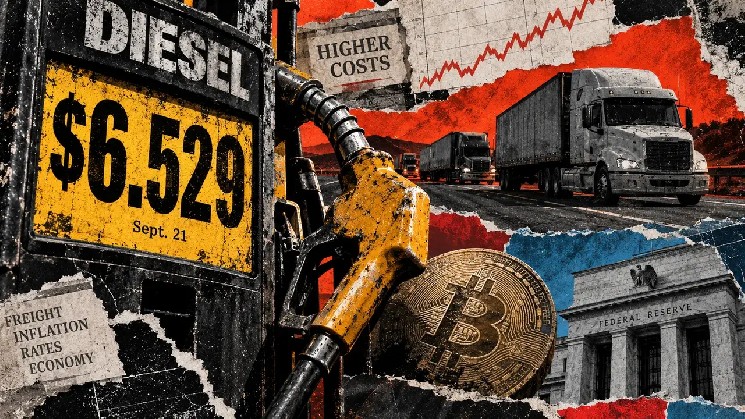
On September 21, the average price of on-highway diesel in the United States climbed to $6.529 a gallon, a striking jump of 24.4 cents in just one week, according to the latest reading from the Energy Information Administration. The move was significant not only for truckers and fleet operators, but also for anyone watching the slow-burning relationship between fuel costs, freight charges, and the broader inflationary environment. Just seven days earlier, the EIA had described the September 14 price as a record in nominal dollars. The newer, higher reading did not just confirm that record; it replaced it. That distinction matters because the record is measured in nominal terms — meaning the dollar price at the pump is not adjusted for inflation. In simple terms, the number is the raw price that consumers see, not a reflection of what that dollar can buy over time.
For Bitcoin investors, the diesel reading may seem like an unlikely indicator. Bitcoin is a digital asset, after all, not a barrel of crude. Yet the financial system has a way of connecting these dots. Diesel is a core input into the movement of nearly everything in the physical economy. When fuel prices rise, freight costs often follow. When freight costs rise, consumer prices can feel the pressure. And when consumer prices remain elevated, the Federal Reserve is more likely to keep interest rates high for longer. That is the channel through which a diesel price spike can ripple into the valuation of assets that are sensitive to borrowing costs and liquidity. The latest record at the pump is therefore more than a transportation statistic. It is a new variable in the inflation debate, and it arrived at a moment when investors are already trying to guess how long restrictive monetary policy might last.
Distillate Stocks Slip Again, Pointing to a Tighter Market
Adding to the concern is the latest snapshot of the nation’s fuel buffer. The Energy Information Administration reported that U.S. distillate stocks — the inventory category that includes diesel and heating oil — stood at 107.431 million barrels in the week ended September 18. That marked a decline from 107.859 million barrels in the previous week, a drop of roughly 428,000 barrels. The EIA published the stock reading on September 23, and the numbers reinforce the picture of a market operating with limited room for error. A shrinking inventory buffer is rarely a reason to panic by itself, but it becomes far more significant when global supply is already strained and crude prices are elevated.
The EIA itself has pointed to tight global distillate supply and elevated crude prices as the main forces behind the recent surge in diesel costs. That is an important reminder that the United States is not operating in isolation. Diesel markets are shaped by refinery capacity, international trade flows, and the price of crude on world markets. When refineries elsewhere run into trouble, or when demand for distillate rises in other regions, the effects can show up at American pumps within weeks. The fact that inventories are declining at the same time that prices are setting fresh records suggests that the market is not simply dealing with a seasonal wobble. It is dealing with a structural mismatch between supply and demand, and that mismatch has a direct effect on the cost of keeping the economy moving.
For trucking companies, railroads, and every business that relies on shipping, the message is straightforward: diesel is becoming a more expensive and less predictable input. The EIA has noted that high diesel prices can contribute to higher road and rail shipping costs, and the implications run far beyond a single filler-up at the pump. The cost of moving food, clothing, fuel, medicine, parts, and raw materials is embedded in the price tag of nearly every product sold. The question is not whether higher diesel costs will affect the freight industry, but how much of that increase will be passed along to consumers — and how quickly that pass-through will occur.
Why Diesel Powers the Inflation Conversation
Diesel is the fuel that keeps the American supply chain in motion. A large share of freight in the United States is moved by trucks, and the trucking industry depends on diesel to run. Rail networks, too, rely heavily on diesel locomotives. When the price of diesel climbs, the cost of moving goods climbs with it. That connection is exactly why the EIA has cautioned that high fuel prices can translate into higher transportation costs for both road and rail freight. But the link between diesel costs and consumer prices is not always direct or immediate. The timing depends on how freight contracts are structured, how competitive the market is, and how long the elevated fuel prices last.
Some carriers operate under long-term agreements that include fuel surcharges tied to published diesel indexes. Those arrangements can allow cost increases to flow through in a predictable, formula-driven way. Others operate in spot markets where pricing can shift quickly in response to changes in fuel costs. In both cases, the duration of the fuel spike matters enormously. A single expensive week at the pump may be absorbed by carriers or offset by efficiency gains. A sustained squeeze that carries across multiple billing cycles is a different story entirely. That kind of pressure embeds itself into freight pricing, and once freight pricing moves, the effects are far more likely to show up in the consumer price data that the Federal Reserve watches closely.
The distinction between a temporary spike and a lasting increase is central to the current debate. Investors are trying to determine whether the recent diesel record is a one-off event or the beginning of a broader trend. If it is merely a sharp but short-lived jump, the inflation impulse may be limited. If it marks the start of a prolonged period of expensive fuel, then freight costs could rise, supply chains could adjust, and the pressure on consumer prices could intensify. That is the risk that has Bitcoin investors paying attention to a seemingly non-adjacent data point. The route from the diesel pump to the digital asset market runs through inflation expectations, and inflation expectations run through the Federal Reserve.
August Producer Prices Offer an Early Warning Signal
Data from the Bureau of Labor Statistics released earlier in the season provide a useful preview of how the pressure was building before the latest retail record. In August, the producer price index for diesel fuel jumped 24.1% from the previous month. That is a dramatic increase, and it signals that the cost pressures were not limited to the final retail sale. Producers were charging significantly more for diesel fuel before it ever reached the pump. At the same time, the BLS truck freight transportation price index rose by 2.0% in August. Both increases occurred before the most recent retail diesel record was set, meaning they capture the early stages of what may now be flowing through the economy.
The juxtaposition of those two figures is important. The producer price index shows that the energy sector was already repricing diesel fuel aggressively. The truck freight index shows that the transportation sector had started to feel the weight of those higher costs. A 2.0% monthly rise in truck freight prices may not sound alarming on its own, but it is a notable move for an index that tends to reflect real-world shipping conditions. Together, the two data points paint a picture of upstream price pressure building in August, before the September spike in retail diesel prices. They also suggest that the freight market may be more sensitive to diesel costs than some economic models assume.
That said, the data stop short of proving that the freight increase was caused by diesel prices alone. Freight rates are shaped by many factors, including labor costs, capacity, demand, and route efficiency. The cause of the August freight increase, and its eventual effect on consumer prices, remains an open question. What the data do show is that the system was already moving in a direction that bears watching. The August numbers are a reminder that fuel costs work their way through the supply chain with a lag, and that the full effect of a record diesel price may not be visible in the headline inflation readings for several months. For investors, that lag is both a challenge and an opportunity. It means that today’s fuel prices may contain information about tomorrow’s inflation data, even if the connection is not immediately obvious.
Bitcoin’s Exposure to Rate Expectations in the Higher-for-Longer Era
The potential Bitcoin effect of a diesel price spike is indirect but real. Bitcoin has no direct exposure to the fuel market, but it is highly sensitive to the financial conditions that fuel prices help shape. The transmission mechanism runs through inflation and interest-rate expectations. If sustained diesel prices and freight costs keep broader inflation uncomfortably firm, investors are likely to expect the Federal Reserve to hold interest rates higher for longer. That kind of expectation tends to weigh on assets that are sensitive to financing conditions. Bitcoin, with its long-dated and speculative profile, is one such asset. When the cost of money stays high, risk appetite often shrinks, and assets that cannot be easily valued on traditional cash flow models become more vulnerable to pressure.
The Federal Reserve had already made its position clear. On September 16, the Fed raised its target range to 3.75% to 4%, citing elevated inflation in its decision. That move came before the September 21 diesel reading, and the Fed’s accompanying statement spoke broadly about inflation rather than pointing to any single commodity. Still, the timing is worth noting. The central bank’s decision was made in an information environment that did not yet include the latest diesel spike. The next round of policy assessments will have to contend with whatever the fuel and freight markets show in the weeks ahead. If the diesel record turns out to be part of a sustained trend, it will add to the evidence that inflation is not cooling as quickly as hoped. That would feed directly into expectations about future Fed action, and through that channel, into the market for digital assets.
Bitcoin’s response to this particular diesel move remains to be seen. It is possible that markets will shrug off the record as an isolated event. It is also possible that the numbers will reinforce a broader narrative about sticky inflation and persistent price pressure. The crypto market is not driven by a single data point, but it is shaped by the aggregate direction of policy and liquidity. For now, the diesel record serves as a reminder that the fight against inflation is not confined to the categories that dominate headlines. Energy costs, freight costs, and the logistics networks that bind them together are still capable of injecting uncertainty into the outlook. Investors who dismiss those forces do so at their own risk.
The Upcoming Data Calendar Could Settle the Debate
The most recent consumer price report covers the month of August, which ended before the new diesel record was set. The August CPI rose 0.4% from July, a meaningful increase in its own right but not a direct test of the current fuel shock. The September data, which will incorporate some of the recent energy price movement, will offer a far more relevant measure of whether diesel costs are leaking into the broader economy. The Bureau of Labor Statistics is scheduled to release the September Consumer Price Index on October 14, and the producer price report is scheduled for October 15. One day later? No, Oct 15. That two-day window will be an important moment for anyone trying to assess the true direction of inflation.
Around the same time, the Bureau of Economic Analysis is scheduled to release September data on Personal Income and Outlays, including the Personal Consumption Expenditures price index, on October 29. The PCE price data are particularly important because they feed into the Federal Reserve’s preferred inflation measures, and they offer a more detailed view of how households are responding to price changes. Together, these releases will provide a much clearer picture of whether the diesel surge is having a lasting effect on the economy or simply producing a temporary bump in one corner of the energy market. If diesel prices ease in the coming weeks, and if freight and consumer price indices show little evidence of pass-through, the case for a lasting inflation impulse will weaken considerably. If, on the other hand, the September data confirm that the pressure is spreading, the debate over rates and liquidity will enter a new phase.
For now, the questions outnumber the answers. The diesel record is a fact. The narrowing stockpile is a fact. The rise in producer prices and freight charges is a fact. What remains unknown is how far those changes will travel through the economy, and what they will mean for the Federal Reserve’s next move. Bitcoin investors, like everyone else, are left to watch the data arrive in real time. The freight-cost inflation risk is no longer theoretical. It is showing up in the numbers, and the next several weeks will reveal whether it fades into the background or becomes one of the defining economic stories of the season. Until then, the diesel market is not just a concern for truckers and fleet managers. It is a lens through which the broader fight over inflation, interest rates, and financial conditions will continue to be viewed.