





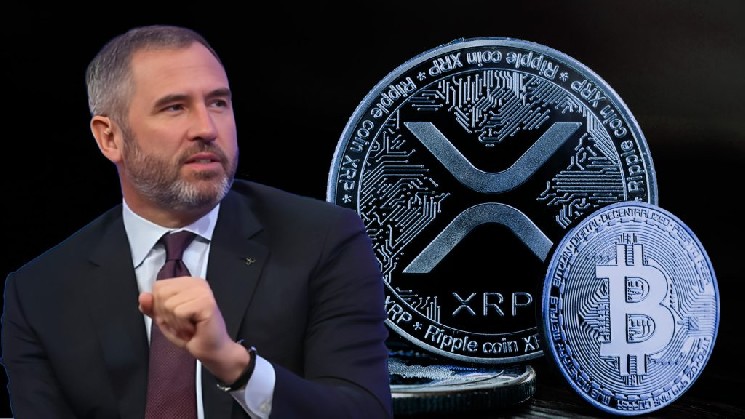
Ripple CEO Brad Garlinghouse Lays Out a Five-Year Crypto Strategy Built on the Market’s Biggest Assets
A Five-Year View in an Unpredictable Market
Brad Garlinghouse, the chief executive of Ripple and one of the most recognizable voices in the cryptocurrency market, has a surprisingly straightforward message for investors looking at the long term: stop trying to outsmart the market. Speaking at a recent industry event, Garlinghouse said that for the average investor, a sensible strategy may be as simple as buying the five largest cryptocurrencies by market capitalization and holding them for five years. In his assessment, an approach like that could deliver “great results” over time. It is a statement that stands out from the usual hype surrounding digital assets, partly because of its modesty and partly because of who is making it. Garlinghouse has been in the middle of the crypto conversation for years, navigating both the explosive growth of the market and the regulatory storms that have followed it. His view is not the perspective of a detached observer; it is the position of an executive who has seen projects rise and fall, who has witnessed the impact of exchange collapses, legal battles, and shifting investor sentiment. By suggesting a market-cap-weighted basket, Garlinghouse is effectively saying that the best way to manage crypto volatility is not to predict the future but to diversify across assets that have already demonstrated staying power. That may sound simple, but in a market known for complicated derivatives, leveraged trades, and constant hype, simplicity can be a radical idea. The broader context matters too. Institutional adoption of digital assets has accelerated in recent years, and conversations once reserved for crypto-native investors are now happening in boardrooms and family offices. Garlinghouse’s remarks reflect this shift: what was once a niche asset class is increasingly being viewed through the same lens as traditional portfolios, with an emphasis on diversification, time horizon, and fundamentals.
The Top Five: A Basket of Digital Giants
The basket Garlinghouse described refers to the five largest cryptocurrencies at the time of his remarks: Bitcoin, Ethereum, Tether, BNB, and XRP. These are not just random selections. Each one occupies a distinct role in the digital asset ecosystem, and together they represent a broad cross-section of the market. Bitcoin, the oldest and largest cryptocurrency, remains the entry point for most investors and is often described as a store of value in the digital age. Ethereum, the second largest, is the leading platform for smart contracts and decentralized applications, supporting an enormous ecosystem of developers and projects. Tether is the largest stablecoin, designed to track the U.S. dollar and provide a stable anchor in a market that is anything but stable. BNB, created by Binance, is one of the most widely traded tokens in the world and is deeply integrated into the exchange’s products and services. XRP, the asset associated with Ripple, focuses on cross-border payments and has carved out a unique space in the financial services industry. What links all five is scale. Each of these assets has a substantial market capitalization, deep trading volumes, and the kind of liquidity that institutional investors increasingly demand. For Garlinghouse, that combination of size and stability is precisely why they make sense as long-term holdings. He is not suggesting that investors bet everything on one project; he is suggesting that they align themselves with the assets that have already proven they can survive the market’s harshest cycles. It is also worth noting that market-cap rankings are not static. The cryptocurrency market is still young, and today’s top five could shift in response to regulatory changes, technological breakthroughs, or broader economic forces. But at the moment Garlinghouse spoke, these five represented the heavyweight division of digital assets—and his strategy was built around that reality.
XRP’s Place in the Conversation
Given that Garlinghouse is the CEO of Ripple, the inclusion of XRP in this top-five list naturally drew attention. Some critics may see it as an attempt to boost his own company’s token, but Garlinghouse has never described himself as an XRP maximalist. In fact, he has repeatedly said that the cryptocurrency industry is large enough to support many successful projects. That broader perspective makes his recommendation more credible. He is not saying “buy XRP only”; he is saying “buy a diversified basket that happens to include XRP.” There is a meaningful difference between promoting a project and acknowledging that it has earned a place among the major assets in the market. For XRP, that acknowledgment comes after a period of intense regulatory scrutiny. The token has faced legal challenges, exchange delistings, and years of uncertainty about its status in the United States. Even so, XRP has remained one of the most valuable digital assets in the world. That resilience, Garlinghouse argued, is exactly what investors should look for. The ability to survive regulatory pressure, maintain liquidity, and continue serving a real-world payments function is a sign of long-term viability. In his view, XRP’s place in the top five is not an accident or a matter of loyalty; it is a reflection of fundamentals that have held up over time. The token was created to solve a specific problem—making cross-border payments faster, cheaper, and more transparent—and it has maintained that focus even as the broader market has chased trends like meme coins, NFTs, and so-called metaverse tokens. That discipline may be part of the reason why XRP continues to command a significant share of market attention.
A Thoughtful Take on Solana and the Wider Market
The event also included a question that has become increasingly common in crypto circles: why should an investor choose XRP over Solana? Garlinghouse answered in a way that cut against the usual rivalry. He said he was not trying to convince anyone to choose one network over the other. He then made a revealing admission: he personally owns a small amount of Solana. Garlinghouse described Solana positively, saying that he has a favorable view of several cryptocurrencies, each for different reasons. This is not the kind of answer that generates headlines in a divided community, but it is the kind of answer that makes sense in a maturing market. Solana has gained a reputation for speed and efficiency, with transaction costs that are significantly lower than many older networks. It has attracted developers in areas such as decentralized finance, NFTs, and Web3 gaming. The question of whether Solana competes directly with XRP is, in Garlinghouse’s view, misplaced. They are different networks with different priorities. XRP has focused on payment settlement for financial institutions, while Solana has emphasized high-performance smart contracts and developer adoption. There is no law of nature that says only one of these approaches can succeed. Garlinghouse’s comments were a reminder that the cryptocurrency market is not a zero-sum game. Rivalries can drive engagement, but they do not necessarily reflect how the technology or the investment landscape actually works. For investors, the lesson is clear: a portfolio that includes multiple strong networks may be more resilient than one built around a single conviction. It also signals a broader shift in how some of the industry’s most prominent executives are talking about competition—less as a winner-take-all contest and more as a diverse ecosystem where different blockchains can serve different users and different use cases.
Liquidity, Utility and the Foundations of Value
Underpinning Garlinghouse’s confidence in XRP—and, by extension, his faith in the top-five basket—is a firm belief about what makes digital currencies valuable over time. He said the true markers are trust, usability, and transaction speed, which he summed up as liquidity. In his view, the most liquid cryptocurrencies tend to be the most valuable, because liquidity is one of the primary reasons people want to hold an asset at all. That point deserves some unpacking. Liquidity means that buyers and sellers can enter and exit the market without causing huge price swings. It means that an institutional investor can move large amounts of capital into and out of an asset with relative ease. It also creates confidence: a token that trades heavily and consistently is generally seen as safer than a token with thin volume and irregular activity. For XRP, this is not just a theoretical argument. The token has been used for years as a bridge between currencies in cross-border payments, allowing financial institutions to settle transactions in seconds. Ripple’s partnerships with banks and payment providers have given XRP a concrete utility that many other projects cannot claim. At the same time, the asset has developed a substantial and durable trading market, giving it the kind of liquidity that few digital assets can match. That combination of utility and liquidity, Garlinghouse argued, is what drives sustained demand for XRP. It is an argument rooted in fundamentals rather than speculation, and it offers a useful framework for evaluating any cryptocurrency. In traditional finance, after all, liquidity has always been a key determinant of value. Stocks with higher trading volumes tend to attract more institutional interest, and assets that can be easily bought and sold are generally assigned a lower risk premium. Garlinghouse is essentially applying the same logic to digital assets.
A Five-Year Strategy, With a Clear Disclaimer
Of course, none of this should be read as financial advice. Garlinghouse’s proposal was not a promise of returns, and he did not present it as a one-size-fits-all solution. Instead, he described a thought process—a way for investors to approach the digital asset market without getting lost in the chaos of short-term trading. The five-year timeframe is significant because it forces a focus on the long view. In five years, the crypto market could look very different. New regulations may reshape how tokens are issued and traded. New technologies may challenge current leaders. Solana, XRP, or any of the assets in the top five today could be overtaken by projects that have not yet been created. That is why Garlinghouse’s strategy is a basket rather than a single bet. It acknowledges that the industry is still evolving, and it leans on assets that have the scale and liquidity to adapt. There is no guarantee that the next five years will mirror the last five, but the principle behind his remarks is solid: exposure to a diversified group of the most established tokens is a less fragile foundation than chasing narratives, meme coins, or unproven networks. At a time when the crypto space is full of conflicting predictions and relentless online debates, that kind of long-term, fundamentals-first thinking stands out. Garlinghouse, for all his ties to one specific token, was making a broader point about the industry’s maturation. The future of crypto, in his view, is not about a single champion. It is about a growing ecosystem of digital assets, each with distinct strengths, and it is the patient investor who looks at the full picture who is most likely to be rewarded. This is not investment advice.