





Bitcoin Defies the Yield Invasion: The Data Behind Crypto’s Indifference to the Bond Market’s 2007 Flashback
As the U.S. 10-year Treasury yield rockets to a 16-year high north of 5.1 percent, the grim predictions for Bitcoin are already rolling in. Yet every meaningful statistical measure suggests the two markets have been marching to completely different drummers.
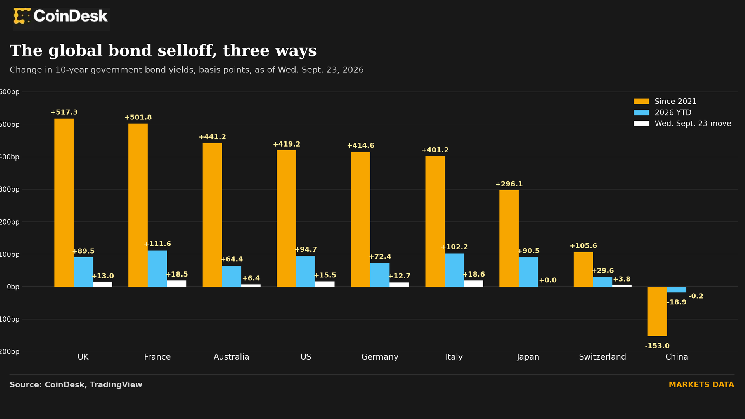
Wednesday’s session in the U.S. bond market had all the hallmarks of a genuine inflection point. The 10-year Treasury yield vaulted 15 basis points in a single decisive move, slicing through the psychologically significant 5 percent threshold to reach 5.13 percent — a level not visited since 2007, when the global financial system was unknowingly careening toward the worst crisis in modern history. The shockwaves traveled quickly across the Atlantic and the Pacific, shoving government borrowing costs higher in Europe, Asia, and far beyond, as investors everywhere recalibrated their assumptions about how long central banks would keep monetary policy restrictive. In the cryptocurrency corner of the financial world, the reaction was swift and almost reflexive. Bitcoin, the largest digital asset by market value, hovering at just above $83,000, was immediately flagged as one of the most vulnerable pieces on the board. The logic is simple, clean, and endlessly repeated on financial television: when bond yields climb, the opportunity cost of holding non-yielding assets like Bitcoin and gold climbs with them, so money naturally flows out of crypto and into government debt. Let the yield rise high enough, the argument goes, and Bitcoin’s speculative foundation is bound to crack. It sounds unimpeachable in theory. But the empirical record — spanning multiple rate cycles, inflation scares, and genuine bond-market convulsions — tells a sharply different story, one that challenges whether Wall Street’s favorite macro heuristic ever truly applied to the world’s most volatile major asset. There is something almost ritualistic about the pattern: every time yields spike, the same predictions surface, and every time, the market quietly fails to confirm them. That gap between the tidy narrative and the untidy reality has become one of the defining tensions of this market cycle, and it has never been more visible than it is right now.
To understand why the bearish narrative keeps missing the mark, it is worth unpacking the mechanical logic more closely. A U.S. Treasury bond is the benchmark for risk-free investing, and a 10-year yield above 5 percent signals that investors can earn an extraordinary return merely by parking their money in the world’s most liquid debt market. By extension, every other asset is supposed to adjust. Equities get repriced at higher discount rates, credit spreads widen, and assets producing no income at all are theoretically subject to the most brutal revaluation. Bitcoin, which generates no dividends, no coupons, and no cash flow, sits at the very edge of that theoretical spectrum. If the only question that matters is yield, why would anyone hold an asset that can drop 30 percent in a month when the U.S. government offers a guaranteed 5.13 percent? The question carries genuine weight, and it is repeated in investment committee meetings, fund-manager surveys, and financial television segments with the confidence of a scientific law. Yet the law has failed to hold in practice, and it failed most conspicuously during the most aggressive rate-hiking cycle in decades. Between early 2022 and late 2023, the Federal Reserve lifted its benchmark interest rate by more than five percentage points, while the 10-year Treasury repeatedly touched its highest levels in a generation. Over that stretch, Bitcoin’s price was governed less by the trajectory of yields than by a sequence of idiosyncratic shocks: the collapse of Terra and FTX, the subsequent regulatory reckoning, and eventually the sudden institutional inflows triggered by the approval of spot Bitcoin exchange-traded funds in early 2024. One does not need to dig deep into the historical record to find months when yields and crypto rose together, or fell together, in total defiance of the expected inverse relationship. The bond market narrative, in short, is a comforting explanation that has rarely survived contact with actual crypto market dynamics — and its persistence owes more to habit than to evidence.
The statistical picture, when examined soberly, is even more devastating to the conventional view. According to data analyzed by CoinDesk, the 90-day correlation coefficient between Bitcoin’s daily returns and daily changes in the U.S. 10-year Treasury yield stands at minus 0.18. For readers who don’t speak statistics fluently, that figure is so close to zero that it conveys almost no meaningful connection. A coefficient of minus 1 would signify a perfect inverse relationship — Bitcoin falling every time yields rise — while plus 1 would indicate perfect synchronization. The observed minus 0.18 sits squarely in the territory of statistical noise, the sort of number econometricians would dismiss as insignificant in any rigorous analysis. Nor does the picture improve with a longer perspective. The 180-day correlation falls to minus 0.06, and the one-year figure rests at minus 0.03 — both effectively indistinguishable from zero. Even more striking, this pattern is not confined to American assets. Bitcoin’s correlation to government bond yields in other major economies, from Germany and Japan to the United Kingdom and Australia, is similarly negligible, which suggests that the digital currency’s independence from interest-rate dynamics is structural rather than situational. In plain English, the relationship between Bitcoin’s price and the global bond market ranks among the weakest macro correlations in modern finance. Traders and commentators love to explain Bitcoin’s daily moves with reference to Treasury auctions, Federal Reserve speeches, or yield-curve dynamics — and the habit endures even though these correlations have repeatedly failed to forecast where the cryptocurrency would head next. When a deviation from the narrative occurs, it is explained away by idiosyncratic crypto events, which is perhaps the most telling evidence of all: the macro explanation is so unreliable that analysts must constantly reach for crypto-specific stories to account for price movements.
None of this is to suggest that Bitcoin is hermetically sealed off from the broader economy. There have been moments when the digital currency moved powerfully in response to macro shocks. The abrupt liquidity crunch of March 2020 sent everything from gold to the S&P 500 into freefall, and Bitcoin was swept along in the deluge. Liquidity conditions, dollar strength, and shifts in global risk appetite have all made their presence felt in crypto’s price action at various times. But the narrow question of bond yields — specifically, the daily grind of the 10-year Treasury — has simply not served as a reliable lever for Bitcoin’s price. Several plausible explanations exist for the seeming paradox. First, Bitcoin’s investor base is far more global and far more heterogeneous than that of a typical macro asset. Retail speculators in Southeast Asia, institutional allocators in the United States, and long-term accumulators in Latin America operate on entirely different investment horizons, and their buying and selling decisions are driven by very different sets of inputs. Second, Bitcoin’s realized volatility remains so high relative to bonds that the modest day-to-day moves in yields are often little more than background noise; a 20-basis-point shift in the 10-year is a headline for bond traders, but for crypto traders accustomed to 3 percent daily swings, it is hardly a blip. Third, and perhaps most fundamentally, Bitcoin’s supply schedule is governed by immutable code — strictly capped at 21 million coins — making its monetary dynamics categorically distinct from those of fiat-denominated debt instruments. It is an asset shaped by engineered scarcity in a sea of elastic supply, and its price behaves less like a short-duration rate product and more like a referendum on the durability of that scarcity. The correlation that does occasionally appear is typically driven by simultaneous reactions to third-party shocks, rather than by any direct causal chain running from bond yields to Bitcoin prices.
The stakes of getting this relationship right extend far beyond academic debates about correlation coefficients. Since Bitcoin’s earliest days, one of the most powerful arguments in its favor has been the claim that it would eventually behave like digital gold — a hedge against monetary debasement and fiscal profligacy, rising when real assets become more attractive than paper promises. By that logic, the current environment of elevated real yields should be unequivocally toxic to Bitcoin’s investment case. But the correlation data suggests the digital gold thesis is more aspirational than descriptive. Bitcoin has not, in fact, behaved like a traditional store of value in the bond-yield dimension; it has not reliably exhibited gold’s supposedly tight inverse relationship with real interest rates. Instead, the asset has functioned as something else entirely — a hybrid of speculative technology play and hard asset, with conviction-driven holders responding to adoption narratives, regulatory developments, and internal market cycles that have little to do with the latest reading on the 10-year Treasury. This matters enormously for asset allocators and portfolio managers. If Bitcoin is genuinely decoupled from bond yields, then integrating it into a portfolio structured around interest-rate risk offers diversification benefits that the conventional wisdom fails to appreciate; in theory, non-correlation smooths overall portfolio volatility rather than amplifying it. Conversely, if one accepts the narrative that yields are the ultimate arbiter of cryptocurrency valuations, then nearly all of Bitcoin’s recent price action becomes inexplicable — a mismatching of asset and story that says more about the persistence of narrative habits in financial markets than about how those markets actually function. The data offers a clear verdict: the bond market is not the puppet master of crypto, no matter how many pundits wish it were.
Where does this leave investors in the weeks and months ahead? With the 10-year Treasury hovering near multi-year highs and global yields still climbing, the temptation to read the crypto macro tea leaves in bearish terms will remain — and will almost certainly intensify. There are scenarios in which the two markets genuinely align. A disorderly, rapid spike in yields that forces sudden deleveraging across all risk assets would almost certainly claw at crypto as well, simply because it would trigger margin calls and indiscriminate liquidations in every speculative corner of the market. In those moments of acute stress, Bitcoin’s 24/7 trading calendar and deep leverage make it an easy asset to sell first and ask questions later. But those episodes are panic reactions, not evidence of a stable structural relationship. The longer-term evidence, grounded in years of daily return data, points to an asset that has repeatedly shrugged off meaningful bond-market moves while remaining focused on its own internal dynamics — the four-year halving cycle that slashes new supply, the pace of institutional adoption via regulated exchange-traded funds, the growth of on-chain activity, and the broader cultural momentum that has made digital assets a permanent feature of the global financial landscape. For investors bracing for a grinding bear market solely because bonds look generous, the data delivers a word of caution: Bitcoin has absorbed yield shocks that would have leveled most speculative markets, and it has emerged on the other side relatively intact, time and again. The bond market may be the dominant force in most corners of finance, but in the world of crypto, it has been an unreliable narrator. The price action in the months ahead may finally force analysts to update the script.