






The Anatomy of a Digital Ghost: What 15 Years of Forensic Reconstruction Reveals About Satoshi Nakamoto
For more than a decade and a half, the identity of Satoshi Nakamoto has remained the most tantalizing enigma of the digital age, a modern mystery play acted out on public ledger systems, archived mailing lists, and forgotten source code repositories. While mainstream media outlets have repeatedly attempted to unmask the creator of Bitcoin with dramatic, headline-grabbing disclosures that inevitably collapse under scrutiny, a quieter, far more rigorous investigation has been unfolding in the background. Cryptographers, digital forensic scientists, and cyber-historians have spent fifteen years meticulously picking apart Nakamoto’s emails, Subversion code commits, and PDF document metadata, constructing a remarkably detailed psychological and technical profile of the world’s most famous anonymous developer. What these researchers have uncovered rarely makes it to the evening news, yet the breadcrumbs left behind in the margins of early cryptocurrency history paint a vivid picture of a developer who was deeply human, pragmatically flawed, highly security-conscious, and yet surprisingly vulnerable to the tiny, unconscious habits that define our digital signatures. From the precise version of open-source office software used to draft the original architecture to the subtle, manual administrative tasks required to keep a fledgling forum online, the forensic record reveals that Bitcoin’s birth was not an immaculate conception of pure code, but rather a grueling, hands-on labor of love managed by an individual—or an incredibly tight-knit team—deeply anchored in the technical realities and operating systems of a specific era.
Tracing the Digital Paperwork: The Secret Metadata of the Bitcoin White Paper
File: bitcoin.pdf
Producer: OpenOffice.org 2.4
Creation Date: 2008-10-03 13:49:58 -07’00’
The physical trail of Satoshi Nakamoto may not exist, but the electronic paper trail begins with the very document that introduced peer-to-peer electronic cash to the world: the Bitcoin white paper. Forensic analysis of the PDF document properties reveals that the landmark October 2008 draft, as well as the final version published in March 2009, was created using OpenOffice.org 2.4, a popular open-source alternative to Microsoft Word. Inside the XML metadata of these files, the operating software lists the Creator simply as “Writer” and the Producer as “OpenOffice.org 2.4,” a mundane detail that immediately grounds the mythical creator in the practical utility of mid-2000s freeware. Far more intriguing, however, is the temporal anomaly buried within the October 2008 draft’s creation timestamp: the document carries a timezone offset reading 20081003134958-07’00’, which points directly to Mountain Standard Time in North America. This would initially suggest a creator operating out of the Western United States or Canada; however, October 3, 2008, fell during Daylight Saving Time, a period when Mountain Time should have mathematically registered as -06’00’ rather than -07’00’. This mismatch has triggered endless debates among researchers, with some suggesting a deliberate clock misconfiguration designed to obfuscate Nakamoto’s location, others pointing to a known OpenOffice timezone bug on certain operating systems, and some arguing it represents a manual override by a creator active in a completely different part of the world. This American timezone footprint stands in stark, puzzling contrast to the developer’s subsequent activity; when researchers examined the Subversion (SVN) repository commits where the early Bitcoin code was hosted throughout late 2009 and 2010, the timestamps shifted dramatically, registering consistent British Summer Time offsets of +0100 in the winter and +0000 in the summer, solidifying a pattern aligned with the United Kingdom and leaving investigators with a bifurcated trail of geographical clues.
The Anatomy of the Genesis Code: Outdated Dialects and Forgotten Prototypes
// Visualizing the structure of Bitcoin’s pre-alpha v0.1 code:
[Bitcoin Directory]
├── main.cpp (Hungarian notation: psz, nValue)
├── base58.h (Custom serialization)
└── headers (Hardcoded block parameters: 10,000 BTC reward target)
To understand the builder behind the blockchain, one must look directly at the handwriting of their code, where Nakamoto left behind stylistic markers that are almost impossible to fake. The original C++ source code of Bitcoin was written using Hungarian notation—a variable naming convention where the variable’s type or intended use is reflected in its prefix, such as using psz to denote a “pointer to a null-terminated string” in files like base58.h. By 2008, Hungarian notation had fallen out of favor with the broader open-source development community, viewed as a relic of a bygone era; its prominent presence in the Bitcoin code suggests a developer whose programming habits were forged in the Windows C++ development environments of the late 1980s or 1990s. This Windows-centric profile is further supported by the fact that Nakamoto primarily compiled Bitcoin using MinGW, a minimalist development environment for Windows, utilizing Microsoft Visual C++ exclusively for testing and debugging purposes. Long before the public release of version 0.1, early pre-alpha drafts of the network proposed radically different economic parameters than the ones we know today, including an initial block reward target of 10,000 BTC rather than the famous 50 BTC, along with a system that calculated satoshis using only four decimal places instead of eight. Interestingly, the very term that defines the modern cryptocurrency revolution—”blockchain”—is entirely absent from Satoshi’s codebase and written correspondence; the white paper and early emails exclusively refer to a “chain of blocks” or a “block chain,” with the compressed, single-word compound only entering the public lexicon years after Nakamoto departed the project. This early engineering phase was dictated by strict pragmatism: when choosing a protocol for Bitcoin’s programming interface, Nakamoto opted for JSON-RPC over the then-standard XML-RPC, writing to developer Martti Malmi that the available C++ XML libraries were simply too buggy, dependency-heavy, and difficult to compile, illustrating a creator who valued operational simplicity and compile-ready code over academic perfection.
The Practical Administrator: Google PageRank, Mail-Order Cash, and Crisis Management
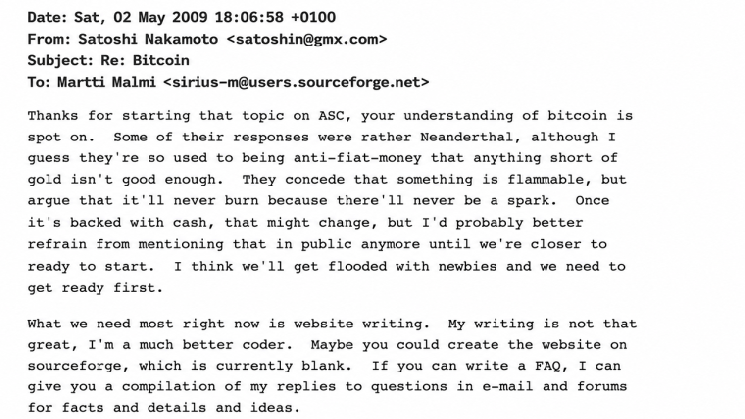
Behind the philosophical statements on decentralization was a highly practical, hands-on web administrator who was intimately involved in the day-to-day operations of the early Bitcoin community. In a series of newly historical emails exchanged with early developer Martti Malmi, Nakamoto proved to be remarkably self-aware and humble about his technical limits, writing in May 2009, “My writing is not that great, I’m a much better coder,” before actively recruiting Malmi to draft the promotional copy for the official website. Satoshi was also a surprisingly sophisticated digital marketer, demonstrating an acute awareness of search engine optimization (SEO) by meticulously blueprinting a multi-stage migration of the bitcoin.org domain to protect its organic Google PageRank; he ordered that the server’s IP address and the actual site content be updated in separate, insulated phases so search engine indexing algorithms would not flag the transition as a malicious domain-hijacking event. This pragmatism extended into physical reality: when the young project desperately needed infrastructure funding, Satoshi coordinated the receipt of a $3,500 cash donation, sent physically via snail mail to Malmi’s home address in Finland, later instructing that $1,000 of those cash funds be allocated directly to guarantee liquidity for Malmi’s pioneering fiat-to-bitcoin exchange service. But the administrative burden was grueling, occasionally forcing the creator to retreat; in the spring of 2010, Satoshi vanished entirely for nearly six weeks, later explaining to Malmi in a quiet May email, “I’ve also been busy with other things for the last month and a half. I just now downloaded my e-mail since the beginning of April.” When active, however, Satoshi was a tireless webmaster, manually editing the PHP source code of the Simple Machines Forum (SMF), customizing CSS stylesheets, installing security modifications via SSH, manually routing DNS records, and acting as the ultimate shield for the network—such as on August 15, 2010, when a disastrous value overflow bug threatened the protocol’s existence, prompting Nakamoto to bypass standard developer channels and issue a frantic, network-wide broadcast: “DO NOT TRUST ANY TRANSACTIONS THAT HAPPENED AFTER 15.08.2010 17:05 UTC (block 74638) until the issue is resolved.”
Early Bitcoin Operations Timeline (2009-2011):
[May 2009] ── Satoshi recruits Malmi: “I’m a much better coder [than writer].”
[Late 2009] ── Coordinates $3,500 physical cash donation sent to Finland.
[Spring 2010]── Goes offline for 6 weeks: “Busy with other things.”
[Aug 2010] ── Unveils emergency network alert system to patch overflow exploit.
[Jan 2011] ── Final forum/wiki corrections; shifts focus to handover.
Stylometric Ghosts: Deciphering the Creator’s Linguistic Blueprint
Linguistic Fingerprints of Satoshi Nakamoto:
├── Spacing Preference: [Double-space after period] (81% – 86% frequency)
├── Spelling Variations: [American (52)] vs. [British (35)] vs. [Misspellings (21)]
├── Absolute Exclusions: [“cannot” used exclusively] vs. [“can not” (0 occurrences)]
└── Date Notation: [DD/MM/YYYY] (Standard British/Commonwealth format)
When a creator refuses to show their face, their words become their physical features, and stylometric researchers have spent years studying Satoshi’s texts to map this linguistic anatomy. One of the most glaring socio-political markers was left on the creator’s P2P Foundation profile, which listed a birthdate of April 5, 1975, and claimed residency in Japan—a date widely interpreted by political historians as deeply symbolic rather than literal, as April 5 marks the anniversary of U.S. President Franklin D. Roosevelt signing Executive Order 6102 in 1933, which criminalized the private ownership of gold hoards. Beyond political metaphors, Nakamoto’s everyday typing habits reflect someone trained in an older era of documentation: statistical analyses of his forum posts and emails reveal that he used double-spacing after a period at a rate of 81 to 86 percent, a distinctive typing habit common among those who learned to type on mechanical typewriters or under strict, mid-century secretarial guidelines. Additionally, Nakamoto consistently utilized the DD/MM/YYYY date format throughout his public communications, a standard common in the United Kingdom, Europe, and Commonwealth nations, but notably absent from everyday American usage. Yet his actual spelling remained a complex, almost contradictory hybrid; a comprehensive manual review of his writings found 108 instances of regional spelling variations, consisting of 52 American English spellings (such as “characterize” or “defense”), 35 British English spellings (such as “colour” or “neighbour”), and 21 flat-out typos, shattering the common theory that Nakamoto was a perfectly consistent British academic. There are, however, absolute boundaries to his writing style: across his entire documented corpus, Satoshi used the single-word contraction “cannot” at least 15 times, while the two-word alternative “can not” never appears a single time, leaving a stark, binary linguistic footprint that rules out thousands of potential candidates whose natural writing defaults to the split form.
The Grand Handover and the Sleeping Sovereign of the Blockchain
Ultimately, the most telling aspect of Satoshi Nakamoto’s character is not how the network was built, but how it was surrendered to the public. As the project grew and matured, Nakamoto became incredibly sensitive to how Bitcoin was framed to the outside world, recognizing early on that its long-term survival depended on political neutrality and regulatory survival. He deliberately instructed Martti Malmi to scrub references to “anonymous” transactions from the official website copy, replacing them with “pseudonymous” descriptions, pragmatically warning that “anonymous sounds a bit shady” and could invite preemptive crackdowns from financial regulators. In a similar vein, Nakamoto was fiercely protective of Bitcoin’s legal classification, writing a stern email to developers in 2009 demanding the immediate removal of promotional bullet points that suggested users should “consider… [Bitcoin] an investment,” warning that framing the currency as a speculative asset was legally dangerous and could invite catastrophic securities regulation before the network could even stand on its own feet. Having stress-tested the consensus engine locally using automated scripts that continuously simulated high database load and transaction activity, Nakamoto knew the system was ready for institutional custody, but he needed a successor who possessed the institutional weight to shepherd it forward.
In December 2010, bypassing his earliest confidant, Martti Malmi, Nakamoto chose Gavin Andresen to inherit the primary codebase repository and assume the public-facing role of lead developer, writing: “It should be Gavin. I trust him, he’s responsible, professional, and technically much more linux capable than me.” With those final directives, the creator retreated into the digital ether, sending his final known email in April 2011. Left behind in the genesis blocks of the network is the legendary “Patoshi” mining pattern—first mapped by security researcher Sergio Demian Lerner—which traces a highly unique, customized CPU mining fingerprint characterized by a specific ExtraNonce sequence that dominated the network’s early blocks. This entity, universally understood to be Satoshi Nakamoto’s personal mining rig, accumulated between 1 million and 1.1 million BTC during the network’s infancy. Today, as the global financial landscape shifts and the calendar moves forward through 2026, those legendary “Patoshi” coins remain completely unspent, sitting motionless in the digital vaults of the blockchain—an silent, untouched multi-billion-dollar fortune that serves as a testament to the ultimate self-discipline, finality, and enduring mystery of Bitcoin’s faceless creator.