






Geopolitical Strain and Hawkish Monetary Policy Halts Crypto’s Summer Momentum as Traditional Equities Rally
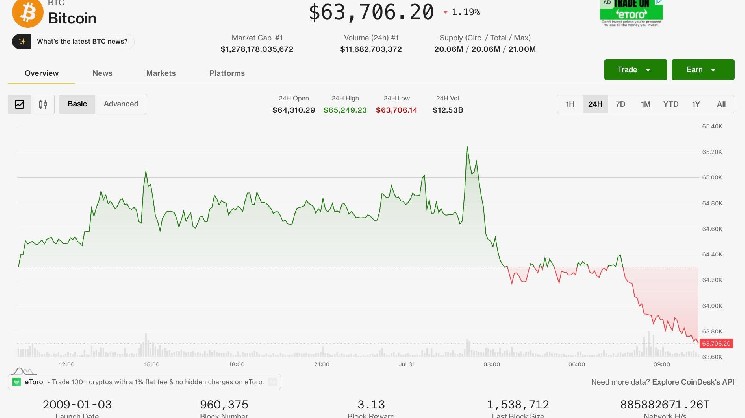
The digital asset market is navigating a turbulent transition as July draws to a close, with early-month optimism giving way to a wave of selling pressure that has left major cryptocurrencies struggling to find solid ground. Bitcoin ($BTC) has experienced a notable setback, slipping 1.31% over a single intraday cycle to trade around $63,870, while Ether ($ETH) mirrored this downward trajectory with a 1.40% retreat to $1,890, further distancing itself from the psychologically significant $2,000 threshold it briefly reclaimed earlier in the month.
This late-summer correction has caught many market participants off guard, primarily because it represents a stark divergence from traditional equity markets, which have continued to exhibit robust risk-on behavior. In Asia, South Korea’s benchmark Kospi index recently surged by over 15%, while in the United States, futures tied to both the tech-heavy Nasdaq 100 and the broader S&P 500 have consistently traded in positive territory, signaling that traditional investors remain highly confident in corporate earnings and broader economic resilience.
The primary catalysts dragging down the cryptocurrency sector are twofold: escalating geopolitical anxieties in the Middle East, which have historically triggered risk-off sentiment in more speculative asset classes, and a series of hawkish pronouncements from key members of the Federal Reserve’s monetary policy committee, which have effectively dashed expectations for aggressive interest rate cuts in the immediate future.
Although the aggregate CoinDesk 20 Index has registered a 2.34% decline since the start of the week, indicating widespread short-term pain, the broader monthly perspective offers a glimmer of hope for long-term bulls; the index is still on track to post an 8.7% gain for the entirety of July, marking its first positive monthly performance in three months and its strongest single-month showing in nearly a year, proving that beneath the current malaise lies a resilient underlying market structure.
+————————————————————-+
| JULY MARKET PERFORMANCE COMPARISON |
+——————————+——————————+
| Asset Class / Index | Performance Metrics |
+——————————+——————————+
| Bitcoin ($BTC) | Down 1.31% (to $63,870) |
| Ether ($ETH) | Down 1.40% (to $1,890) |
| South Korea Kospi | Up over 15% |
| CoinDesk 20 Index (Weekly) | Down 2.34% |
| CoinDesk 20 Index (Monthly) | Up 8.7% (Best in 12 months) |
+——————————+——————————+
Bears Assert Dominance in Derivatives as Negative Cumulative Volume Delta Signals Aggressive Urgency
Beneath the spot market’s price fluctuations lies a highly defensive derivatives landscape where professional traders appear to be braceing for further downside. The taker long-to-short volume ratio in the futures market—a vital metric that tracks the balance between aggressive buyers and sellers—continues to lean decidedly bearish, revealing a pervasive downside bias among active market participants.
Unlike limit order makers who passively wait for prices to come to them, market takers are participants who execute orders immediately against existing liquidity in the order book, making their behavior a direct reflection of real-time urgency. This aggressive selling pressure is further illustrated by a persistently negative 24-hour open interest-adjusted Cumulative Volume Delta (CVD) across almost all dominant alttokens, including high-profile assets like Uniswap ($UNI).
In financial derivatives, a negative CVD indicates that market participants are executing short positions through aggressive market sell orders rather than setting passive limit orders on the bid side, highlighting a dominant sentiment where bears are proactively chasing the price downward rather than waiting to buy the dip. This structural imbalance in execution styles has historically been a reliable leading indicator during sharp market drawdowns over the past twelve months, serving as a warning to retail investors that institutional and leveraged traders are actively positioning for a deeper correction across the board.
XRP Short Sellers Gather Leverage as Bitcoin Open Interest Stagnates Within a Tight Trading Band
A granular analysis of individual asset derivatives reveals a fascinating and highly polarized market structure, characterized by aggressive speculation in select altcoins contrasted with total paralysis in major blue-chips. Ripple’s native token ($XRP) has emerged as a primary target for aggressive short sellers, with its futures open interest (OI) expanding steadily for three consecutive weeks to reach a staggering 2.27 billion tokens—its highest level since late June.
Crucially, this dramatic accumulation of open interest has occurred while the spot price of $XRP fell from $1.13 to $1.07 during the same period. In the lexicon of technical market analysis, the combination of crashing spot prices and soaring open interest provides textbook confirmation of an active, highly capitalized downtrend, indicating that new capital is entering the market specifically to leverage-short the asset in anticipation of a much steeper valuation collapse.
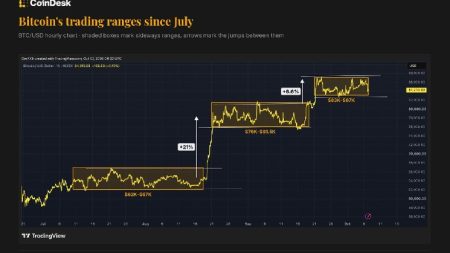
Conversely, Bitcoin’s derivatives market paints a picture of complete capitulation to apathy; its open interest has remained entirely flat at roughly 750,000 contracts throughout the month. This total lack of growth in Bitcoin futures leverage suggests that large-scale institutional traders are unwilling to commit dry powder to the asset despite its superficial stability, which explains why the premier cryptocurrency’s impressive early-month rebound from below $58,000 has completely stalled within a highly restricted $62,000 to $65,000 trading corridor—a pattern of consolidation that is being replicated almost identically by secondary giants like Ether and Solana.
Options Expiry Waves Goodbye to $10 Billion as Record-Low Implied Volatility Presages a Steep Price Drop
The options market is sending equally cautionary signals, marked by massive capital reshuffling and structural shifts in volatility that could herald an impending trend reversal. On the premier crypto options exchange Deribit, a massive $10 billion worth of Bitcoin and Ether options contracts officially expired at the end of the month, purging a significant amount of legacy leverage from the ecosystem.
With those positions cleared from the boards, the distribution of remaining open interest stretching all the way to June 2027 reveals that a protective put option at the $60,000 strike price has consolidated its position as the single most popular and highly capitalized bet in the market. A put option represents a classic bearish vehicle, used either by speculators looking to profit from a price drop or by institutional spot holders looking to hedge their downside risk, indicating that the broader market is collectively bracing for a test of this critical support layer.
This defensive positioning is occurring against a backdrop of collapsing volatility; Bitcoin’s 30-day implied volatility index (BVIV) recently tanked to just 37%, a multi-month low last seen in May. In recent years, volatility compression of this magnitude has consistently acted as a structural floor for the index, typically preceding a sharp expansion in market activity.
Because the correlation between Bitcoin’s spot price and the BVIV has turned significantly negative since the introduction of spot Exchange-Traded Funds (ETFs) in early 2024, any sudden spike or “bounce” in market volatility is highly likely to be accompanied by a aggressive flush-out in spot prices, making the current low-volatility environment a potentially dangerous calm before the storm.
+————————————————————-+
| DERIVATIVES AND OPTIONS RISK INDICATORS |
+———————-+————————————–+
| Metric Name | Current Market Interpretation |
+———————-+————————————–+
| Taker Long-Short | Leaning heavily bearish; dominance |
| Futures Volume Ratio | of active market sellers. |
| | |
| XRP Futures Open | Up to 2.27B tokens; falling price |
| Interest (OI) | confirms dominant short building. |
| | |
| Bitcoin Futures | Flat at ~750K; represents trader |
| Open Interest (OI) | apathy and range-bound trading. |
| | |
| Bitcoin 30-Day BVIV | Dropped to 37% (low volatility floor |
| (Implied Volatility) | which typically precedes a dump). |
| | |
| Deribit Outstanding | Overwhelmingly concentrated in the |
| Open Interest (Put) | $60,000 strike put option. |
+———————-+————————————–+
Decentralized Finance Outperforms as Uniswap Rides the Coattails of BlackRock’s Institutional Tokenization
Amid the broader market gloom, select decentralized finance (DeFi) protocols are managing to build impressive bullish momentum, proof that idiosyncratic, fundamental catalysts can still override macro-driven market sell-offs. Uniswap ($UNI) stood out as a clear market leader, posting a massive 9.30% gain within a 24-hour window to trade at $4.41, building on the structural tailwinds generated by its highly publicized Robinhood layer-2 network integration earlier this month.
More importantly, Uniswap has established itself as the undisputed leader in open interest growth for three consecutive days, with its total outstanding futures contracts rising to an aggregate of 75.80 million UNI—the highest concentration of leverage seen for the utility token since mid-February. This rapid accumulation of open interest amid rising spot prices stands in stark contrast to XRP’s bearish setup, signaling that high-net-worth investors are aggressively buying into the Uniswap ecosystem.
The primary driver behind this sudden institutional interest is the growing integration of traditional finance with decentralized rails, highlighted by BlackRock’s strategic decision to debut its premier USD Institutional Digital Liquidity Fund (BUIDL)—a tokenized Treasury product—directly within Uniswap’s decentralized architecture. This integration has injected a high level of fundamental validation into the protocol, illustrating a growing trend where sophisticated market participants are shifting their capital away from speculative meme assets and funneling it into battle-tested DeFi protocols that offer concrete utility, real-world fee generation, and deep institutional partnerships.
Cardano Establishes a Quiet Recovery as the Broader Altcoin Sector Visualizes an Uneven Recovery Path
The broader altcoin landscape remains highly fragmented, characterized by a mix of tentative technical recoveries, steep post-rally corrections, and a general lack of directional unity. Cardano ($ADA) has quietly emerged as an under-the-radar success story, adding 0.94% over its intraday cycle and a solid 4.09% over 24 hours to continue a multi-week recovery effort aimed at recouping the devastating 45% valuation plunge it suffered throughout June.
This slow-and-steady reclamation of lost ground highlights a broader market trend where historically oversold layer-1 protocols are experiencing organic accumulation from long-term value investors. In contrast, Ethena ($ENA) showcased a more volatile recovery path, gaining 1.23% on the day to trade at $0.082, though analysts quickly pointed out that the synthetic dollar-backing token still remains down more than 90% from its absolute all-time high, highlighting the sheer scale of the hill it must climb to restore investor confidence.
Other corners of the market have experienced significant profit-taking, exemplified by the privacy coin sector where Zcash ($ZEC) retraced by 2.15% to $459, giving back a portion of the aggressive gains it registered earlier in the week as regulatory concerns regarding anonymous transactions continue to damp long-term hold strategies.
Similarly, Lighter ($LIT) fell an additional 2.28% as its post-peak correction deepened, leaving the token trading roughly 20% below the local highs established in early July following its meteoric 200% run throughout the late spring. Ultimately, these polarized performances confirm that the cryptocurrency market has entered a highly selective phase where macro headwinds will continue to cap aggregate growth, requiring investors to navigate a highly nuanced landscape where only the most fundamentally sound assets can hope to outrun the dominant bearish trend.