




Global Markets Face Dual Shock as Geopolitical Fractures and Federal Reserve Hawkishness Trigger Massive Capital Reallocation
The delicate equilibrium of global speculative capital faced its most severe test in recent months as an overlapping matrix of hawkish domestic monetary policy and escalating physical conflict in the Middle East sparked a sharp, defensive rotation out of traditional risk assets. Across global trading desks, the institutional narrative shifted abruptly from optimistic growth projections to defensive risk-mitigation, resulting in a sweeping global market sell-off that hammered major equity indices while leaving the digital asset ecosystem trading in a remarkably resilient, albeit tightly compressed, sideways pattern. This synchronized market reaction highlights how sensitive modern international capital flows have become to geopolitical market impact, particularly following official confirmations that the United States military resumed active, targeted airstrikes against Iranian-backed forces in the Middle East—a decisive and direct retaliation designed to address a previous ballistic missile strike launched against American military positions. This localized escalation of physical warfare has instantly introduced a premium on risk, forcing institutional portfolio managers to reassess their global supply-chain assumptions, oil price targets, and sovereign debt exposures. Consequently, the financial landscape on Wednesday was characterized by an intense struggle between macroeconomic headwinds and systemic resilience, leaving both seasoned equity analysts and cryptocurrency market trend forecasters searching for technical support levels as the broader macroeconomic landscape shifts underneath their feet.
Wall Street Trembles Under the Weight of the Federal Reserve’s Hawkish Guardrails and Mounting Dissent
The underlying driver of Wednesday’s pronounced equity capitulation was the Federal Reserve’s latest policy determination, which shattered hopes of a soft, accommodative pivot by reinforcing a restrictive monetary framework designed to choke off lingering inflationary impulses. The central bank’s decision to maintain elevated Federal Reserve interest rates was accompanied by an unusual display of internal policymaking friction, as three separate members of the Federal Open Market Committee dissented from the majority consensus, registering votes in favor of an aggressive 25-basis-point interest rate hike to preemptively cool economic activity. This internal policy schism jarred investors who had priced in a smoother glide path toward monetary easing, triggering a rapid re-pricing in the fed funds futures market, where traders now assign a definitive 57% probability to a formal rate hike occurring at the Federal Reserve’s upcoming September meeting. The immediate fallout across equity indices was nothing short of dramatic: the Dow Jones Industrial Average plummeted by a staggering 1,153.18 points, or 2.19%, to close the trading session at 51,594.14, while the broader, market-capitalization-weighted S&P 500 fell 1.52% to settle at 7,316.1. Even the technology sector, long considered insulated from basic macroeconomic gravity due to secular growth trends, was not spared from the bloodletting, as the Nasdaq Composite Index fell 1.74% to close at 24,442.94. This aggressive liquidation highlights a profound shift in capital prioritization, as market participants recognize that cheap, abundant capital is unlikely to return anytime soon, thus forcing a painful valuation adjustment down the entire corporate debt and equity maturity spectrum.
Digital Assets Hold Critical Support Structure Amid Global Equity Bloodletting and Structural Asset Maturity
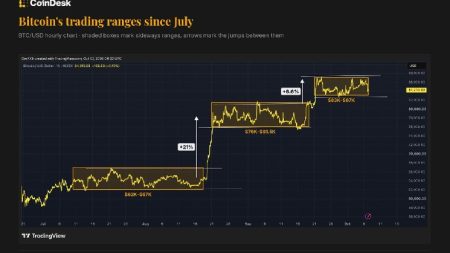
While traditional equity markets experienced what was arguably one of their most devastating sessions of the fiscal year, the cryptocurrency market trends exhibited a surprising degree of structural stability, flatly refusing to join the broader equity indices in their downward spiral and instead establishing a solid, rangebound floor. Bitcoin, the premier sovereign digital asset, became anchored in a highly active but narrow horizontal trading channel between the key psychological thresholds of $63,000 and $64,000, absorbing vast amounts of selling volume from distressed traditional funds without breaking local technical support trends. This resilient lateral movement was closely mirrored by Ethereum, the premier smart-contract platform, which locked into a tight, protective trading range around the $1,900 mark, displaying an impressive level of price defense despite the broader market panic. Meanwhile, major altcoins with highly volatile historical profiles, such as payments-centric XRP and the high-beta meme token Dogecoin, also defied expectations of a steep correction by trading horizontally, presenting a clean, non-correlated performance profile that is increasingly characteristic of a maturing market asset class. This localized stability capped the total global cryptocurrency market cap decline at a highly modest 0.28% over the preceding twenty-four hours, holding firmly at an aggregate valuation of $2.18 trillion. This remarkable divergence in price behavior suggests that the digital asset class is beginning to detach from its historical role as a simple, highly levered shadow-beta of the Nasdaq, instead exhibiting structural characteristics similar to an independent monetary safe-haven that attracts capital when traditional systemic trust is challenged by sovereign debt inflation and military conflicts.
The Massive Leverage Purge: Clearing the Derivatives Board as Open Interest Continues to Rise
Underneath the outward appearance of calm, rangebound spot prices, the internal mechanics of the digital asset derivative markets underwent a massive, high-velocity liquidation event that systematically eliminated weak, over-leveraged long positions from the system. According to live network data compiled by the derivatives intelligence platform Coinglass, more than $400 million in highly leveraged speculative positions was completely erased from the marketplace in a continuous twenty-four-hour window, with long-biased market participants bearing the absolute brunt of the destruction. This structural deleveraging process represents a classic market “flush,” wherein short-term, speculative traders who utilized aggressive leverage to buy the local top are systematically forced to liquidate their holdings as prices dip, thereby transferring their assets into the hands of spot buyers and long-term capital allocators. Paradoxically, rather than dampening future trading interest or signaling a secular shift toward a bearish regime, the total outstanding open interest across major crypto derivatives contract platforms expanded by a robust 1.52% over the same daily period. This expansion in open interest, combined with verified exchange order book data indicating that retail participants and institutional-grade whale entities on Binance preserved a deeply entrenched net-long posture, strongly suggests that the underlying structural demand for digital asset exposure remains completely intact. The leverage purge has effectively served to de-risk the market’s immediate structure, clearing out speculative froth and creating a clean, healthy baseline from which a more sustainable, spot-driven price recovery can occur without the constant threat of cascading long liquidations.
Smart Money Exploits the Pullback: Large Entities Run Aggressive Accumulation Plays During the Bitcoin Price Correction
As retail traders panicked over the hawkish Federal Reserve projections and geopolitical disruptions, the most sophisticated entities in the digital asset space seized the opportunity to aggressively expand their long-term spot positions, viewing the local market dip as a highly attractive entry window. Prominent on-chain analyst Ali Martinez highlighted this profound structural divergence in behavior, noting that despite the prevailing short-term bearishness of retail market commentators, network addresses classification of “whales”—entities holding significant quantities of the circulating supply—had integrated an astonishing 29,075 Bitcoin into their collective reserves over the past week alone. This rapid, multi-billion-dollar crypto whale accumulation campaign during the local Bitcoin price correction illustrates a classic wealth transfer dynamic, where “smart money” entities take advantage of synthetic daily volatility to absorb supply from leveraged, capitulating retail hands. By taking thousands of coins entirely out of the active spot supply during periods of elevated macroeconomic concern, these major investment entities are systematically creating a structural supply shock within the order books, paving the way for an asymmetric upward movement once external macro-regional stability returns. This ongoing, quiet accumulation phase by large-scale investment funds acts as a powerful confirmation that the broader, macro-level crypto bull cycle is far from exhausted, with institutional capital continuing to treat market pullbacks as strategic wealth-generation opportunities rather than structural failure points.
Ethereum’s Coiled Spring: Diminishing On-Chain Supply Awaiting a Pivotal Institutional Catalyst
While Bitcoin’s sovereign store-of-value narrative continues to draw significant capital inflow, the Ethereum future outlook is characterized by a unique structural setup that could position the decentralized application network for a explosive upward re-rating relative to the broader market. According to recent research from the on-chain data analytics firm CryptoQuant, the immense, high-volume transfer spikes that periodically flooded the Ethereum blockchain in previous quarters have completely subsided, replaced by historically low on-chain transfer volumes that signal a profound drying up of active seller liquidity. This remarkable decline in active transfer volumes indicates that long-term Ether holders are increasingly choosing to lock up their assets in staking contracts or secure, cold-storage vaults, resulting in an incredibly tight liquid supply on major centralized trading platforms. However, despite this exceptional supply-side reduction, the asset remains rangebound due to a temporary lack of immediate, high-volume retail demand, highlighting a transactional vacuum that has kept the asset’s spot valuation trapped beneath key psychological resistance boundaries. Market specialists point out that this specific dynamic matches the historical profile of a “coiled spring,” where empty order blocks and low liquid supply mean that any sudden, robust influx of external institutional buying power will have a disproportionately large upward impact on the price. With institutional exchange-traded financial instruments continuing to gain regulatory traction and global corporations looking to settle cross-border economic transactions on decentralized settlement layers, a renewed wave of institutional adoption is poised to serve as the critical fundamental trigger that breaks Ethereum out of its accumulation phase and drives the entire decentralized finance sector into its next major expansion era.