


Headline: BitGo CEO Dismisses AI’s Ability to Crack Bitcoin’s Core, But Urges Immediate Quantum Preparedness
Date: October 9, 2025
The intersection of artificial intelligence and cryptography has become fertile ground for speculation, with doomsday scenarios often dominating the discourse. However, a leading voice in the digital asset security sector is pouring cold water on the idea that AI poses an imminent threat to Bitcoin’s fundamental encryption. Mike Belshe, the CEO of BitGo, has publicly pushed back against the growing narrative that artificial intelligence will inevitably shatter the cryptographic foundations of the world’s largest cryptocurrency. While he firmly rebuffed the notion of an immediate AI-induced cryptographic apocalypse, Belshe did offer a significant concession regarding the long-term viability of current security measures, emphasizing that the industry must act now to safeguard assets against threats that are still on the horizon.
In a recent exchange that has captured the attention of the fintech community, Belshe directly addressed the anxieties circulating on social media and within tech circles regarding the potential for advanced algorithms to decode Bitcoin’s private keys. His comments, made on October 8, serve as a counter-narrative to the prevailing fear that quantum and AI advancements are on the verge of rendering the trillion-dollar asset class obsolete. Belshe’s technical argument centers on the mathematical complexity underpinning the SHA-256 and Elliptic Curve Digital Signature Algorithm (ECDSA). He contends that while AI is a transformative force for data analysis and process automation, the brute-force computational requirements to reverse-engineer a private key remain so astronomically high that they are practically insurmountable with current and foreseeable technology. He characterized the fear that AI will “break Bitcoin” as a fundamental misunderstanding of how decryption works, far removed from the reality of computational limits.
Despite his dismissal of the immediate AI threat, Belshe pivoted to a more pressing, albeit future-oriented, concern: the rise of quantum computing. In his statement, he drew a sharp distinction between the speculative dangers of AI and the theoretical, yet mathematically proven, dangers of quantum machines. The CEO articulated that while an AI model cannot “guess” a private key through pattern recognition, a sufficiently powerful quantum computer utilizing Shor’s Algorithm could theoretically solve the mathematical problems that secure digital identities in a fraction of the time. This is not a question of intelligence, but of mathematics. It is this specific vector of attack that Belshe regards as the genuine existential risk for the industry, prompting his urgent call for the adoption of “post-quantum” security standards long before such hardware becomes commercially viable.
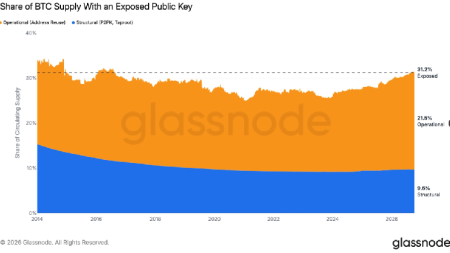
This nuanced position is a strategic pivot for industry leaders, moving the conversation from paralysis-by-fear to actionable preparation. Belshe’s commentary suggests that the real vulnerability lies not in the encryption itself, but in the absence of migration plans for existing digital assets. He stressed that the threat window is not “if” but “when”—and that the industry faces a “harvest now, decrypt later” scenario. In this prescient strategy, malicious actors could theoretically be copying encrypted data and wallet signatures today, storing them in massive repositories with the expectation that they will be able to decrypt them with quantum computers in the future. It is this specific risk that makes the protection of wallets today a matter of extreme urgency for high-net-worth individuals and institutional investors who hold significant positions in digital assets.
The BitGo CEO’s call to action involves a proactive re-engineering of how digital assets are stored. Rather than waiting for a quantum breakthrough to occur, the infrastructure must be upgraded to support quantum-resistant cryptographic algorithms. Belshe pointed to the necessity of implementing lattice-based cryptography or other post-quantum algorithms into the signing processes. This is not a simple software patch; it requires a fundamental overhaul of the hardware security modules (HSMs) and multi-party computation (MPC) protocols that currently safeguard the industry’s digital vaults. By advocating for these upgrades now, Belshe positions BitGo—and the wider custodial sector—as a forward-thinking guard against the eventual obsolescence of current security models.
In the immediate term, however, the industry is left to balance the hype cycle of AI with the pragmatic requirements of cybersecurity. Belshe’s rejection of the AI threat does not diminish the need for robust security practices, but it does help recalibrate expectations for investors who may have been spooked by sensational headlines. The future of Bitcoin, according to the CEO, is secure against the silicon-based intelligence of modern AI, but it hinges entirely on the industry’s collective ability to prepare for the entirely different physics of quantum mechanics. As we look ahead, the race is not against the clock, but against the qubit, and the custodians who heed this warning today will be the ones best positioned to protect the fortunes of tomorrow.