


Anthropic IPO Mania Looms Over Bitcoin as $1.9 Trillion Valuation Rattles Crypto Markets
The intersection of traditional finance and the cryptocurrency world has long produced strange contradictions, but few have been as striking as the current convergence of mega-cap tech IPOs and bitcoin’s volatile trading patterns. When SpaceX shares began trading on June 12, the rocket company surged roughly 19% above its initial public offering price, catapulting its market capitalization past the $2 trillion threshold. That spectacle alone was enough to capture the attention of institutional investors. Now, a new behemoth is stepping onto the stage. Crypto traders have begun pricing Anthropic’s potential public debut at a staggering $1.9 trillion valuation, a figure that puts the artificial intelligence powerhouse on nearly equal footing with the total market value of the entire bitcoin network. For context, bitcoin’s current market capitalization hovers near $1.6 trillion, meaning the perceived worth of two of the most hyped public offerings in recent memory could soon eclipse the flagship cryptocurrency’s entire market presence. The growing anticipation surrounding Anthropic’s IPO is not merely a sideshow for equity markets; it is becoming a gravitational force capable of redirecting capital flows, reshaping risk appetites, and testing the resilience of digital assets in ways that market participants are only beginning to understand.
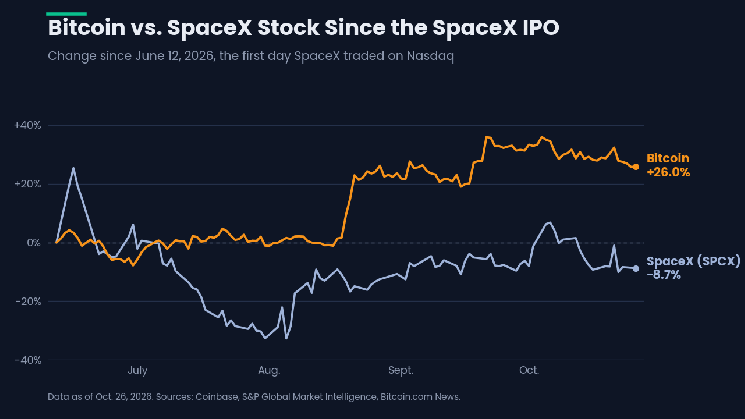
Bitcoin’s behavior around the SpaceX listing offers a revealing preview of what may lie ahead. In the weeks leading up to the June IPO, the leading cryptocurrency experienced a notable decline, dipping briefly after trading commenced before continuing its slide. By June 30, bitcoin had sunk to fresh yearly lows, closing near $58,500. That downturn, however, proved short-lived. From that trough, the digital asset has mounted an impressive recovery, climbing roughly 37% to its current levels, representing a gain of approximately 26% since the moment SpaceX shares first hit the tape. Meanwhile, SpaceX’s own stock has cooled considerably, falling 9% from its debut-day high even as it maintains a 9% premium above its IPO price. This divergence between the performance of a high-profile equity and the cryptocurrency market underscores a critical lesson: bitcoin does not simply move in lockstep with the fortunes of the latest Wall Street darling. The pre-IPO slide was exacerbated by a confluence of factors that had little to do with SpaceX itself, including significant outflows from bitcoin exchange-traded funds, a notable sale of bitcoin by Strategy, and the liquidation of long positions across major trading venues. These headwinds serve as a reminder that the crypto market operates on multiple axes simultaneously — a complex ecosystem where traditional IPO dynamics, macroeconomic policy, and crypto-specific leverage each pull the price in different directions. As Anthropic mania builds, analysts caution that this listing cycle could amplify those forces, potentially creating even sharper short-term distortions.
Crypto Industry Helps Drive Rotation From Bitcoin
The mechanics of how these mega-IPOs influence the crypto market have evolved considerably, and the industry itself is playing an active role in facilitating the rotation. Crypto exchanges, ever eager to capture retail attention, have begun offering synthetic exposure to Anthropic in much the same way they did with SpaceX ahead of its listing. Prior to the rocket company’s debut, several major platforms listed pre-IPO perpetual futures — derivative contracts that track a company’s expected share price without requiring the underlying shares to change hands. These products allowed traders to bet on the outcome of the IPO using cryptocurrency collateral, effectively blurring the line between equity speculation and digital asset trading. Now, the same playbook is being deployed for Anthropic, giving crypto-native traders a direct channel to participate in one of the most anticipated tech offerings of the decade. The trend takes this integration even further in some cases. Several exchanges introduced tokenized SpaceX shares in the run-up to the listing, digital representations intended to be backed by actual IPO shares. However, those products were abruptly canceled on listing day, and exchanges refunded users after failing to secure the necessary share inventory. The episode highlighted both the appetite for such hybrid instruments and the operational complexities involved in bridging traditional settlement systems with on-chain infrastructure. Anthropic itself has moved to assert control over its capital structure, warning that any sale or transfer of its stock — or any interest in its stock — that has not been approved by its board of directors is void. While the company did not explicitly reference perpetual futures, the statement signals that it is closely monitoring secondary-market activity and the growing array of synthetic products sprouting around its private shares.
Different Macro Environments
Beyond the immediate dynamics of the IPO cycle, the backdrop against which this new chapter unfolds differs meaningfully from the environment that shaped the SpaceX debut. In June, the Federal Reserve was holding interest rates steady while markets increasingly priced in the possibility of a hike. The policy landscape has since shifted. The Fed raised rates in September, although bitcoin responded with a rally that surprised many observers. On Wednesday, October 28, the central bank will announce its next decision, with markets largely anticipating that rates will remain unchanged. The inflation picture has also undergone a complex evolution. When SpaceX went public, May’s annual CPI reading of 4.2% marked the highest level since 2023, raising concerns about persistent price pressures. That figure eased over the following months, offering a brief window of relief. By September, however, inflation had reaccelerated to 3.7%, driven primarily by surging energy costs. The trajectory of oil prices has been equally turbulent. During the late June window of the SpaceX IPO, hopes for a diplomatic resolution to the United States’ conflict with Iran in the region pushed Brent crude to its lowest level since before the hostilities began. That optimism proved fragile. The conflict escalated sharply in July, and by October, fresh reports of potential strikes on Iranian targets sent Brent soaring above $116 per barrel. The fixed-income market tells a similar story of deterioration, with bond yields now significantly higher than their June levels. This tightening of financial conditions across multiple asset classes creates a more hostile environment for risk assets, yet bitcoin’s resilience in the face of these headwinds has been noteworthy.
Political Impact and ETF Flows
The approaching U.S. midterm elections on November 3 add another layer of uncertainty that could dampen bitcoin market activity. History shows that investors often prefer to stand on the sidelines during major political inflection points, waiting for clarity before committing capital. The same pattern appears to be forming now, as some participants choose to delay buy or sell decisions until after the ballots are cast. The flow dynamics of bitcoin ETFs have similarly shifted. While outflows dominated the narrative in June, with investors pulling assets from these vehicles amid the broader sell-off, inflows have since recovered. That recovery, however, has stalled during what traders affectionately call “Uptober” — a month historically associated with bullish performance for the cryptocurrency. ETF flows have remained mostly flat during this period, putting the current month on track to diverge from its historical averages once again. This pattern of muted participation suggests that while the panic of June has subsided, conviction has not yet fully returned. The convergence of political uncertainty, elevated yields, and the distraction of blockbuster IPOs appears to be holding institutional capital in check. Yet the narrative of the SpaceX debut offers a paradoxical counterpoint. SpaceX went public amid falling oil prices, easing inflation, and a Federal Reserve that was holding rates steady — conditions that might reasonably have been expected to support risk assets, including bitcoin. Instead, bitcoin soon hit new lows before roaring back with double-digit gains even as macroeconomic conditions continued to deteriorate. This historical episode underscores the reality that while these juggernaut IPOs can affect bitcoin’s price in the short term, the top cryptocurrency by market cap has repeatedly demonstrated its capacity to move in the opposite direction of what its broader environment might suggest. That applies equally to rallies and downturns, and it is precisely this unpredictability that now sets the stage for another test.
“Hard Asset,” According to Whom?
The question of how bitcoin fits into an increasingly crowded and contested investment landscape has drawn sharp commentary from prominent voices in the digital asset space. Nik Bhatia, founder of The Bitcoin Layer, argued in a video commentary released Monday that the Anthropic IPO filing — alongside SpaceX’s $40 billion debt raise and Meta’s estimated $95 billion equity raise — revealed something deeper about the state of corporate America. In Bhatia’s view, these massive capital-raising efforts signal that companies are scrambling for the last available liquidity before funding windows narrow further. The backdrop, he contends, is tightening credit and liquidity conditions across the risk-asset spectrum. Investors, faced with this reality, will increasingly prioritize safer assets with visible cash flows over speculative startups that may struggle to refinance as defaults rise. “These are some red flags that I believe valuations are starting to come down; earnings growth is also starting to top out,” Bhatia said. His assessment frames the current moment as a critical inflection point for digital assets. Bitcoin is once again being tested on a fundamental question: are bitcoiners alone in viewing it as a hard asset that exists outside the struggling traditional credit system, or is that perspective gaining broader acceptance among institutional players? If the latter is true, then the Anthropic IPO — despite its enormous fanfare and potential to draw speculative capital away from the crypto market — could prove to be nothing more than another blip on bitcoin’s long-term price chart. If the former holds, the cryptocurrency may face a more prolonged period of underperformance as investors gravitate toward the certainty of cash-generating businesses and the safety of government bonds. Either way, the next several weeks promise to deliver a definitive signal about whether the digital asset’s status goes beyond the conviction of its most dedicated believers.