



Bitcoin Price Steadies Near $81K as Fed Decision Looms and Derivatives Data Paint a Cautious Picture
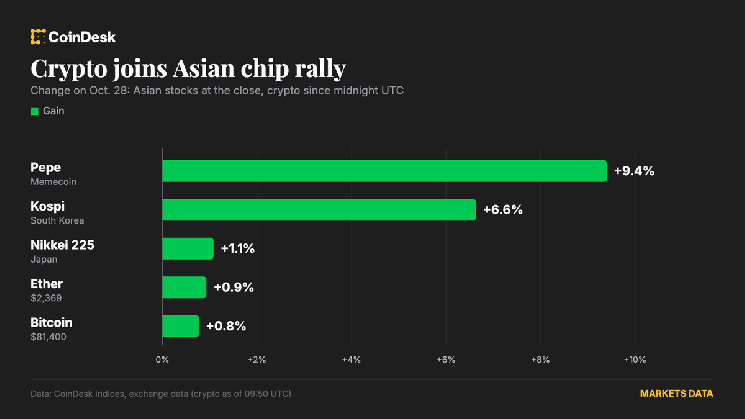
Bitcoin catches a bid after a shaky start. Just when it looked as though Bitcoin’s slide had room to run, buyers emerged from the sidelines. The leading cryptocurrency climbed roughly 0.8% from midnight UTC to trade near $81,400 on Monday, steadying after a dip that briefly dragged it below the psychologically important $80,000 level. For a market that had been spooked by macro uncertainty, the bounce was modest but meaningful. Altcoins quickly followed: ether rose 0.9%, while CoinDesk’s Memecoin Index advanced 1.3%, suggesting that risk appetite was returning to the digital-asset complex. The positive tone extended beyond crypto. Asian chip stocks mounted a striking rebound in AI-linked equities, with South Korea’s Kospi index jumping 6.6%. SK Hynix, a key barometer for the global semiconductor cycle, surged around 11% after reporting a sevenfold jump in profit. Nasdaq-100 futures gained 0.5%, pointing to a firmer open on Wall Street. The fact that Bitcoin rebounded so quickly after dipping below $80,000 is itself a signal. In previous selloffs, a breach of a major psychological level often opens the door to further liquidation. This time, the buyers came in almost immediately, and the subsequent price action in altcoins suggested the selling was exhausted, at least for now. That backdrop matters because the U.S. Federal Reserve is set to announce its interest-rate decision at 18:00 UTC. CME’s FedWatch tool gives roughly a 92% probability of no change, but the market knows the real signal will come from Fed Chair Kevin Warsh’s press conference. Traders will be listening for any hint that the central bank is contemplating rate increases or, conversely, preparing to signal a more dovish path. There is also a concrete flow story developing in the background: U.S.-listed spot Bitcoin exchange-traded funds took in $176 million on Tuesday, marking a second consecutive day of inflows. With Alphabet and Microsoft reporting earnings after the closing bell, the macro and earnings calendar is crowded. For Bitcoin, the reaction to the Fed will be decisive, but so too will be the positioning data that has built up in recent days.
Futures trading is active, but leverage remains restrained. Under the surface, the derivatives market is telling a more disciplined story. In the 24 hours through Wednesday morning, crypto futures trading volume rose 7.5% to $163.2 billion, while open interest—the total number of outstanding contracts—crept up by just 1.3%. That gap matters. It means traders were actively moving positions around, but they were not, for the most part, stacking on new risk. Liquidations jumped 38% to $183.6 million, a reminder that the recovery was not a one-way street. Taker volume was split almost evenly, 50.7% long and 49.3% short, another sign that conviction is not yet one-sided. The picture becomes clearer when looking at the largest assets. Bitcoin rose 2.3% in this period, yet its open interest slipped 0.1%. Ether gained 2.7%, but its open interest rose just 1.7%. In both cases, price outperformed positioning, implying the moves were driven by spot demand and short covering rather than fresh leveraged bets. Funding rates are positive but subdued—0.0090% for Bitcoin, 0.0079% for Ether, both near the 0.01% baseline that generally indicates a balanced market. When funding turns extremely positive, the consensus becomes crowded and the market is vulnerable to a reversal; right now, there is no such crowding. At the same time, Bitcoin and Ether suffered the largest liquidation events of the day, at $56.4 million and $46.0 million respectively. Combined, those two assets accounted for more than half of all liquidations. That suggests a market with two-way volatility, where stop-losses are clustering just below key levels. One important caveat is that a 24-hour window is short, and a longer time horizon would provide a fuller picture of whether open interest is truly resetting. But for now, the combination of muted funding and flat open interest is the kind of backdrop that has historically preceded a more sustainable move. The absence of a derivatives meltdown, despite those liquidations, is another reason to read the current recovery as cautious rather than euphoric.
Zcash brings fresh money, while gold and oil send mixed messages. One altcoin is standing out for all the right reasons. Zcash’s open interest jumped 14% during the same 24-hour window, against a 6.3% gain in its price. That is the clearest signal among the larger coins that new capital is entering the market, rather than existing positions being shuffled. The funding rate for Zcash sits at 0.0076%, still comfortably below overheating levels, so the buildup does not look crowded. Zcash also saw the highest liquidation figure among altcoins, at $8.6 million, which speaks to the volatility that accompanies any fresh wave of attention. Traditional markets, by contrast, are sending a more fragmented signal. Gold futures rose 1.4%, but open interest fell 10%—a classic sign that the move was driven by short covering and book squaring rather than new accumulation. Tether’s tokenized gold product, XAUT, offered a different read: open interest climbed 11.6% alongside a 1.3% gain in price, suggesting that some investors prefer to take exposure on-chain. Crude oil leans bearish in the derivatives data. Open interest in the front-month CL contract rose 3.3% while price slipped 0.7%, and volume surged 26%. Perpetual funding for oil is negative at -0.0135%, the most negative reading among the major contracts, meaning traders are paying to stay short. That combination—rising open interest, falling price, and negative funding—usually points to a market where speculators are building on bearish bets rather than merely hedging. The fact that oil traders are leaning short even as prices hover near levels that have historically attracted geopolitical hedging suggests they see more downside risk than upside. For crypto, this is not necessarily a bad thing: a weakened commodity complex can relieve inflationary pressures and, in turn, reduce the pressure on the Federal Reserve to keep policy tight. The broader read is that investors are not aggressively chasing risk across every asset class. They are selective, and that selectivity is visible in Zcash’s inflows just as clearly as it is in the caution around oil and gold.
The chip rally is broad, but not crowded; crypto order flow is more constructive. The semiconductor rebound that lifted sentiment across global markets comes with a similar caveat. SOXL, the three-times leveraged semiconductor ETF, jumped 12% in its latest session, but its open interest rose only 2%. SK Hynix gained 8.7% with open interest up a modest 3.9%, and SanDisk advanced 7.1% while open interest actually contracted by 1.8%. In each case, the price move ran well ahead of any expansion in derivatives positioning. Funding rates reinforce the point: SOXL and SK Hynix both carry slightly negative funding, while SanDisk is close to zero. In other words, the chip rally is not being powered by a wave of leveraged longs. It looks more like a short squeeze combined with spot buying, which can create sharp moves in the short run but often lacks the durability of a position-driven rally. In crypto, the equivalent measure paints a more constructive picture. Most coins are recording positive 24-hour cumulative volume delta, or CVD, after being adjusted for open interest. That means market buy orders are outweighing sell orders relative to the size of the market. XLM has the most positive CVD reading, while Tether’s XAUT sits at the opposite end. CVD is not a crystal ball; it is a measure of aggression in the order flow. But when it is positive across a wide range of assets at the same time, it signals that the market is being supported by buyers who are willing to cross the spread to get filled. That is a much healthier foundation than a rally built on short covering. The divergence between equity and crypto derivatives is important. The equity rally is leaning on short covering; the crypto rally is drawing in genuine spot demand. If the chip rally fades, Bitcoin and ether are not necessarily doomed, because the sources of buying are different. But if the global risk mood sours, the crypto market will still have to fight the macro current.
Options traders are less fearful in the near term; Pepe leads the altcoin charge. Options market signals have also shifted in a more constructive direction. On Deribit, Bitcoin’s one-week put-call skew tumbled to less than 1% from nearly 10% a week earlier. That is a dramatic normalization. A week ago, traders were willing to pay a significant premium for puts, or downside protection; now, that premium has almost disappeared, at least for the near term. Longer-dated skews, however, still show a pronounced bias toward puts. The one-month, three-month, and six-month skews all remain tilted in favor of protecting against downside, which tells you that the broader institutional community is not yet ready to call an all-clear. The most heavily traded Bitcoin contract in the past 24 hours was a $65,000 put expiring on Oct. 30—a bearish hedge that remains in demand. For Ether, the most-traded contract was a $3,400 call expiring on Oct. 29, showing that some traders are positioning for upside. The split is telling: Bitcoin traders are still paying up for a large downside hedge, while Ether traders are chasing a call. It reflects a market that is hesitant on Bitcoin’s macro risk but more willing to express bullishness on Ethereum, perhaps because of expectations around staking or network upgrades. In the spot market, the memecoin corner is heating up again. Pepe, the Ethereum-based frog-themed token, jumped 9.4% to lead the CoinDesk 100 Index. The move was fueled in part by an Arkham Intelligence report linking wallets tied to Tron founder Justin Sun with roughly $51 million in Pepe holdings, making Sun the largest holder outside exchanges. Floki and dogecoin also rose, gaining 3.4% and 1.9% respectively. The meme sector remains the most speculative corner of the market, but its renewed strength suggests a segment of traders is willing to take on risk again.
AI tokens lag, DeFi lags, and altcoin season is slowly arriving. Not every corner of the market is participating in the rebound, though. AI-linked tokens failed to reflect the strength in AI stocks for a second consecutive day, with Venice’s VVV token falling 8.2%, Grass’s GRASS dropping 3.3%, and Kite’s KITE losing 2.4%. The disconnect is noteworthy. Stock investors are rewarding AI-related companies while crypto traders remain hesitant to chase tokenized AI narratives, perhaps a reflection of previous cycles where those tokens ran too far ahead of real adoption. Decentralized finance, or DeFi, tokens are also lagging. CoinDesk’s DeFi Index (DFX) rose just 0.6% against a 0.9% gain for the broader CoinDesk 80, marking the smallest advance of any CoinDesk Index in the latest window. That is a sign of a market that is broadening, but slowly. The most encouraging metric may be CoinMarketCap’s “Altcoin Season” index, which rose to 60/100 from 57. While not yet at the threshold that declares a full altcoin season, it is edging in that direction, suggesting investors are starting to look beyond the two largest cryptocurrencies. Historically, altcoin season begins when Bitcoin consolidation gives rise to capital rotation. The current index level of 60 is just past the halfway mark, and the fact that it is rising while Bitcoin is stabilizing, rather than falling, is a healthy sign. Still, the rotation has yet to become broad-based. AI tokens and DeFi tokens remain outliers, and the memecoin strength is concentrated rather than universal. For the next phase of the market, the key variable remains the Fed. A dovish surprise could ignite a broader rotation and push the altcoin season index significantly higher. A hawkish tone, by contrast, would put the recent resilience to the test. What is clear is that the positioning data no longer looks as fragile as it did a week ago. Leverage is subdued, spot flows are positive, and the fear premium in the options market has faded. That is not a recipe for euphoria, but it is a recipe for continued accumulation—provided Bitcoin can hold the line at $80,000.