


Bitcoin Mining Difficulty Jumps to Seven-Month High as Network Activity Surges
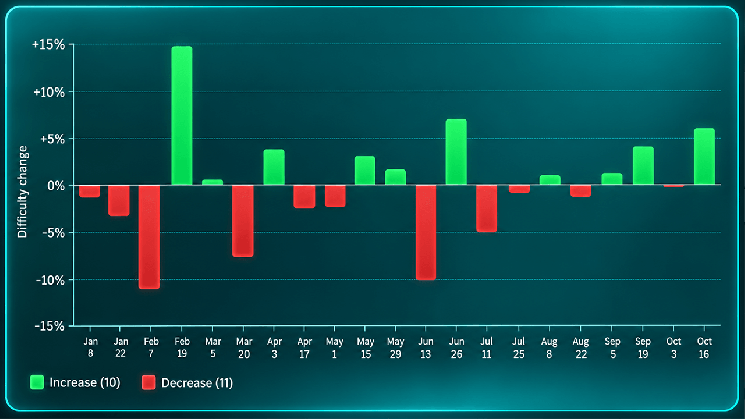
In a clear signal that the Bitcoin network is expanding once again, mining difficulty has surged to levels not seen in over half a year. The latest recalibration, which took effect this week, pushed the network’s difficulty up by 5.92 percent — from 132.72 trillion to 140.58 trillion — marking one of the most significant upward adjustments of the year. The move represents the third-largest increase recorded in 2024 and adds fresh momentum to a recovery that first began taking shape during the summer months.
For those unfamiliar with the inner workings of the world’s most prominent cryptocurrency, mining difficulty is essentially a measure of how hard miners must work to solve the complex mathematical puzzles required to validate transactions and add new blocks to the blockchain. The higher the difficulty, the more computational power is needed to secure a block reward. This self-regulating mechanism is fundamental to Bitcoin’s design, ensuring that blocks are discovered at a steady, predictable pace regardless of how much computing muscle is plugged into the network at any given time. According to data tracked by industry metrics, Bitcoin has undergone a total of 21 difficulty adjustments so far this year, with the latest marking the tenth time difficulty has moved upward. That bias toward expansion tells a broader story about the health of the mining sector and the competitive pressure building beneath the surface.
A Self-Correcting Mechanism in Full Force
To truly appreciate what this latest increase means, it helps to understand the elegant rhythm of Bitcoin’s proof-of-work system. Roughly every two weeks — or more precisely, every 2,016 blocks — the network evaluates how quickly blocks are being mined and recalibrates the difficulty accordingly. If blocks are being solved faster than the target ten-minute average, the difficulty ratchets upward, making it harder for miners to earn rewards. Conversely, if blocks are taking longer to produce, the network eases the difficulty to encourage participation and keep the system running smoothly.
This automatic recalibration has been working overtime in recent months. The summer months saw a steady climb in difficulty after a period of turbulence and consolidation in the mining industry. Now, with the latest adjustment, the network has decisively moved past its previous plateau, reaching a difficulty level that last surfaced in the spring. For miners, this means the bar has been raised once again. Only those with access to efficient hardware and relatively inexpensive electricity are likely to remain profitable in this increasingly competitive environment.
The implications extend far beyond the mining community, though. Difficulty is often viewed as a proxy for overall network health and miner confidence. When difficulty rises, it typically signals that more computational power is being committed to the network — and that miners, on the whole, expect to be rewarded for their efforts. That confidence appears well-founded, judging by recent market dynamics. The significance of the 10th upward adjustment out of 21 total recalibrations this year cannot be overstated; it reflects a sustained, structural expansion rather than a fleeting blip. With the bulk of the year’s adjustments trending upward, the narrative of a maturing, increasingly fortified network is difficult to dispute.
Price Rally Lifts Miner Revenue and Accelerates the Uptrend
The timing of the difficulty surge was no accident. In classic Bitcoin fashion, the network’s mining economics are inextricably linked to the price of the underlying asset, and recent weeks have provided a textbook demonstration of that relationship. The difficulty increase coincided with a meaningful price spike in Bitcoin, which in turn translated into enhanced revenue for miners operating on the network. The so-called hashprice — a key metric that estimates the daily revenue generated by a single petahash per second (PH/s) of computing power — began climbing noticeably in mid-September.
On Sept. 16, the hashprice stood at $37.56. Over the subsequent two-week window, it pushed higher, breaking through the $41 threshold on two separate occasions, including Oct. 2. For the better part of the past month, mining revenue hovered comfortably between 6 percent and 9 percent above the mid-September baseline. These may sound like modest margins, but in an industry defined by razor-thin profitability, such improvements can mean the difference between operating at a loss and turning a healthy profit.
However, the good times proved slightly ahead of the market’s appetite. By Friday, Oct. 16, the hashprice had cooled, retreating to $36.75 per petahash per second. That pullback serves as a reminder of how volatile and sentiment-driven mining economics can be. But even with that cooler reading, the overall picture remained constructive. Miners who had been sitting on the sidelines or contemplating whether to bring additional capacity online were given a clear financial incentive to act, and many of them did.
The revenue environment isn’t just about the spot price of bitcoin, of course. Transaction fees, network congestion, and the efficiency of the mining rig itself all play a role in determining what a miner ultimately takes home. Yet when the price climbs as sharply as it did in late September, it tends to overshadow all other variables. Miners respond not by hesitating but by committing more resources — and that behavior is precisely what drives the difficulty level higher.
Hashrate Reclaims the Zettahash Milestone
Perhaps the most striking development to emerge from this period of improving economics is the resurgence of Bitcoin’s total network hashrate. With revenue prospects looking brighter, a larger number of miners were compelled to plug in their machines and participate, propelling the network’s collective computing power back above a critical threshold: 1,000 exahashes per second (EH/s), a figure that translates to a staggering 1 zettahash per second (ZH/s).
To put that number in perspective, consider that just a few years ago, the entire Bitcoin network operated at a small fraction of this capacity. A zettahash represents a quintillion hashes per second — a scale so vast that it defies easy comprehension. Crossing back above that milestone carries ceremonial and practical significance. It signals that the network has regained the strength it lost during periods of mining capitulation and indicates that institutional and industrial-scale miners are confident enough in the long-term outlook to deploy serious capital.
The push past 1 ZH/s also reflects the broader consolidation trend that has reshaped the mining industry over the past several years. Gone are the days when hobbyists with a handful of graphics cards could meaningfully participate in Bitcoin mining. Today, the sector is dominated by publicly traded companies, sophisticated funds, and large-scale operations housed in purpose-built facilities with access to cheap, often renewable energy. These players operate on tight margins and make decisions based on data, hedging strategies, and long-term price forecasts rather than emotion. Their willingness to expand hashrate capacity suggests that the prevailing sentiment among industry insiders is cautiously optimistic.
The growth in hashrate is also a testament to the resilience of the network itself. Bitcoin has weathered regulatory crackdowns, environmental criticism, and some of the most brutal bear markets in financial history. Each time, the network has emerged stronger, with more computational power securing the chain. The current recovery, punctuated by this latest push back above the zettahash milestone, follows that familiar pattern of resilience and expansion.
Deeper Implications for Network Security and Miner Strategy
The combination of rising difficulty and a resurgent hashrate carries profound implications for the Bitcoin ecosystem — most notably in the realm of network security. A higher hashrate makes the network exponentially more resistant to attacks. The computational cost required to stage a 51 percent attack, in which a malicious actor would need to control a majority of the network’s computing power to manipulate transactions, has grown to prohibitively expensive levels. In essence, the ongoing investment in mining infrastructure serves as a deterrent to would-be attackers, reinforcing the integrity of the entire system.
But for the miners themselves, the calculus is more complex. Higher difficulty means the same amount of computational work now yields fewer bitcoin rewards, at least on a per-hash basis. This dynamic puts pressure on mining companies to continually upgrade their hardware and seek out ever-cheaper sources of electricity. Machines that were profitable at lower difficulty levels may now find themselves operating at a deficit, forcing operators to make tough choices about whether to invest in newer, more efficient rigs or sit on the sidelines until market conditions shift.
This environment tends to favor larger, better-capitalized players who can weather short-term fluctuations and negotiate favorable power contracts. We have seen a steady trend of consolidation in the mining industry, and the latest difficulty adjustment is unlikely to reverse that trajectory. Smaller miners may be squeezed, but they remain an important part of the network’s decentralized fabric. Their participation, combined with the expanding footprint of industrial-scale operations, creates a diversified ecosystem that is both robust and adaptable.
Interestingly, the difficulty adjustment also feeds back into the market narrative. When difficulty rises, it is often interpreted as a vote of confidence in the future price of bitcoin. That perception can attract additional investment, both from the traditional financial sector and from retail participants who view mining economics as a leading indicator of market sentiment. It becomes a self-reinforcing cycle: price rises attract miners, miners increase hashrate, difficulty adjusts upward, and the network becomes more secure — all of which reinforces positive sentiment.
What Lies Ahead for Bitcoin’s Mining Economy
Looking forward, the trajectory of Bitcoin’s mining economy will hinge largely on two interrelated factors: the continued performance of the bitcoin price and the broader macroeconomic environment. If the current rally extends and bitcoin manages to hold onto its gains, miners can expect the favorable revenue conditions to persist, encouraging further hashrate growth and additional difficulty increases. If, however, the price stalls or retreats, the hashprice could slide further, and the difficulty may plateau or even pull back in subsequent adjustments.
There is also the lingering question of the halving cycle. Bitcoin underwent its most recent halving earlier this year, cutting the block reward from 6.25 to 3.125 bitcoin. Historically, halvings have been followed by periods of price appreciation, as the reduced supply of new coins collides with steady or growing demand. If that historical pattern holds, the current difficulty surge could be merely the opening chapter of a much larger expansion. On the other hand, the full impact of the reduced reward is still being absorbed, and miners have had to adapt to a reality in which they earn fewer bitcoin for the same amount of work.
Industry analysts remain divided on the near-term outlook, but a few themes have emerged with clarity. First, the mining sector is far healthier today than it was during the depths of the bear market, when hashprice fell to historic lows and forced many operators into bankruptcy. Second, the infrastructure built during the downturn — more efficient machines, more strategic power agreements, more sophisticated financial hedging — leaves the industry better prepared to handle both upside and downside scenarios. And third, regardless of short-term fluctuations, the long-term trend in both difficulty and hashrate remains unmistakably upward.
For observers of the cryptocurrency market, the latest difficulty adjustment is more than just a technical footnote. It is a snapshot of an industry in motion, a reflection of confidence, and a harbinger of what may come. As the network continues to grow and evolve, the machines humming in warehouses across the globe are not just securing a digital currency; they are powering a financial revolution that is still very much in its early chapters. The seven-month high in mining difficulty is a chapter worth noting — a quiet but forceful reaffirmation that, in the world of Bitcoin, the work of securing the network only gets harder from here. And for those participating in it, that is ultimately a good thing.