


Macroeconomic Headwinds and Geopolitical Realignment Keep Digital Assets in Suspended Animation
The global cryptocurrency market remains locked in a state of suspended animation as market participants brace for the Federal Reserve’s pending interest-rate decision, presenting a vivid picture of macro-driven paralysis across both digital and traditional financial networks. The benchmark CoinDesk 20 Index, which tracks the most liquid and influential digital assets in the space, posted a minor, highly cautious advance of 0.41% since midnight UTC, signaling an evenly divided sentiment where exactly ten of its constituent assets logged gains while the remaining ten receded. This collective hesitation reflects a complex macroeconomic puzzle facing monetary policymakers in Washington, where persistent domestic inflation, currently stubbornly recorded at a 4.1% annualized rate, is building a compelling logical foundation for the central bank to execute its first interest-rate hike in three years. Yet, this hawkish pressure is being dynamically countered by a fragile de-escalation of hostilities between the United States and Iran, which has pacified global energy markets, trimmed Brent crude prices, and marginally reduced the statistical probability of an immediate rate hike. This delicate state of equilibrium is mirrored across traditional equity indices, where futures for the S&P 500 and the tech-heavy Nasdaq 100 have both edged into positive territory, while defensive safe-havens like gold continue to hold ground above the historic $4,000 threshold and silver advances by 1.40%, illustrating a broader market regime characterized by strategic hedging over raw directionality.
Bitcoin Recovers from East Asian Equity Shockwaves as Ethereum Struggles to Find Catalysts
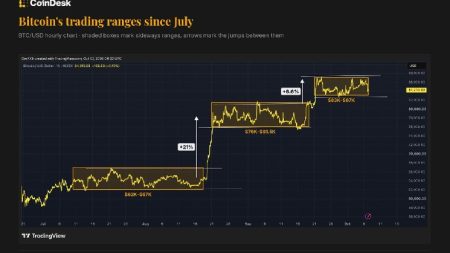
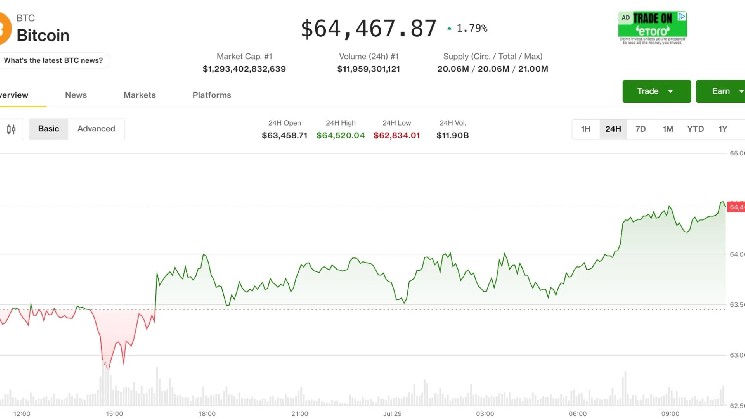
Within this macroeconomic holding pattern, Bitcoin ($BTC), the undisputed bellwether of the digital asset economy, demonstrated its characteristic capacity for rapid reclamation by adding 1.75% to trade around $64,491.67, successfully clawing back a significant portion of the steep losses suffered during Tuesday’s volatile trading session. The preceding 48 hours served as a stark reminder of the globalized, highly interconnected nature of modern digital asset liquidity, which saw Bitcoin experience a sharp rejection after testing a bullish regional target of $66,700 last week, only to crash precipitously to a local floor of $62,400 in the wake of a sudden, panic-induced rout in South Korean equities. This swift East Asian sell-off triggered automated risk-off protocols across western trading desks, washing out late-stage leveraged long positions before stabilizing as institutional buyers stepped in to absorb the discounted supply. In contrast, the market’s premier smart-contract platform, Ethereum ($ETH), failed to mirror this corrective bounce, drifting downward by a marginal 0.13% on the session; this lethargic price action reflects a broader narrative of capital concentration inside Bitcoin ahead of central bank decisions, as traders prioritize the relative security of the network’s hard-cap monetary policy over Ethereum’s more complex, gas-dependent fee-burning dynamics while wait-and-see sentiment dominates the decentralized application ecosystem.
Cryptographic Derivatives Hold Steady as Flat Open Interest Reveals a Lack of Positional Conviction
A granular diagnostic of the cryptocurrency derivatives space reveals a fascinating narrative of institutional standoff, where high-volume intraday trading has completely replaced long-term directional positioning. The crypto taker long-short volume ratio has settled into an almost perfect statistical balance ahead of the Federal Open Market Committee (FOMC) announcement, proving that neither the bullish spot buyers nor the bearish short-sellers possess the momentum required to establish a clear trend direction. While aggregate derivatives volume experienced a notable 10% surge over the last 24 hours to reach $205 billion, the total open interest (OI)—representing the total value of outstanding derivatives contracts that have not yet been settled—remained rigidly flat near the $113 billion mark, which points to heightened intraday capital churn rather than structural trend-building. Furthermore, despite spot price rallies of over 1% for both BTC and ETH during the session, this spot market strength has conspicuously failed to draw new participants into the leveraged futures market, as Bitcoin’s overall futures open interest remained practically unchanged near 750,000 BTC. Meanwhile, Ethereum’s open interest actually recorded its fourth consecutive daily contraction, sliding to 14.14 million ETH, indicating that derivatives traders are actively winding down their leveraged exposure to avoid the catastrophic liquidation cascades that historically follow unexpected, hawkish rhetorical pivots from the Federal Reserve.
Institutional RWA Innovation Catapults Uniswap Exposure Amid Broad-Market Deleveraging
Bucking this trend of derivative stagnation is Uniswap ($UNI), which emerged as a phenomenal structural exception after logging a substantial increase in its futures open interest to 68.53 million tokens, marking its highest overall participation level since July 13. This unusual accumulation of derivative contracts validated a highly domestic 5% surge in Uniswap’s spot price, which came directly on the heels of an announcement that BlackRock, the world’s largest asset manager, intends to expand its tokenized Treasury fund (BUIDL) to the Uniswap decentralized protocol. This landmark move represents a major validation for the real-world asset (RWA) tokenization narrative, proving that sovereign debt and traditional yield-generating products are finding permanent native homes on permissionless public ledger infrastructure to change the structural utility of native DeFi tokens. This isolated development is further reflected in the 24-hour open interest-adjusted Cumulative Volume Delta (CVD), which presents a highly fragmented ledger across different networks. While tokens like Cardano ($ADA), Tron ($TRX), Ripple ($XRP), and Uniswap ($UNI) showed positive CVD trends—meaning buyers are aggressively executing market orders rather than waiting for limit orders to fill—the rest of the altcoin market is displaying soft, defensive characteristics, suggesting that institutional interest remains highly selective and concentrated around platform utility and compliance-friendly initiatives.
Options Volatility Paradox Reveals Systemic Hedging Against Central Bank Surprises
As the hour of the Federal Reserve’s interest-rate decision draws closer, the pricing of risk in the options ecosystem is presenting an intriguing financial paradox that challenges traditional analytical assumptions. Despite the persistent unease holding sway across macroeconomic research desks, the 30-day implied volatility indexes for both Bitcoin and Ethereum remain remarkably close to their historic lows, indicating that option writers do not anticipate sudden, violent market fluctuations in the immediate future. This complacent options pricing directly contradicts the volatile sentiment in the analyst community, who note with concern that traders are still assigning a highly unusual 35% probability to the prospect of a surprise rate hike, an unprecedented statistical dispersion given that markets typically establish a nearly unanimous consensus on monetary policy paths long before the official press conference begins. To protect their balance sheets against the tail-risk of a hawkish central-bank surprise, institutional desks have initiated significant defensive shielding on Deribit, where Bitcoin put options positioned at the $62,000, $60,000, and $54,000 strike levels have heavily dominated the 24-hour volume tables, showing that investors are quietly paying premiums for downside insurance. Conversely, the options market for Ethereum displays a diametrically opposed posture characterized by call option dominance, indicating that traders are actively positioning for a major, post-meeting relief recovery once the macroeconomic overhang is resolved.
Fragmented Altcoin Performance Traces the Rise of Utility and the Decline of Early-July AI Hype
Outside of the two dominant digital assets, the broader utility and application token sectors are undergoing a highly selective, performance-driven consolidation that paints a realistic picture of an asset class maturing beyond uniform speculative waves. Ripple ($XRP) spearheaded the mid-cap altcoin recovery, climbing 1.72% to trade at $1.086, while Cardano ($ADA) logged a complementary gain of 1.48% to reach $0.1635, as both veteran protocols continue to claw back the substantial losses incurred during the regulatory and structural sell-offs of early July. In the Decentralized Finance (DeFi) arena, Jupiter ($JUP), a major liquidity router built on the Solana ecosystem, posted the day’s standout performance with a robust 5.79% advance on rising spot volumes, securing gains in three of its last four active sessions on the back of expanding platform metrics. However, this bullish momentum failed to transmit to the heavily hyped Artificial Intelligence (AI) sector, where Fetch.ai ($FET) continued its sharp retreat by dropping 4.60% since midnight and shedding 6.78% over 24 hours, confirming that the speculative enthusiasm which insulated AI assets in early July is undergoing a persistent, structural unwind. This speculative reset was also observed in retail-driven meme coins such as PUMP, which declined by 5.14% as retail momentum faded, while the privacy-focused Monero ($XMR) quietly resumed its upward trend by adding 1.82% to find support at $347, demonstrating that specialized, privacy-centric networks continue to draw steady sovereign capital flows even in times of intense macroeconomic scrutiny.