






Bitcoin Stuck in Summer Slumber as ETF Demand Meets Miner Selling
The world’s largest cryptocurrency remains locked in a narrow trading band, with institutional appetite counterbalanced by persistent supply pressures.
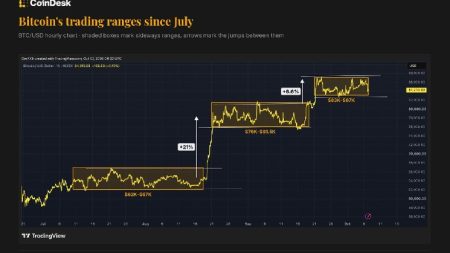
Bitcoin hovered near the $63,500 mark on Tuesday, sliding roughly 0.6 percent over the past 24 hours as the digital asset extended its longest period of price stagnation in recent memory. The muted movement continues a five-week standstill that has confined the leading cryptocurrency to a tight corridor between $62,000 and $66,000, a range that has held firm since the early days of summer trading.
Market observers point to a fascinating standoff developing beneath the surface—a tug-of-war between the steady accumulation of exchange-traded funds (ETFs) and the relentless distribution from miners and corporate treasury desks. This delicate equilibrium has left Bitcoin range-bound even as broader risk markets show signs of renewed vigor.
The Battle of Flows Beneath the Surface
“Bitcoin’s recent price action has largely been driven by steady ETF inflows being offset by over-the-counter selling from miners and Strategy,” explained Paul Howard, senior director at trading firm Wincent. The observation cuts to the heart of what has become a defining characteristic of the current market cycle: institutional adoption through regulated vehicles is real, but so too is the pressure from those who extract and hold the asset.
The numbers tell a compelling story. Daily spot Bitcoin ETF flows have remained consistently positive throughout August, according to data from SooValue, suggesting that traditional investors continue to allocate capital to digital assets through regulated channels. Yet these inflows have been almost perfectly counterbalanced by selling activity from mining operations and corporate holders seeking to monetize their positions or manage treasury exposure.
The result has been a market that resembles a coiled spring—accumulating energy but lacking the catalyst needed to break free from its constraints. Crypto trading volumes have fallen to their lowest levels in three years, Howard noted, leaving little firepower to push Bitcoin decisively in either direction. This liquidity drought has amplified the impact of even modest selling pressure while simultaneously reducing the momentum required for a sustained breakout.
The Institutional Shift Reshapes Market Dynamics
Bitfinex analysts have identified a fundamental shift in how Bitcoin’s supply-demand equation functions in the current cycle. Exchange-traded funds and bitcoin treasury companies have emerged as two major sources of what they term “price-insensitive demand”—buyers who accumulate regardless of short-term market fluctuations. These entities represent a new class of holder, one that views Bitcoin through the lens of strategic allocation rather than speculative trading.
Yet the same institutional framework that provides this steady bid has also introduced new sources of selling pressure. Corporate treasury activity, particularly from companies that accumulated substantial positions during earlier market phases, has recently provided offsetting distribution. This helps explain why Bitcoin gained only about 2 percent last week despite robust ETF inflows and stronger performance across traditional risk markets.
The dynamics represent a maturation of the market structure, one where institutional participation cuts both ways. While the approval of spot Bitcoin ETFs in January marked a watershed moment for mainstream adoption, it also created new channels through which large holders can efficiently exit positions without causing the dramatic price dislocations seen in previous cycles.
Miners Navigate the Post-Halving Landscape
The selling pressure from miners deserves particular attention given the industry’s evolving economics. The quadrennial halving event, which occurred in April, reduced the block reward from 6.25 to 3.125 Bitcoin, effectively halving the daily supply of newly minted coins. Despite this reduction in new supply, miners have maintained or even increased their distribution activity as they contend with rising operational costs and the need to fund expansion.
Publicly traded mining companies, which now dominate the industry’s hashrate, face additional pressures from shareholders to demonstrate profitability. This has led to a more disciplined approach to treasury management, with many operators selling a significant portion of their mined Bitcoin to cover operational expenses and capital expenditure requirements.
The interplay between reduced supply and sustained distribution creates a paradoxical situation where Bitcoin’s fundamental scarcity improves while its market price remains suppressed. It is a temporary condition, analysts suggest, but one that could persist until either demand accelerates meaningfully or selling pressure exhausts itself.
The Liquidity Conundrum
Perhaps the most significant factor constraining Bitcoin’s price discovery is the dramatic contraction in trading volumes. The three-year low in activity represents a flight of speculative capital that once provided the fuel for dramatic price movements. Market makers have responded by widening spreads and reducing their inventory positions, which in turn makes larger trades more impactful but also less frequent.
This environment rewards patience and punishes impulsivity. Large institutional buyers can accumulate positions without significantly moving the market, but they also face challenges when attempting to exit. The reduced liquidity amplifies the impact of any significant flow imbalance, creating the potential for sudden, sharp movements in either direction once the current equilibrium breaks.
The CPI Catalyst on the Horizon
Wednesday’s U.S. inflation report could finally provide the spark that traders have been seeking. The Consumer Price Index reading represents the most significant macroeconomic data point since the Federal Reserve’s last policy meeting, and it carries the potential to reshape expectations for interest rate policy heading into the autumn months.
A softer-than-expected inflation print would reinforce the case for rate cuts, potentially weakening the dollar and strengthening the appeal of alternative assets like Bitcoin. Conversely, an upside surprise would likely dampen risk appetite across all asset classes, though Bitcoin’s recent correlation with technology stocks suggests it would face particular pressure in such a scenario.
Bitcoin has shown an increasing sensitivity to Federal Reserve policy expectations throughout 2024. The digital asset’s strong performance in the first quarter was largely attributed to expectations of monetary easing, while its subsequent stagnation has coincided with the Fed’s patient approach to rate normalization. A clear signal on the inflation front could provide the directional clarity the market desperately needs.
Looking Ahead: Positioned for a Breakout
The current stalemate cannot persist indefinitely. Historical patterns suggest that periods of extreme low volatility often precede significant price movements, as compressed springs tend to release with force once the restraining mechanism gives way. The question is not whether Bitcoin will break out of its range, but rather what catalyst will trigger the move and in which direction it will ultimately resolve.
The fundamental case for Bitcoin remains compelling. ETF flows continue to demonstrate genuine institutional demand, the supply picture improves with each passing day, and the macroeconomic environment appears increasingly favorable for scarce assets. Yet the market’s inability to translate these factors into price appreciation serves as a reminder that financial markets are driven by marginal buyers and sellers, not aggregate statistics.
For traders and investors alike, the message from the market is clear: patience is required. The forces aligning in Bitcoin’s favor are real but orderly, and the institutional framework that now dominates the market rewards time horizons measured in quarters rather than days. As the summer draws to a close and trading activity typically picks up in the autumn months, the conditions appear ripe for a resumption of directional movement.
Whether that movement carries Bitcoin to new heights or tests the patience of its holders depends largely on the confluence of macroeconomic forces and the continued evolution of institutional participation. What remains certain is that the current quiet period will eventually give way to volatility—the only question is which direction the wind will ultimately blow.