

Is Bitcoin Money or Digital Capital? A BIS Economist and Michael Saylor Offer Clashing Visions
The debate over Bitcoin’s true role in the global financial system has never been settled, and it was reignited this month by a new working paper from the Bank for International Settlements. Iñaki Aldasoro, an economist at the BIS, delivered a pointed critique of Bitcoin, arguing that the cryptocurrency cannot function as money because money, by definition, depends on trust — while Bitcoin was designed to eliminate trust altogether. His paper uses a striking metaphor: “The dog wants an asset that is no one’s liability because it does not trust. It wants gold. It wants bitcoin. But it cannot have money without trust, because money without trust is a contradiction in terms.” The BIS, often described as the central bank for central banks, has long been skeptical of cryptocurrencies. But Aldasoro’s framing goes beyond price warnings and volatility concerns, challenging the very idea that Bitcoin can ever serve as a monetary foundation. On the other side of the argument stands Michael Saylor, executive chairman of Strategy, the company formerly known as MicroStrategy, and one of Bitcoin’s most influential corporate champions. Saylor has spent years building a very different narrative: Bitcoin is not a currency at all. It is capital — a digital asset so valuable that it should not be spent, but rather held, borrowed against, and built upon. With roughly $71 billion worth of Bitcoin on Strategy’s balance sheet, Saylor’s conviction is measured in billions of dollars. The clash between the BIS economist and the Bitcoin evangelist is not merely academic. It shapes how regulators, institutions, and individual investors think about the future of money, the meaning of trust, and whether Bitcoin will ever move from the margins of finance to its center.
The Capital Idea
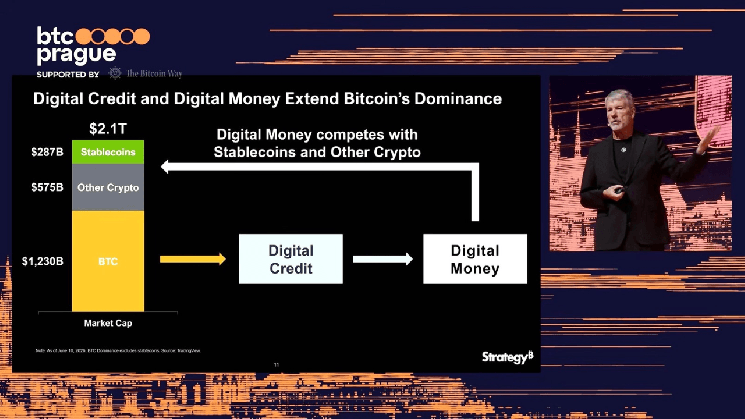
Aldasoro’s paper draws a sharp conceptual line between money and credit. Money, he argues, is a means of settlement that extinguishes an obligation when payment is due. Credit, by contrast, is a promise to pay money at some point in the future. Under that definition, Bitcoin struggles to qualify as money because it is neither issued by a central authority nor backed by a promise. Gold, Aldasoro suggests, has a similar problem, but it occupies a special place in the monetary imagination. He calls gold “not a monetary alternative, but a monetary protest” — a symbol of distrust rather than a working medium of exchange. Bitcoin, he writes, “shares this impulse and adds a technological veneer.” That critique extends to Bitcoin’s fixed supply, which Aldasoro describes as “unresponsive to any conceivable state of the world,” meaning the asset cannot adapt to changing economic conditions. He also points to the two countries that have tried to adopt Bitcoin as legal tender — El Salvador and the Central African Republic — and argues that both experiments have failed. For Saylor, however, Bitcoin’s fixed supply is precisely the point. He rejects the framing of Bitcoin as money altogether. In his view, Bitcoin is digital capital, a long-term store of value that can serve as the foundation for a new financial system. “Digital Capital is the foundation for Digital Equity and Digital Credit,” he said recently. That vision has led Saylor to propose what he calls “digital money”: a dollar-pegged, yield-bearing product built from Bitcoin-backed credit combined with fiat cash equivalents. In practice, this would allow users to make everyday payments with a stable digital instrument while Bitcoin itself remains the ultimate asset beneath it. As Saylor put it in June, “This is not a rejection of Bitcoin. It is a bridge from the fiat world to the Bitcoin world.” Strategy has already begun selling such credit products, including a yield-paying preferred stock known as STRC. Notably, that product is not collateralized by Strategy’s Bitcoin holdings, and its dividends are paid from the company’s own cash flows. Still, the direction is clear: use Bitcoin as an anchor, then build financial instruments on top of it.
Bitcoin’s Credit Superstructure
Despite their apparent disagreements, Aldasoro and Saylor actually describe a similar financial structure. Both envision a scarce, decentralized asset sitting at the bottom of a layered system, with credit instruments and settlement mechanisms built above it. Aldasoro writes about gold that “the settling is done in a credit superstructure, with the metal anchoring rather than circulating.” In other words, gold itself is not passed from hand to hand for everyday purchases; instead, banks, ledgers, and credit instruments circulate above it while gold remains the underlying store of value. Saylor applies exactly the same logic to Bitcoin. “Gold became more useful when banks, capital markets, credit instruments, and settlement systems developed around it,” he said in July. In Saylor’s model, Bitcoin is the anchor, and the credit superstructure — stablecoins, lending products, capital markets — is the layer that makes the system practical for daily use. There is also broad agreement on the role of the dollar. Both Aldasoro and Saylor acknowledge that fiat money, particularly the U.S. dollar, remains the standard unit of account for the global economy. Saylor has conceded that Bitcoin is “not yet the unit of account for most of the world.” That does not diminish Bitcoin’s importance in his eyes, but it does place Bitcoin in a supporting role rather than as an immediate replacement for the dollar. At the same time, both men warn about the risks of layered credit. “The inherent instability of credit” is a recurring theme in Aldasoro’s paper, and Saylor has made similar points about the dangers of excessive leverage in crypto markets. When people create claims on Bitcoin or gold — through loans, derivatives, or synthetic products — they often create more claims than there is actual Bitcoin or gold backing them. That mismatch can lead to cascading failures when asset prices fall. The architecture is already emerging, however. As TD Cowen analyst Lance Vitanza recently observed, the conversation is “moving beyond bitcoin ownership and toward the ecosystem being built around it.” That ecosystem includes custodians, lenders, borrowers, and a growing array of financial products designed to make Bitcoin productive rather than static.
Double Standards for Bitcoin and the Dollar
Saylor’s “capital, not currency” argument has drawn criticism from within the Bitcoin community, where many supporters insist that Bitcoin is everyday money and should be spent, not merely hoarded. But Aldasoro’s paper may be vulnerable to an even sharper critique: it appears to apply a double standard when comparing Bitcoin to fiat money. For example, Aldasoro writes that Bitcoin’s “value rests entirely on the expectation that others will value it.” Yet, under his own framework, all money is sustained by shared expectations. A dollar bill has value because people expect it will be accepted tomorrow, next month, and next year. The difference, Aldasoro argues, is that for fiat money this expectation is “grounded in institutions” such as central banks and governments. That institutional backing, he says, is what allows fiat currencies to command trust at scale. But the paper also acknowledges that money historically begins in the private sector and receives official recognition only later. That admission weakens the argument that Bitcoin’s failed legal tender experiments prove it can never function as money. If money’s origins are private and its official status comes last, then the failures of El Salvador and the Central African Republic may say more about the implementation than about Bitcoin’s fundamental nature. Aldasoro cites the Bitcoin white paper and concludes that “money without trust is a contradiction,” but he immediately concedes that Bitcoin removes “trust in an issuer rather than trust itself.” The white paper itself describes a system where payments can be made “without the need for a trusted third party,” which is not the same as saying no trust is involved at all. In practice, Bitcoin remains far more likely to be held as an asset than used as a means of payment, though its use as money is slowly growing. The credit layer built on crypto has also proven fragile. Celsius, BlockFi, and FTX all collapsed in 2022, and none of them had a government safety net behind them. Saylor, speaking at BTC Prague this year, acknowledged that some failed Bitcoin companies “probably had poor financial practices” and “maybe they were overleveraged.” That is a milder assessment than the one offered by many critics, but it acknowledges the risk without rejecting the foundation.
The Opposite Reasons for the Same Conclusion
Perhaps the most striking aspect of the Aldasoro-Saylor debate is that both men agree on Bitcoin’s current limitations, but they reach opposite conclusions about why those limitations exist. Saylor argues that Bitcoin should not be everyday money because it is simply too valuable to spend. In his view, using Bitcoin to buy a cup of coffee is like using a skyscraper to pay for a parking ticket — it may be possible in theory, but it makes no sense in practice. Aldasoro, by contrast, argues that Bitcoin cannot be everyday money because it is deficient. It is nobody’s IOU, its supply cannot be adjusted in response to economic shocks, and there is no lender of last resort standing behind it. For Aldasoro, credit is the way money actually works. Societies build trust through institutions that can step in during a crisis, and Bitcoin has no such institution. Saylor’s response is to build those institutions on top of Bitcoin rather than inside it. He spent much of 2025 describing ways to transform Bitcoin into a less volatile investment vehicle for a broader range of investors. “A 40% volatility asset is perfect for some investors and unsuitable for others. The answer is not to change Bitcoin. The answer is to build products above Bitcoin that match the needs of each pool of capital,” he argued in June. By October, he was pitching a Bitcoin-backed stablecoin that would pay up to 8% yield. The two men also disagree on what protects the system during a crisis. The BIS paper places its faith in public backstops: the central bank supplies liquidity when no one else will, deposit insurance protects savers, and government backing spreads risk across society. Saylor’s model relies on private capital instead. He describes Strategy’s shareholders as the “junior tranche” of the Bitcoin stack, meaning they absorb volatility first so that other investors can enjoy greater stability. There is no government guarantee in Saylor’s system, only the discipline of equity markets and the inherent value of the underlying asset. Aldasoro’s conclusion is blunt: “Bitcoin aspires to be money without the architecture that makes money work.” Saylor’s response is equally direct: build the architecture, then let the money come later.
What Will Bitcoin Be the Day After Tomorrow?
While the intellectuals debate, Bitcoin itself continues to evolve. Its technology is improving, second-layer solutions are expanding, and adoption is creeping into unexpected corners of the financial world. The argument between “money” and “capital” may eventually look like a distinction without a difference, especially if Bitcoin ends up functioning as the foundation for a credit system that issues its own forms of money. Both Aldasoro and Saylor are, in their own ways, describing a future in which Bitcoin is not passed from hand to hand for everyday purchases but instead sits at the base of a financial system built on top of it. The BIS economist sees that as a fatal flaw, a sign that Bitcoin cannot live up to its original promise. Saylor sees it as a natural evolution, a sign that Bitcoin is becoming more useful, not less. “The world does not need everyone to price coffee in sats tomorrow,” Saylor said in June, leaving the question of Bitcoin’s eventual role deliberately open. That open-endedness may be the most honest position of all. Bitcoin has survived regulatory crackdowns, exchange collapses, and market crashes. It has been called a bubble, a fraud, and a Ponzi scheme by some of the world’s most powerful financial figures. Yet it remains, with a market value that continues to attract institutional interest and a growing ecosystem of financial products designed to harness its unique properties. Whether it ultimately becomes money, digital capital, or something entirely different, the debate is no longer about whether Bitcoin matters. The question now is what, exactly, it will be when it grows up. And that answer may not be decided by economists, executives, or central bankers — but by the millions of users, builders, and investors who are already shaping the system from the ground up.