



Crypto Crackdown: Binance Severs Transfers With MEXC After FinCEN Sanctions Blitz
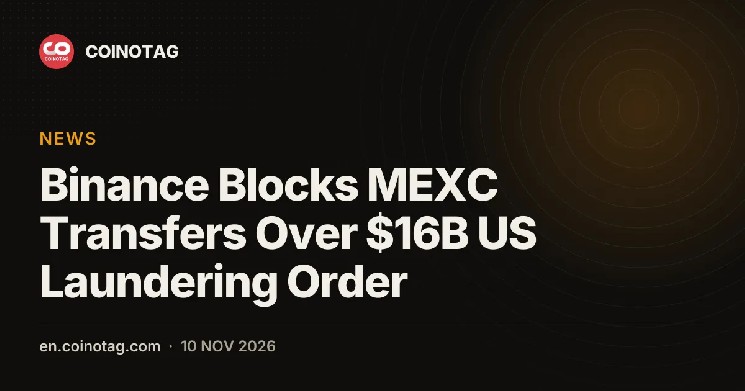
On November 10, Binance abruptly halted all transfers involving MEXC Global and its affiliated entities, a decisive compliance action that landed just four days after the U.S. Treasury’s Financial Crimes Enforcement Network moved to cut the offshore exchange off from the American financial system. The announcement came through a compliance notice posted on Binance’s support portal, where the exchange instructed customers in no uncertain terms: do not send or receive funds — directly or indirectly — through Binance in connection with MEXC or any of the related companies tied to the platform. The decision effectively shut down a major financial corridor between the world’s largest cryptocurrency exchange and one of the most scrutinized trading venues in the digital asset space. It also sent a loud signal to the broader crypto market that sanctions enforcement is no longer a peripheral concern, but a live operational risk that can reshape how exchanges interact with one another overnight.
The mechanics of the freeze are as significant as the announcement itself. Withdrawals from Binance wallets to any of the named entities are now automatically rejected, while deposits arriving from those same entities are being held in temporary limbo while compliance teams conduct their reviews. In a strikingly firm warning, Binance said customers whose incoming funds are flagged could face restrictions on their own accounts during the investigation. The exchange went further, stating that it may impose additional limits or terminate access to its services altogether under its terms of use. The scope of the restriction is broad, reaching across an expansive list of legal entities and affiliated business names, including MEXC Global Limited, MEXC Estonia OÜ, GIDA Technology AG, MXC Global Ltd, MEXC Global Foundation Ltd, MEXC Singapore Pte Ltd and MEXC (Comoros) Ltd, along with several other names and affiliates identified in the notice. Binance did not offer a specific timeline for how long the compliance reviews might take, nor did it set a separate schedule for the release of funds that remain frozen in review. For users caught in the middle, the message is clear: the exchange is prioritizing legal and regulatory risk over customer convenience, and it is willing to hold funds indefinitely in the name of compliance.
At the center of this escalation is FinCEN’s November 6 ruling designating MEXC as a primary money laundering concern under Section 9714 of the Combating Russian Money Laundering Act, a powerful provision designed to restrict foreign financial institutions that facilitate illicit Russian finance. The designation marks one of the most aggressive uses of that authority against a cryptocurrency exchange, and the Treasury Department’s accompanying press release painted a sobering picture. According to federal investigators, at least $16 billion flowed through MEXC between May 2021 and May 2026 in transactions tied to sanctions evasion, cybercrime, and other illegal activity connected to Russia, Iran, and North Korea. The Treasury also identified roughly $1 billion in direct transfers involving more than 40 Iranian cryptocurrency exchanges, some of which were already under sanctions, as well as $22 million linked to Iran’s central bank and the Islamic Revolutionary Guard Corps, including its Qods Force. The same assessment placed MEXC’s daily transaction volume above $1 billion, with reserves estimated at around $5 billion, underscoring the scale of an exchange that has long operated in the gray zones of global crypto finance. Those numbers, if accurate, would place MEXC among the most consequential offshore trading platforms in the world — and, according to U.S. authorities, among the most dangerous.
MEXC, unsurprisingly, rejected the allegations. In a statement released on November 7, the exchange said its trading services remained operational, its customers’ assets were secure, and it was reviewing the FinCEN findings alongside legal and compliance teams while conducting an independent examination of its anti-money laundering and sanctions controls. The company’s chief executive, Vugar Usi, later acknowledged elevated withdrawal volumes in the wake of the regulatory action but insisted that deposits and withdrawals were continuing normally. Yet not everyone in the industry is taking that reassurance at face value. Binance is by no means acting alone. Reports from crypto.news noted that OKX chief executive Star Xu warned users against transferring funds directly from MEXC, saying that deposits tied to affected platforms could be frozen and that users might face further investigation under enhanced compliance checks. That kind of public caution from a competing exchange is rare, and it underscores the degree to which the industry is collectively recalibrating its relationship with MEXC. At the same time, Binance was careful to clarify that its action does not amount to a global shutdown of MEXC’s services. The restrictions apply only to transfers routed through Binance involving the named entities, meaning MEXC can still operate through other channels. But the practical effect is still severe: cutting off the largest exchange in the world removes a major liquidity artery for MEXC users and creates an immediate trust deficit that will be difficult to repair.
Pressure on MEXC had been building long before FinCEN’s formal designation. In October, the exchange announced it would discontinue services for customers in Russia and Belarus, giving affected users individual instructions for closing positions and withdrawing assets, though no common deadline was set. That decision, which arrived without any specific regulatory order cited, was widely interpreted as a preemptive attempt to distance the platform from mounting scrutiny over Russian financial flows. In May, MEXC restricted selected futures trading pairs for users in Russia, Ukraine, Armenia, and Belarus, blocking new positions in affected contracts. And in July, the exchange made a visible effort to professionalize its compliance operations by appointing Robert MacDonald as chief compliance officer and entering into a partnership with LSEG Risk Intelligence to integrate World-Check screening tools into its platform. Those steps, while significant on paper, clearly were not enough to prevent the U.S. government from moving forward. FinCEN’s action takes effect 30 days after publication in the Federal Register, giving covered U.S. institutions a defined window to sever their own ties to MEXC. Banks, money services businesses, and other financial firms operating under U.S. jurisdiction will be expected to identify and block transactions associated with the exchange, and the ripple effects of that mandate are likely to be felt across the global crypto ecosystem for months.
For the broader digital asset market, the message is unmistakable. Sanctions enforcement is no longer an abstract legal concern confined to traditional banking; it is now a defining force in how cryptocurrency exchanges structure their relationships, manage liquidity, and treat their user base. The Binance-MEXC episode illustrates just how quickly a single regulatory finding can transform a functioning business corridor into a compliance minefield. It also highlights the increasingly precarious position of exchanges that operate with limited oversight or deliberately serve high-risk jurisdictions. In an environment where regulators are actively coordinating across borders, offshore platforms cannot assume that geographic distance will shield them from the long arm of the U.S. financial system. For users, the lesson is more immediate: funds held on an exchange can become inaccessible almost overnight, not because of hacking or market volatility, but because of geopolitical and regulatory shocks beyond their control. The coming weeks will reveal how MEXC navigates a landscape that has suddenly turned hostile, and whether its efforts to strengthen compliance infrastructure can withstand the weight of a U.S. designation. But one thing is already certain — the era of unchecked, lightly regulated crypto exchanges operating freely across borders is coming to an end, and Binance’s decision to sever ties with MEXC may be remembered as one of the defining turning points in that shift.