

Headline: Inflation Cools Slightly in October, but Hotter-Than-Expected CPI Keeps Fed on Track for December Rate Hike
Subheadline: Consumer prices rose 0.4% last month, above forecasts, while core inflation also topped expectations. Stocks slipped, Bitcoin fell, and Treasury yields jumped as traders weighed the possibility of a more aggressive Federal Reserve.
October’s inflation report offered a thin sliver of relief, but not nearly enough to change the Federal Reserve’s likely path. The Consumer Price Index rose 0.4% during the month, according to the Bureau of Labor Statistics, easing from September’s 0.6% jump but still coming in above the 0.3% increase that economists had forecast. More importantly, the latest reading keeps inflation well above the central bank’s 2% target, all but guaranteeing another rate hike when the Fed convenes for its final policy meeting of the year next month. For a central bank that has spent much of the past two years trying to wrestle price growth back under control, this report is a reminder that the job is far from finished. The deceleration from September’s elevated pace is welcome, but the underlying trend remains stubbornly hot, and the details of the report only reinforce that message. Investors, already bracing for a hawkish shift, took the data as confirmation that the era of easy money is firmly over. The only real debate now is not whether the Fed will raise rates in December, but by how much. The report arrives at a critical juncture, with households still feeling the sting of elevated prices and businesses wrestling with higher borrowing costs. Every component of the index is being scrutinized for clues about where inflation is headed next, and the latest numbers suggest that the central bank’s tightening campaign has not yet achieved its intended effect. Consumer demand remains resilient, supply chains have largely healed, but prices are still climbing at a pace that keeps the Fed’s foot firmly on the brake.
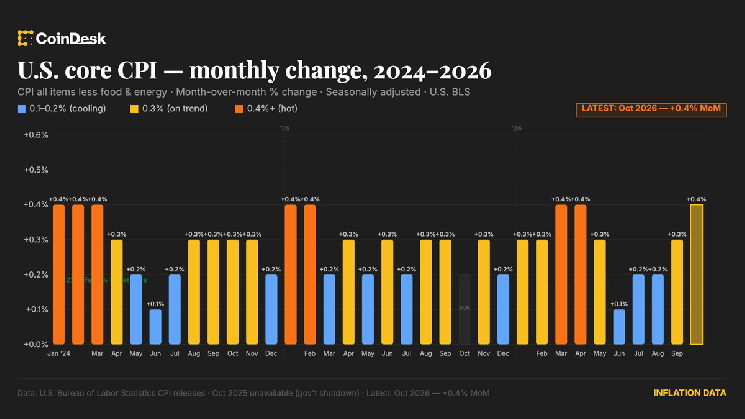
Beneath the headline, the data were even less reassuring. Core CPI, which excludes the often volatile food and energy categories, rose 0.3% in October, matching September’s increase and exceeding the 0.2% consensus forecast. That consistency is significant. It tells economists that price pressures are not merely a story of expensive oil or temporary food supply disruptions. Instead, inflation is embedded in a broader range of goods and services, and it is proving stubbornly resistant to the Fed’s tightening efforts. To put that in perspective, a sustained monthly core increase of 0.3% would translate to an annualized rate of roughly 3.7%, well above the Fed’s 2% target. The headline number, if sustained, would be even higher. The report also contained an unusual and consequential gap: the Bureau of Labor Statistics did not release a year-over-year CPI rate. The reason, according to the BLS, was that no October 2025 report existed, because of the government shutdown that was ongoing at the time. That means the standard annual comparison, the one most commonly used by policymakers and financial analysts to gauge long-term price trends, was simply unavailable. It is a frustrating development for economists who were already struggling to make sense of an unusually volatile inflation environment. Monthly readings are useful, but they can be noisy. Without the annual figure, it becomes much harder to determine whether October’s slowdown is the beginning of a sustained trend or just a temporary lull in an otherwise persistent upward drift. Core inflation is widely viewed as a more reliable signal of underlying price trends because it filters out the noise of energy price swings and food costs, which can change for reasons unrelated to broader economic demand. The fact that it is still running at 0.3% month after month, despite the Fed’s cumulative rate increases, is a warning sign that the battle against inflation is far from won.
Markets responded quickly, and not with relief. Bitcoin, which had already been under pressure, slipped another 1% to around $73,600, adding to what had already been a rough stretch for cryptocurrency investors. U.S. stock index futures also turned decisively lower. The Nasdaq 100 fell 1.15%, while the S&P 500 dropped 0.5%, reflecting the unease that has become all too familiar whenever inflation data lands on the hot side. The divergence between the two indexes was telling. The Nasdaq’s heavier concentration in technology and growth stocks makes it especially sensitive to rising interest rates, because the value of those companies depends so heavily on future earnings. When the Fed is expected to tighten, those future earnings get discounted more aggressively. The S&P 500’s more modest decline suggested that some sectors were still holding up, but the overall mood was clearly risk-off. Investors had been hoping that October’s data might give them reason to believe the Fed could soften its stance. Instead, they got a report that reinforced the opposite conclusion. The immediate reaction in futures trading was a classic reflex: sell risk assets, reduce exposure to high-duration stocks, and move into cash. The moves also underscored how fragile market sentiment has become. Any sign that inflation is not cooling quickly enough can trigger a rapid repricing of assets, and the latest session was no exception. With the Fed’s December meeting now just weeks away, volatility is likely to remain elevated, and the crypto market, which has become a barometer of risk appetite, is expected to stay under pressure as well.
The move in bond markets was even more pronounced, and it was driven in part by remarks from Federal Reserve Governor Chris Waller. Speaking overnight, Waller said the central bank should raise rates next month even if the CPI report turned out to be soft. He went further, suggesting that a strong reading might warrant a 50-basis-point increase—a much larger move than the quarter-point hike that markets had largely priced in. Those comments were enough to push Treasury yields higher before the data even arrived, and the CPI report only amplified the selling. The 10-year Treasury yield rose 6.5 basis points to 4.93%, bringing it closer to the psychologically significant 5% threshold. The 2-year yield, which is far more sensitive to expectations for the Fed’s near-term policy moves, jumped 14 basis points to 4.69%. That sharp divergence matters. It shows that traders are not primarily worried about long-term economic growth; they are worried about what the Fed is going to do at its December meeting. A basis point is one-hundredth of a percentage point, and a move of 14 basis points in a single session is a meaningful repricing. The futures market now reflects a small but real chance that the Fed could deliver a 50-basis-point hike, a scenario that would mark a significant escalation in its fight against inflation. Waller’s remarks were among the most explicit signals yet that the Fed is prepared to act aggressively if price pressures persist. For homeowners and corporate borrowers, the rise in yields translates directly into higher financing costs, adding another layer of pressure to an economy already grappling with elevated prices. The Treasury market, after all, is the primary channel through which monetary policy expectations are transmitted to the broader economy.
For the Federal Reserve, this report lands at an awkward and delicate moment. On one hand, October’s inflation rate was lower than September’s, which provides some evidence that price pressures may finally be peaking. On the other hand, both the headline and core readings came in above forecasts, and the core rate has now held at 0.3% for two consecutive months. That is not the kind of sustained, convincing disinflation the Fed has said it needs to see before it can ease up. The missing year-over-year figure only compounds the problem, leaving policymakers with an incomplete picture at a critical juncture. The Fed is now widely expected to raise rates again at its December meeting, and Waller’s comments suggest that even a weaker report would not have changed that. The only real question is whether the Fed moves by a quarter point or a half point. For households, the stakes are high. Persistent inflation continues to eat into purchasing power, while rising Treasury yields are pushing borrowing costs higher for mortgages, auto loans, and credit cards. For businesses, the prospect of higher-for-longer rates means tighter financial conditions and a more challenging environment for investment. For investors, the message is clear: the path back to 2% inflation is going to be longer and bumpier than many had hoped. The Fed, meanwhile, is walking a tightrope. Move too aggressively and risk tipping the economy into recession; move too slowly and risk allowing inflation to become deeply entrenched. It is a delicate balancing act, and every new piece of economic data carries outsized weight. The lack of annual CPI data only makes it more difficult for businesses to plan pricing decisions and for workers to negotiate wages with confidence.
Looking ahead, the final weeks of the year will be shaped by more economic data and more signals from Fed officials. Employment reports, consumer spending figures, and other inflation measures will all factor into the central bank’s decision. But October’s CPI report has already made one thing unmistakably clear: inflation is moderating, but it is not moderating fast enough. The Federal Reserve’s 2% target remains a distant goal, and the battle to get there is far from over. Waller’s overnight remarks underscored just how determined the central bank’s hawks are to avoid repeating the mistakes of the past, when inflation was allowed to become entrenched. The stronger-than-expected CPI report gives them more ammunition. For markets, that means continued volatility is likely. Stocks, bonds, and digital assets will remain sensitive to every headline, every data point, and every comment from a Fed official. Bitcoin’s slide and the sell-off in equity futures were just the first reactions. More could be on the way. The December Fed meeting is now one of the most consequential in recent memory, and the decision will reverberate far beyond Wall Street. Until then, investors, businesses, and everyday consumers are left to watch the numbers, brace for another rate hike, and hope that the inflation storm finally begins to break. The data may have cooled slightly, but the pressure is as hot as ever.