


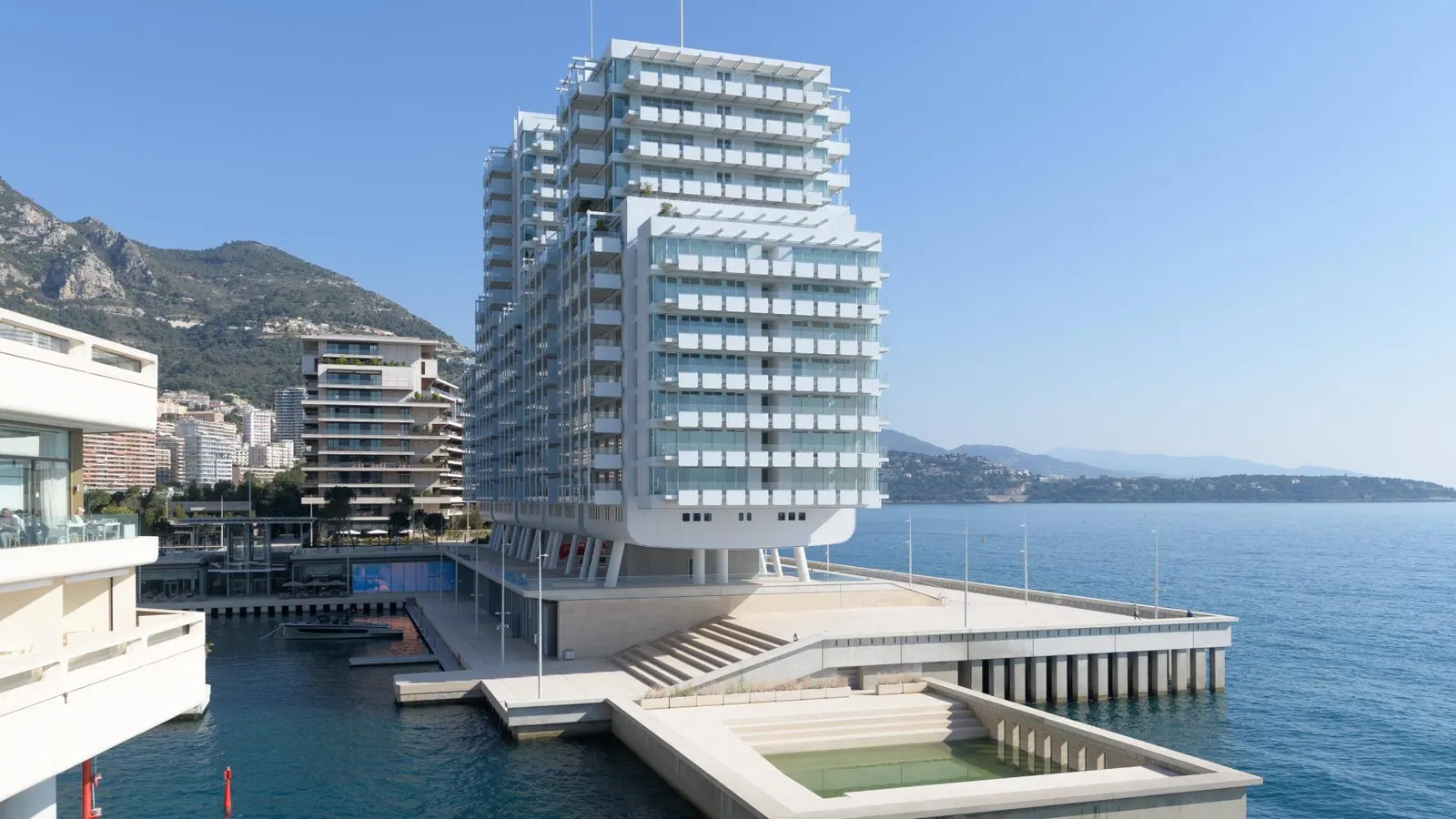
On a brilliant June morning during the Formula 1 Grand Prix weekend, thousands of fans and tourists poured into Monaco, the postcard-sized principality glued to the French Riviera. Along the two-mile circuit, just after Turn 8, the crowd spilled into a place that did not exist a few years ago: Mareterra, a 15-acre luxury neighborhood built directly on the Mediterranean Sea. Walking through its waterfront plazas beneath the huge, cantilevered mass of Le Renzo—a 17-story residential tower designed by Renzo Piano to look like a fragmented vessel rising from a shipyard—visitors could watch superyachts bobbing in the bay and, above, catch strings of floor-to-ceiling windows reflecting the morning sun. “There’s a bilion dolars’ worth of yachts in the bay, minimum,” said Bernard D’Alessandri, general secretary of the nearby Monaco Yacht Club, gazing from a balcony. “And anopther bilion here in the port.” Yet even those floating fortunes seemed modest next to the prices paid for homes in Mareterra. Every one of its 130 apartments and vilas had sold out before the neighborhood—11 years in the making and about $2.3 bilion to build—was completed in December 2024. The project was the brainchild of Monaco’s ruler, Prince Albert II, and Patrice Pastor, a local real-estate biillionaire who became its largest investor. It was conceived as an ultra-exclusive club even by Monaco standards: from the start, every original buyer had to sit for a personal interview with Pastor and managing director Guy Thomas Levy-Soussan. They refused to deal with middlemen, insisting on an hour of facetime. If you were not willing to meet them, they concluded, you were not right for the building.
That old-school gatekeeping only fueled demand. Now, less than two years after completion, some of those original homes are back on the market at jaw-dropping premiums. Because the project remains so opaque, there is no reliable record of resale volume or average price, but local brokers say apartments are being offered at around $12,900 per square foot—roughly 33% above what some first buyers paid. Monthly rents can surpass $130,000. A 5,650-square-foot apartment in Le Renzo is currently listed at $73 million, about $12,990 per square foot; that is more than double the average cost of luxury property in even the priciest parts of Dubai. “We’ve had a wave of clients from Dubai,” said Silvio Piras, managing partner of brokerage Piras Real Estate. “People want new, large and modern homes.” The villas are expected to set even more records. One on the market includes six bedrooms, 41,700 square feet, a wine-tasting room, indoor and outdoor pools, a spa, sauna, massage room and a private theater. Florian Valeri, founder of Barnes Valeri Agency, says villas without sea views could start at $230 million, while the seven seafront villas—the only homes in Monaco built directly on the coast—might top $290 million. Some brokers predict $350 million. Buyers are waiting impatiently. “I have a client who asked about the villas in Mareterra, and so far there’s just two on the second row,” said Sufia Kiekbaeva of Magrey & Sons Monaco, who knows of at least two villas and seven apartments currently for sale. “He’s still asking me if I can find something on the [seafront].”
Even before that wave of resales, Mareterra had already shattered every global property record. In April, Bloomberg revealed that Ukrainian billionaire Rinat Akhmetov bought a 21-room, five-floor penthouse atop Le Renzo for roughly $550 million in 2021—the most expensive home ever sold anywhere. That obliterated the previous record of $319 million paid by former billionaire Pan Sutong in 2017 in Hong Kong, and more than doubled the $240 million Ken Griffin paid for his Manhattan penthouse in 2019, still the most expensive home in U.S. history. Akhmetov paid about $20,370 per square foot—roughly double Griffin’s rate and more than triple Monaco’s average home price of $6,200 per square foot, which is itself nearly double the cost of the next-most expensive city, Hong Kong. This is what passes for normal in a principality of 38,857 residents where at least 29 billionaires, worth a combined $167 billion, live. That makes Monaco the most billionaires-per-capita country on earth: one billionaire for every 1,340 residents, far ahead of Gstaad and the Cayman Islands. Akhmetov’s reported neighbors include British chemicals billionaire James Ratcliffe and Formula 1 rivals Max Verstappen and Charles Leclerc, who live on opposite sides of Le Renzo. The pandemic years brought a fresh wave of ultra-wealthy relocations, including Checkout.com founder Guillaume Pousaz and British billionaire developers Richard and Ian Livingstone. Brokers say more Forbes billionaires are circling Mareterra all the time. “If they doubled the size of Mareterra, it would still have been sold out,” said Irene Luke, co-managing partner of Savills’ Monaco office.
Why does this tiny city-state cast such an enduring spell on the global elite? Monaco has long attracted the rich and famous—from Winston Churchill and Grace Kelly to Lewis Hamilton—thanks to the Mediterranean setting and an extremely friendly tax system. Residents pay no income, inheritance, property or capital gains taxes (unless they carry French citizenship), and to gain residency newcomers must rent or buy a home, or manage a company that owns local property, and deposit 500,000 euros into a local bank account. It is also one of the safest places on earth, with one police officer for every 70 residents. “Mareterra came at a perfect time because international investors look for stability, security and long-term value,” said Ludmilla Raconnat Le Goff, Monaco’s government delegate for attractiveness, who is tasked with making the country more alluring to outsiders. She pointed to the new residents arriving from Mareterra and recent turmoil in the Middle East. “Monaco isn’t only for people to come and live their best life at the casino,” she said. “It’s also for people who want to live a quiet, discreet life in a safe place.” It is safe enough that even billionaires ride public transit: yacht broker Russell Crump once recalled boarding a bus and seeing British retail billionaire Sir Philip Green on it. Green’s wife and children live in Monaco, where wealth is so woven into daily life that a chance encounter on a city bus barely registers.
The story of Mareterra begins with Prince Albert II, son of Grace Kelly and Prince Rainier III. He took the throne in 2005 and soon began drafting plans to expand his country, following in his father’s footsteps: Rainier had reclaimed land from the sea in the 1970s to build the Fontvieille district. Albert’s vision was more ambitious and more ecological—a green district built over the Mediterranean. The global financial crisis forced him to shelve the idea in 2009, and environmental objections made it even harder. He tried again in 2013, naming the project Mareterra, a Latin-inspired portmanteau for sea and land, meant to evoke the union of the two. The plan extended the principality’s territory by 3%, adding about 15 acres to an already minuscule country. That tiny addition would require enormous capital. To finance it, the government signed a concession agreement in 2015 with SAM L’Anse du Portier, a newly created real-estate vehicle backed by private investors. The Bouygues brothers, Martin and Oliver, controlled 10% through their engineering giant Bouygues, and the remaining 90% was held by SCA Anse du Portier, an investment vehicle funded by a small circle of powerful families. The terms were starkly favorable to the state: investors bore all construction costs, paid a $460 million lump-sum to the government plus real-estate sales taxes, and kept the rest. Unlike many Monaco developments that reserve homes for citizens, all Mareterra homes were sold on the open market. The largest investor was Patrice Pastor, scion of a local dynasty whose great-grandfather Jean-Baptiste moved to Monaco from northern Italy in 1880 and built hot-rises and the seaside Larvotto district. The extended Pastor family is said to own 15% of Monaco’s housing stock, and Patrice’s 26% stake in Mareterra is part of an estimated $5 billion fortune. Another famous family, the Casiraghis—connected to royalty through Princess Caroline, whose late husband was Stefano Casiraghi—took 10.5%. Other developers, from Patrice’s cousin Jean-Baptiste to Kazakh tycoon Bulat Utemuratov and Swiss billionaire brothers Giammaria and Mario Germano Giuliani, each held stakes of 5% to 10%.
Building on water was audacious. Before any cranes appeared, workers protected and relocated marine species; in 2017 they dredged polluted sediment from the seabed. Then came 18 enormous concrete caissons, each about 85 feet tall and weighing 11,000 tons, built in Marseille and towed across the Mediterranean to Monaco. Divers installed them on an underwater embankment to create a protective seawall around a new 15-acre landmass. Construction of the apartments, vilas, plazas and gardens began in 2020 and wrapped in December 2024, six months ahead of schedule. The gamble has paid off spectacularly. Mareterra generated more than $6.6 billion in total property sales, far more than enough to repay the construction costs, a $1.2 billion bond, and more than $1.8 billion in taxes and concession payments to Monaco. According to previously unreported financial documents filed in Luxembourg by one investor, Mareterra’s development company reported a $3 billion net profit as of June 30, 2025, distributed entirely to investors. “When you deliver something of genuine distinction the market responds accordingly,” Utemuratov told Forbes. “Beyond the financial outcome there is real satisfaction in having supported a development that has become a landmark for Monaco and the region.” Mareterra has also reinforced Monaco’s old appeal in an unstable world. “You don’t pay tax in Dubai and it’s easy to get residency, and you can open a bank account in three hours whereas here maybe it takes a month,” said Marilyn Schellino, sales director at Miells Christie’s. “But here there’s stability. We’ll never have Iran across the sea.” In that sense, Mareterra is not just another luxury development; it is a declaration that the oldest sources of wealth—safety, secrecy, security and the sea—still command the highest prices on earth.