





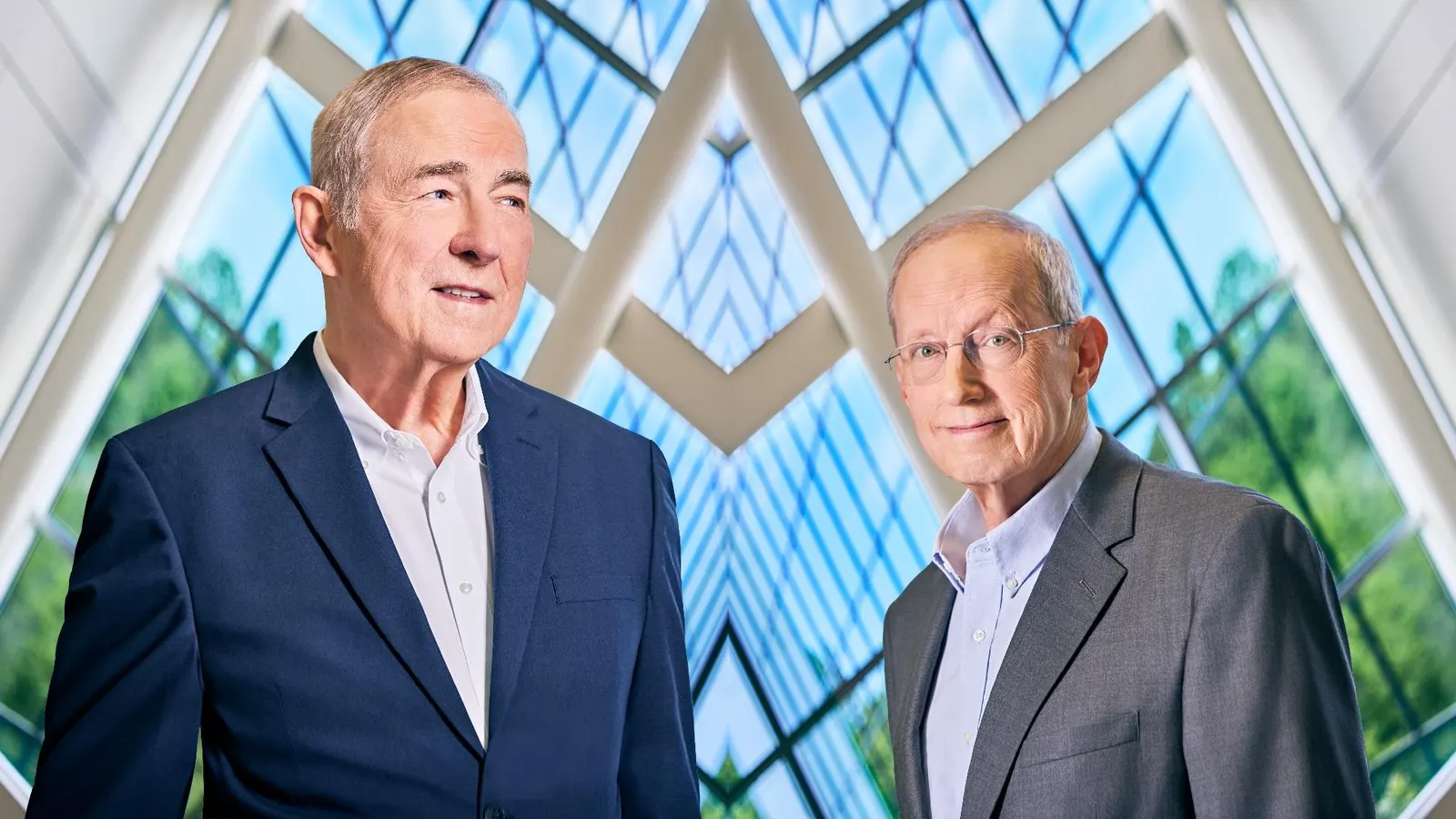
Clad in a simple white shirt, Jim Goodnight, the billionaire cofounder and chief executive officer of global analytics giant SAS, eases into a leather rolling chair within a Cary, North Carolina, conference room that feels far more like a personal geology exhibit than a corporate executive suite. Displayed behind him is a dazzling, carefully curated testament to geological history: shimmering purple amethysts, a heavy clump of metallic pyrite, a jagged meteorite, and a fossilized dinosaur egg—a sixty-nine-million-year-old Hadrosaurus relic recovered from the wind-swept expanses of the Gobi Desert. With a dry, quiet deadpan, Goodnight gestures toward the space rock, remarking that it is certainly not something you would ever want to get hit in the head by. At eighty-three years old, guarding a company celebrating its fiftieth anniversary, Goodnight is a living monument to a patient, methodical era of computing, standing in stark contrast to the modern, hyper-accelerated tech landscape where cash-burning artificial intelligence companies shake the financial world. Like the ancient treasures on his office shelves, both SAS and its founder are sometimes dismissed by hasty tech disruptors as mere legacy software. Yet, SAS specializes in a timeless, highly complex discipline: analyzing immense, real-time data troves to help major organizations make smarter operational decisions. Goodnight, a statistics pioneer who mapped out the very nature of analytics decades before “AI” became an all-encompassing marketing buzzword, refuses to let his life’s work be categorized as stagnant. He points out that SAS has not been gathering dust; rather, its teams have systematically refined, optimized, and upgraded this mathematical engine daily for half a century, proving that mechanical endurance is a product of continuous evolution rather than stubborn stagnation.
Beneath the quiet surface of SAS’s daily operations lies a financial fortress that would stagger most public corporations. Generating just over $3 billion in highly consistent annual revenue, the firm runs vital data operations for the vast majority of the Fortune 100, including ninety percent of financial services giants, every major health and life sciences corporation, and nearly every sovereign government department on earth. What makes this scale truly anomalous in today’s volatile tech ecosystem is that SAS has remained entirely private, consistently profitable, and completely debt-free since its inception. Yet, the current generative AI boom is stress-testing this historic posture, as venture-backed newcomers like OpenAI and Anthropic pitch a future demanding a total break from traditional data infrastructures, while cloud infrastructure giants like Microsoft and Amazon aggressively bundle analytics into massive enterprise cloud contracts. This external pressure converges with a vital internal transition: the inevitable passing of the corporate torch. Goodnight has openly acknowledged that preparing the company for its next chapter, possibly through an initial public offering, will require him to step aside, noting with characteristic self-awareness that public markets demand a fresh face rather than an “old fart” like him trying to sell stock. Consequently, he has spent recent years stepping back from intense daily operations to train and evaluate chief technology officer Bryan Harris and chief operating officer Gavin Day, preparing them to inherit his multi-billion-dollar legacy and guide its transformation in the AI era.
To understand the human, deeply grounded culture of SAS, one must look closely at its spectacular 300-acre headquarters in Cary. Walking through this lush, tree-lined campus feels less like navigating a tech hub and more like exploring a peaceful academic sanctuary. The property boasts its own on-site healthcare facilities and pharmacy, private subsidized childcare, soccer fields where employees play at lunch, a five-star hotel, and docile sheep grazing on manicured lawns underneath massive banks of company-owned solar panels. This idyllic environment reflects the company’s academic origins as the Statistical Analysis System, born out of North Carolina State University in the late 1960s. It was there that Goodnight, a young statistics PhD faculty member, teamed up with Tony Barr, John Sall, and Jane Helwig to build software to analyze agricultural data. When it drew outside clients, they incorporated the institute in 1976. The company grew entirely bootstrapped; Sall fondly recalls early “book brigades” where everyone, including the founders, lined up to unload shipments of physical manuals into an employee’s basement. When sales calls slowed, Goodnight—drawing on the work ethic of his father’s hardware store—split potential clients alphabetically, forcing the co-founders to do direct marketing themselves. This practical focus on organic growth and profitability allowed SAS to flourish without venture capital, while building a legendary employee-first culture—complete with free weekly M&Ms and on-site doctors—designed to eliminate turnover and construct a shared, loyal community.
This reverence for cost-efficiency and practical utility directly shapes how Goodnight views the speculative AI landscape. A telling example of his grounded engineering philosophy occurred when CTO Bryan Harris enthusiastically presented a computer vision tool designed to analyze video feeds from poultry farms to track the spread of avian illnesses. Goodnight listened patiently before asking a single, devastatingly practical question: how much would the physical cameras cost the farmers, and would they ever realistically agree to pay for them? Finding that the math didn’t make practical sense for the end-user, Goodnight immediately killed the project—a sharp contrast to the Silicon Valley playbook where companies spend billions building technologies before discovering if a sustainable market exists. In Goodnight’s eyes, a massive portion of current AI innovation represents wasted capital, and he defines large language models not as magic, but as sophisticated statistical engines predicting the next most probable word in a sentence. While venture-backed AI competitive firms boast of multiplying revenues while burning through investor cash, SAS quietly adheres to a steady growth rate, refusing to compromise profitability for briefly lived market hype. Goodnight believes the industry’s frantic pace needs to slow to align with actual business utility, though SAS is not ignoring the future; the company recently announced a massive $1 billion investment to integrate machine learning within its products. Rather than panicking to catch up, SAS relies on its deepest competitive advantage: five decades of absolute trust in high-stakes fields like banking, medicine, and intelligence, where mistakes are unacceptable.
To defend this valuable domain territory from an onslaught of aggressive modern competitors—ranging from public cloud hyperscalers to specialized data-mining platforms like Palantir, which has aggressively captured massive U.S. government contracts—SAS has adopted a highly strategic posture of “coopetition.” Recognizing that modern enterprise clients demand maximum flexibility, executive Bryan Harris has ensured that SAS products are uniquely malleable, allowing customers to run critical data analyses on-premise, across any public cloud infrastructure, and in whatever programming language they prefer. This absolute fluidity is highly comforting to risk-averse institutions like central banks and state healthcare systems that must navigate strict regulatory environments and sensitive data sovereignty laws. At the same time, SAS is pushing the envelope of engineering innovation by pioneering advanced applied programs, such as industrial “digital twins”—highly precise, AI-powered virtual replicas of physical manufacturing plants developed in partnership with Epic Games. Using this technology, major manufacturers like Georgia Pacific can simulate complex industrial workflows, train autonomous robotics, and predict potential machinery failures in a completely safe, virtual reality environment before implementing changes on the live factory floor. Furthermore, the company is quietly integrating quantum computing architectures to handle ultra-complex transaction analysis, helping retail banks instantly spot sophisticated financial fraud schemes. While some industry analysts caution that SAS’s historic willingness to tackle any technical problem can occasionally dilute its corporate focus, this boundless problem-solving drive has also birthed highly successful collaborations, such as their partnership with Liverpool Football Club to revolutionize statistical sports marketing and fan engagement.
Ultimately, the delicate balancing act between rapid modern innovation and strict preservation of legacy converges on the quiet effort to prepare SAS for an initial public offering. For Goodnight and his long-time cofounder John Sall—who collectively hold multi-billion-dollar stakes in the company—the primary motivation for pursuing an IPO is deeply personal and paternal, aimed at creating a smooth, structured path to liquidate some of their equity for their children, who have chosen not to take over the day-to-day operations of the family business. Rather than selling the firm off in pieces to private equity firms or allowing it to be devoured by a competitor, a public listing represents the cleanest way to preserve the soul, campus, and culture of SAS, though the path to the stock exchange is heavily guarded by strict financial realities. To launch a highly successful offering in a discerning public market, chief financial officer Matt Parson is working diligently to guide the company toward the coveted “Rule of 40″—a standard SaaS metric requiring a company’s combined growth rate and profit margin to equal forty percent—a benchmark that SAS possesses at around twenty percent today. Because of this, Parson is keeping strategic options open, quietly preparing the company for alternative outcomes, such as securing a strategic minority investment or entertaining a massive, protective acquisition from a partner that aligns with SAS’s core cultural architecture, similar to how they handled Broadcom’s $15 billion offer in 2021 before Goodnight decided to walk away. Yet, as he sits quietly in his office, sipping a warm cup of black coffee in front of an authentic piece of the Berlin Wall that he personally helped dismantle years ago, Jim Goodnight remains as beautifully risk-averse, dry, and fiercely independent as he was when he founded the company in 1976. Knowing that his creation has survived decades of tech hype cycles, the legendary founder is ready to let his creation step into the future, dryly wishing to fade quietly from the limelight while leaving behind a timeless architectural legacy.