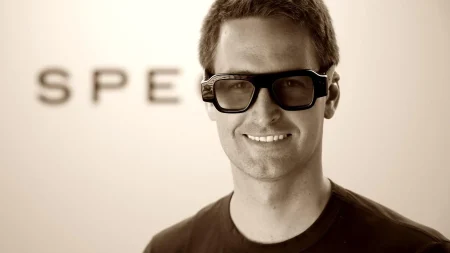








Alex Bouzari is a striking anomaly in the homogenous world of high technology, where the standard uniform consists of drab khakis, corporate fleece vests, and grey hoodies. At 65 years old, the French-Iranian émigré approaches fashion with the theatrical flair of a Regency-era aristocrat mixed with a touch of Willy Wonka-esque extravagance. He rejects off-the-rack clothing entirely, choosing instead to design his own wardrobe, which features sharp, custom-tailored suits, dramatic popped collars, and exotic crocodile-skin shoes. His living spaces are no less expressive of this flamboyant, maximalist philosophy. His primary European residence, a majestic 19th-century apartment on a tree-lined avenue radiating outward from the Arc de Triomphe in Paris, is filled with custom-designed elements. From the swirling patterns of the marbled carpets to the vibrant, lime-green sofas and even the personalized porcelain tableware, almost everything is born from Bouzari’s vivid imagination and executed by a trusted network of specialized artisans who translate his handwritten sketches into physical reality. While Bouzari views this as a vital creative outlet, his lifestyle and sartorial choices frequently draw bewildered reactions. His long-time business partner, the conservative Paul Bloch, admitted he begged Bouzari to tone down his outfits decades ago, while Nvidia’s formidable CEO, Jensen Huang, bluntly characterized his wardrobe as entirely “inappropriate.” Even everyday Parisians occasionally stop their cars in the middle of the street to shout playful historical jeers, asking him if he somehow managed to survive the French Revolution. Unfazed, Bouzari divides his time between this Parisian sanctuary and an Art Deco-infused residence in Las Vegas, seamlessly blending his technological pursuits with an intense appreciation for life’s sensory pleasures. He finds peace strolling through the fifty-nine manicured acres of Paris’s historic Parc de Bagatelle to admire the wild peacocks, indulging in decadent snail soufflés at Le Récamier, attending private baroque opera performances at the Royal Opera of Versailles, or purchasing mammoth, eighteen-inch custom croissants from pastry master Philippe Conticini. For Bouzari, aesthetics and technology are not separate worlds; they are parallel expressions of a singular passion for meticulous design.
Yet, for all his eccentricities and flamboyant personal tastes, Bouzari’s crowning achievement remains a business built on raw mathematical precision and engineering prowess: DataDirect Networks (DDN). Founded in 1998 in Chatsworth, California, DDN was built to solve one of the most critical, yet frequently ignored, problems in the computing world—the severe bottleneck that occurs when processing units outpace their storage systems. In the late 1990s, as the world’s most advanced research laboratories began deploying supercomputers capable of executing calculations at blinding, unprecedented speeds, they quickly encountered a frustrating hardware limitation. While the computer chips themselves could process billions of calculations per second, the physical hard drives storing the necessary data simply could not feed information to the processors fast enough. This imbalance meant that multi-million-dollar supercomputers were frequently left idling, starved of data and unable to operate at full capacity. Recognizing this vulnerability, Bouzari and Bloch pioneered a highly sophisticated approach. Rather than relying on standard hardware improvements, they engineered ultra-fast storage arrays and coupled them with proprietary software designed to intelligently dissect massive datasets. This software split enormous files into thousands of smaller fragments, distributing and retrieving them simultaneously across thousands of physical drives. Bouzari famously visualizes this technology as an open, multi-lane superhighway, ensuring that lanes remain perfectly packed with cars moving at maximum speed without ever encountering a traffic jam or bottleneck. For nearly twenty years, the co-founders quietly and systematically grew DDN into a highly stable, highly profitable, and largely bootstrapped operation generating roughly $300 million in annual revenue. Because their technology was designed for such extreme computational demands, their market was incredibly specialized, catering to a small, elite group of fewer than a thousand scientific research facilities, government weather laboratories, and defense agencies worldwide.
The trajectory of this comfortable, niche business was permanently altered in 2016 when the global semiconductor giant Nvidia began interconnecting its graphics processing units (GPUs) to build massive, specialized clusters optimized for running the complex, parallel computations required for artificial intelligence. Almost immediately, Nvidia’s engineering team encountered the exact same physical bottleneck that had plagued traditional supercomputer users for decades. During initial test runs of their advanced AI systems, the sheer volume of data overloaded the infrastructure, causing the storage systems to fail completely under the strain. Seeking an urgent resolution, Nvidia’s vice president Marc Hamilton brought in DDN to diagnose and address the issue. The integration was a resounding success, establishing a deep-seated partnership that positioned DDN at the absolute center of the impending artificial intelligence gold rush. As generative AI evolved from a speculative laboratory project into an economic powerhouse, the demand for DDN’s specialized infrastructure skyrocketed. The company’s annual revenue rose to $400 million in 2024, climbed to $500 million in 2025, and is currently projected to double to a staggering $1 billion by 2026, driven by massive infrastructure contracts with national governments and elite AI labs, including Elon Musk’s xAI. This exponential growth reflects a broader, industry-wide frenzy where memory-related stocks have experienced historic gains; SanDisk’s stock surged by over 3,000% within a twelve-month window, and Micron saw its quarterly revenue quadruple to more than $41 billion. Within this hyper-competitive landscape, Bouzari’s core value proposition has become irresistible to corporate executives. With modern Nvidia AI servers costing upwards of $500,000 each, companies are horrified to discover that their incredibly expensive hardware often sits idle up to two-thirds of the time due to data delivery delays. DDN’s software acts as a productivity engine, eliminating this costly downtime and ensuring that these massive computational investments remain highly profitable and continuously active.
This remarkable financial performance and strategic relevance quickly caught the attention of major global investors, culminating in a monumental transaction in January 2025 when the private equity giant Blackstone acquired a $300 million minority stake in DDN, valuing the business at a historic $5 billion. This investment provided a massive financial windfall for Bouzari and Bloch, whose equal 40% stakes in the company were officially valued at $2 billion each, firmly cementing their status as billionaires. Yet, for the co-founders, the true value of the Blackstone partnership extended far beyond personal wealth or corporate capital. It granted DDN direct, preferred access to Blackstone’s vast global network of enterprise clients and its unparalleled $325 billion portfolio of data center assets, providing an invaluable pipeline for future growth. However, this massive valuation has also drawn intense competition from a variety of ambitious rivals looking to claim a share of the highly lucrative AI storage market. While legacy enterprise storage providers such as Dell, NetApp, and Everpure were relatively slow to adapt their product offerings to the unique, high-bandwidth demands of artificial intelligence workloads, dynamic new startups began moving aggressively. DDN’s most formidable challenger is Vast Data, a New York-based software disrupter that achieved an eye-popping $30 billion valuation following a major $1 billion funding round. Vast Data has successfully captured significant market share by selling specialized storage software to major AI infrastructure providers like CoreWeave and prominent European artificial intelligence startups including Nebius and Mistral, transforming the storage industry into a high-stakes battleground where agility and software innovation dictate dominance.
Navigating this high-velocity landscape and transforming a mature, twenty-eight-year-old hardware company into an agile, software-first enterprise required overcoming substantial internal and external challenges. For decades, DDN had operated under a traditional product model, bundling its proprietary storage software exclusively with its physical hardware chassis. However, as the industry matured and customers began expressing a strong preference for purchasing their own standardized hard drives, DDN faced a critical decision. In 2023, the company officially pivoted, offering its sophisticated storage software as a standalone product. The financial implications of this shift were profound: while traditional hardware sales yielded respectable gross margins of roughly 60%, standalone software sales generated astronomical gross margins exceeding 90%. Blackstone’s senior managing director John Watson described this evolution as a classic case of a highly successful business undergoing a productive “late-20s puberty,” marveling at how Bouzari and Bloch, despite their established wealth and experience, retain the fierce competitive drive of hungry twenty-something founders. This relentless resilience is deeply rooted in the co-founders’ shared history. After graduating from the prestigious California Institute of Technology (Caltech) in 1984, where they were among the very few French-speaking engineering students on the Pasadena campus, Bouzari and Bloch teamed up to build Mega Drive Systems, scaling it to a $30 million enterprise by 1998. When they transitioned to DDN, they accepted a $10 million venture capital investment in 2001, which quickly devolved into a crisis as the post-9/11 economic downturn prompted panicked investors to demand a fire sale of the company. Refusing to capitulate, Bouzari and Bloch chose to fight back, cutting operational costs, convincing their loyal staff to defer their salaries for weeks, and eventually buying out the hostile investors entirely in 2002 to reclaim absolute control of their destiny.
Having successfully bought back their independence, the co-founders spent the next two decades meticulously expanding their enterprise without relying on a single dollar of external capital. By 2008, DDN’s annual revenues had climbed to $100 million, doubling to $220 million by 2018. This sustained profitability gave Bouzari the freedom to pursue highly ambitious, often eccentric personal ventures, including an intense, highly complex effort to purchase a specialized Norwegian shipyard dedicated to building “explorer class” maritime vessels—a venture he ultimately abandoned due to the immense logistical challenges of global shipbuilding. Rather than retreating, Bouzari redirected his creative vision and engineering ambitions toward a far more massive industrial project: the construction of a monumental 1.3-gigawatt data center in Wheeler, Texas. With estimated construction costs projected to reach $60 billion, this colossus of digital infrastructure is designed to operate on a scale comparable to the largest data centers operated by Meta, consuming enough electrical power to support approximately one million average homes. While Bouzari continues to finalize the complex financing structures required for this Texan megaproject, the endeavor represents the perfect culmination of his unique philosophy. Unlike his residential design projects, which focus on baroque aesthetics and whimsical visual flourishes, this industrial giant is engineered strictly for hyper-efficiency, speed, and massive scale. It serves as a testament to a life lived entirely on his own terms: a journey that bridges the refined, artistic salons of historic Paris with the raw, high-stakes power grids of the American tech frontier, proving that true innovators do not need to wear the uniform of their industry to fundamentally shape its future.