



Paragraph 1: The Long-Awaited Arrival of a Dream
It feels like we have been waiting for this moment since the dawn of the modern internet. Cast your mind back to 2013, when a slightly giddy Jeff Bezos sat down with Charlie Rose and casually unveiled what looked like a toy helicopter, promising that one day, a package of paper towels or a Kindle would land on your porch in thirty minutes or less. For over a decade, that promise has lived in the realm of sleek concept videos, regulatory paperwork, and million-dollar test flights in rural Texas that produced more press releases than actual household deliveries. We were told the future was coming, and we collectively rolled our eyes, assuming it would be perpetually “next year.” Yet, yesterday, Amazon finally dropped the bombshell that makes the future feel aggressively present: Prime Air, their autonomous drone delivery network, is expanding to nearly 500 cities and towns across the United States by the end of this calendar year. This isn’t a gentle expansion; it’s a seismic sixfold leap from the handful of markets where they currently operate. For millions of Americans, the dream of watching a small, quiet aircraft navigate suburban power lines and alight upon their driveway is no longer a science fiction trope—it is rapidly becoming a mundane reality. This isn’t just about Amazon catching up to its own marketing; it’s about the decade of failed test runs, the skepticism of locals, and the sheer physics of the “last mile” conundrum finally cracking under the weight of relentless engineering.
Paragraph 2: The Competitive Swarm and the Race for the Skies
While Amazon has been notoriously slow to bring this dream to scale, it would be a grave mistake to view this announcement in a vacuum. The drone delivery space has transformed from a lonely frontier into a frenzied, competitive free-for-all, and Bezos is arguably arriving to the party a little fashionably late. Look at Alphabet’s Wing—a company that has quietly, methodically perfected the art of the tethered drop. Wing has already surpassed the million-delivery milestone and is aggressively piggybacking on the juggernaut that is Walmart’s retail ecosystem, expanding to nearly 20 U.S. markets where you can order a pack of AA batteries or a tube of toothpaste and have a drone lower it gently from the sky. And Walmart itself isn’t just a passive observer; they hit their own million-delivery mark back in May, boasting an average delivery time of 23 minutes between click and drop, with their fastest recorded flight clocking in at a blistering 4 minutes and 44 seconds—likely faster than it takes you to walk to the kitchen and grab a snack. Then there’s Zipline, the global dark horse, which has utterly dominated the medical and logistics sector with over 2 million commercial deliveries across four continents, recently securing over $600 million in funding and rocketing to a valuation of $7.6 billion. Even Uber is wading into the fray, partnering with delivery startups to ambitiously target a mind-boggling 1 million drone deliveries per day by 2029. In this chaotic swarm, Amazon’s announcement of 500 cities suddenly feels less like a pioneering glory run and more like a necessary defensive maneuver—a giant finally waking up to realize the little birds have already stolen the worms.
Paragraph 3: The Nuts and Bolts of Amazon’s New Reality
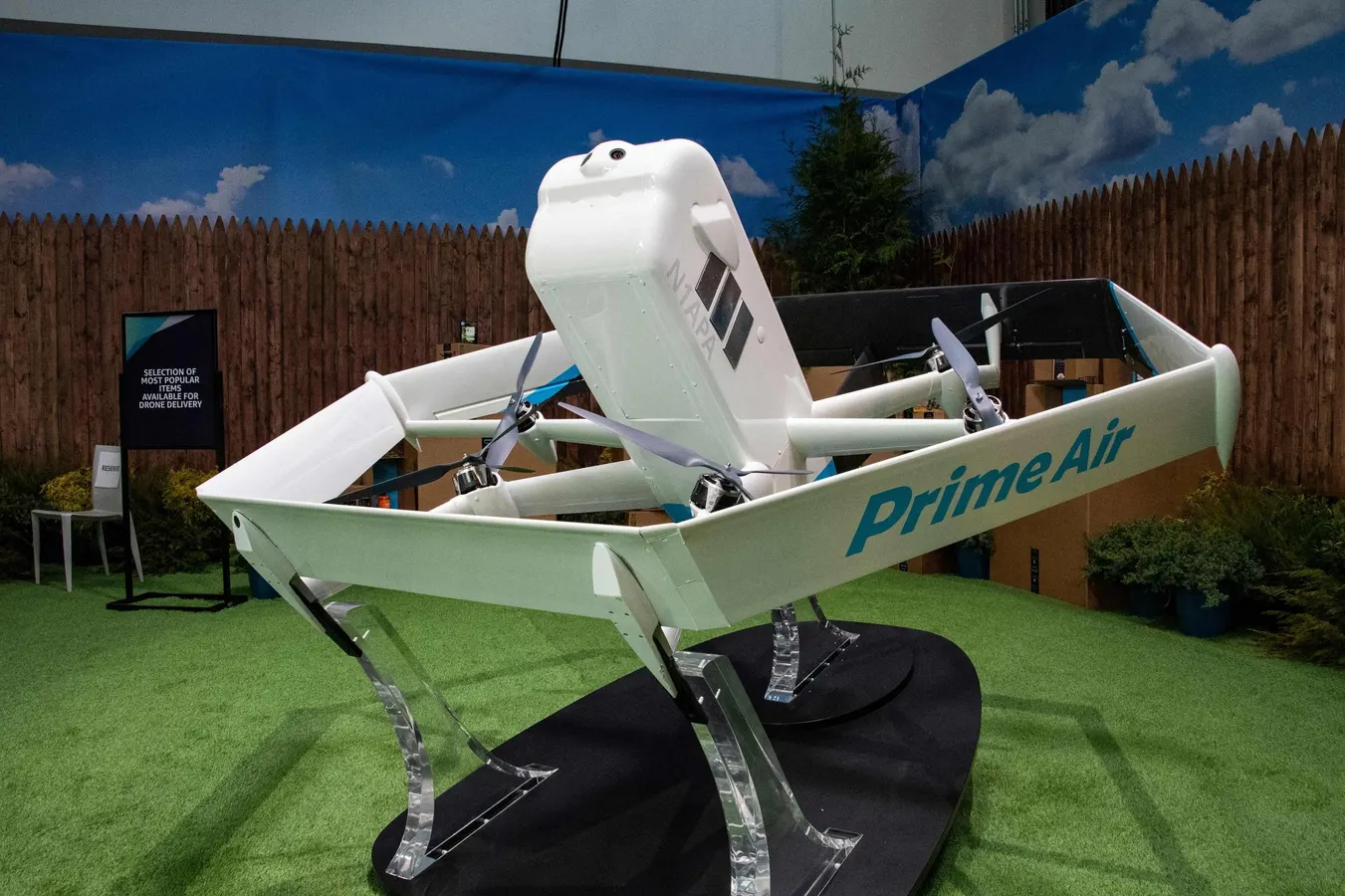
So, what does this massive expansion actually look like on the ground—or rather, in the sky? Amazon’s current footprint has primarily been concentrated around College Station, Texas, and a few select regions in California, totaling roughly 80 to 90 zip codes. That will change dramatically as the MK30 drones—their latest hybrid-electric marvel—fan out across 11 new metropolitan areas, including major hubs like Chicago, Atlanta, Cleveland, and Boise, plus suburbs around Syracuse and several other key points on the map. The specs of the MK30 are the perfect encapsulation of the consumer-centric limits of this technology. These drones can carry packages weighing up to five pounds—which, statistically, covers the vast majority of items Amazon sells daily, from a ream of printer paper to a bottle of vitamins, a phone charger, or that emergency tub of ice cream you refuse to drive for. They operate within a roughly 7.5-mile radius of the local fulfillment center. The average delivery takes just under an hour, though Amazon insiders boast that many packages are dropped off in mere minutes. This rush of activity aligns perfectly with the internal philosophy of Dave Carbon, the vice president of Prime Air, who recently told his team in an internal meeting that customers’ appetite for speed remains insatiable. His exact words, captured on a recording obtained by CNBC, were that “we have yet to reach diminishing returns when it comes to how fast we deliver to our customers.” In the high-stakes world of e-commerce, where a two-day shipping prime subscription is now considered glacial, the drone is the ultimate expression of the “instant gratification” era—a tiny robotic messenger designed to bridge the gap between the online shopping cart and your front door in the time it takes to finish a podcast.
Paragraph 4: The Regulatory Dance and the Scars of Imperfection
Of course, an expansion of this magnitude doesn’t happen simply because Amazon wants it to; it requires the overt blessing of the Federal Aviation Administration. In 2024, Amazon achieved the holy grail of drone logistics: FAA approval for Beyond Visual Line of Sight (BVLOS) operations. This is the critical regulatory shift that allows operators to fly drones without keeping them constantly in eye-shot, relying instead on sophisticated onboard sensors and “detect-and-avoid” systems to navigate around birds, trees, and rogue weather. It’s the difference between a hobbyist flying a model plane and a legitimate aviation operator. However, as with any pioneering technology pushing the envelope of physics and bureaucracy, the road has been littered with embarrassing bumps and alarming crashes. In a reported incident in Tolleson, Arizona, two separate Amazon drones collided with a tall construction crane—a scenario that immediately triggered investigations by both the National Transportation Safety Board and the FAA. Similarly, an incident in Waco, Texas, involved a drone that struck an underground internet cable upon takeoff or landing, severing connectivity for local residents. These are precisely the kind of “human scale” failures that ground fleets and raise public anxiety. They serve as stark reminders that while the software is brilliant, the physical world is messy—cables sag, cranes appear in airspaces they didn’t occupy yesterday, and morning winds can gust capriciously. Navigating these real-world hazards is the true barrier to entry, and every crash is a painful lesson that shapes the next firmware update or flight protocol, ensuring that the 500-city expansion in the coming year is carried out with the wisdom born of trial, error, and a few spectacular drone wrecks.
Paragraph 5: The Human Pushback and the Art of the Gentle Drop
But the most significant hurdle isn’t the FAA or the weather; it’s the people living below the flight paths. As Amazon parachutes into these suburban and semi-urban neighborhoods, they are facing a predictable yet formidable wave of community opposition. Residents have legitimate grievances that range from the niche to the existential. There’s the constant, irksome buzzing that intrudes upon backyard serenity on a Sunday afternoon—imagine a swarm of angry lawnmowers hovering over your petunias. Then there’s the privacy concern: why is a mechanical eyeball hovering outside my kitchen window? Combined with anxieties about property values and the sneaking suspicion that your HOA hasn’t ratified these aerial trespassers, the backlash is mounting. Furthermore, Amazon’s current delivery mechanism is not exactly as graceful as their promotional videos suggest. In many current operations, the MK30 will fly to a designated spot, hover at a height of roughly thirteen feet, and drop the package the remaining distance, relying on the cardboard packaging to absorb the shock. While this works fine for a box of granola bars, it’s a disaster for a carton of eggs or a glass bottle of juice. Amazon, however, is listening. They are currently testing a retractable tether system—a robotic winch that lowers the package gently to the ground, eliminating the dreaded final “thud.” This is where their competitors have already leapfrogged them; Wing has been using tethers since day one. Amazon’s pivot toward this softer-touch approach signals a maturity in their strategy. They are realizing that to win over skeptical suburbanites, they must not only perfect the speed but respect the fragile nature of both the cargo and the fragile egos of the humans waving fists at the sky. It’s a dance between high-tech efficiency and charmingly old-school manners.
Paragraph 6: The Boring Future That Bezos Finally Reached
As we look at the year ahead, we can finally strip the “science fiction” label off of drone delivery. Jeff Bezos’ 2013 vision is about to become a ubiquitous utility, as ordinary as the postal service or the UPS truck. Yet, there is a delicious irony in how this future has unfolded. It did not arrive because of a single magnificent leap from Amazon; it was dragged into existence by a combination of scrappy startups, hungry retail giants like Walmart, and the sheer grinding necessity of e-commerce logistics. Drone delivery was not realized in the boardrooms of Seattle alone, but through a decade of regulatory pressure, thousands of test flights, and even a few crash investigations. The coming months will be awkward—there will be more tangled cables, more irate neighbor posts on Nextdoor, and definitely more dogs chasing shadows. But eventually, the novelty will wear off. A resident of Chicago will order a lost phone charger at 3 PM, hear the faint hum above their roof at 3:27 PM, and simply walk outside to grab it without looking up. The future is never a flashy, singular event; it’s the quiet moment when the extraordinary becomes routine. Amazon’s expansion into 500 cities is the definitive threshold where this technology stops being a “futuristic side project” and starts being an invisible, comfortable part of our daily infrastructure. So, keep an eye on the sky, but don’t expect to gasp when the package arrives—because by the end of 2024, the drone overhead will be as boring and reliable as the morning newspaper, fulfilling that decade-old promise of convenience with a soft, whirring sigh.