

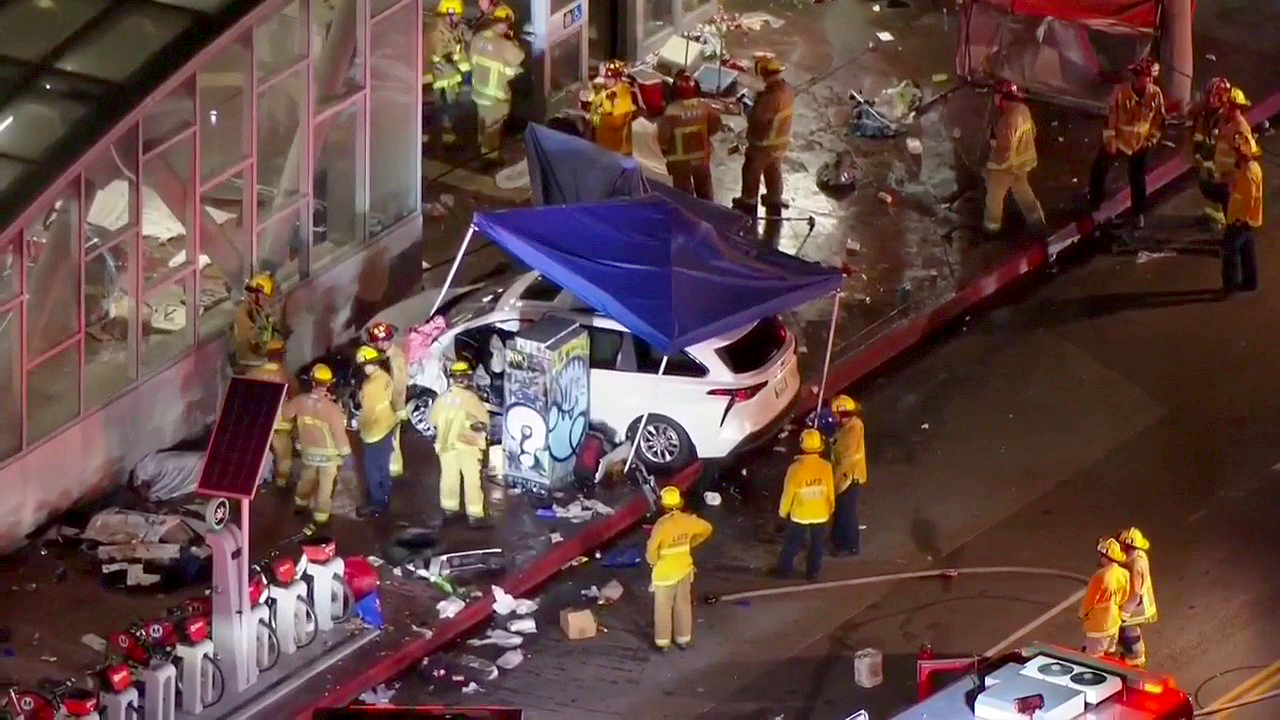
On a warm Tuesday evening, the intersection of Lankershim and Chandler boulevards in North Hollywood should have been just another stop along a busy, working-class corridor. Commuters, students, and neighbors were making their way home, some pausing at a food stand that was likely a familiar beacon of flavor, comfort, and community. Perhaps there was the smell of grilled meat and onions drifting through the air, the cheerful conversation of a vendor handing over a foil-wrapped meal, the tired laughter of someone finally off work and thinking only of dinner. But shortly before six o’clock, a moment of ordinary life turned into tragedy. Authorities say a white SUV careened off the road and slammed into the food stand, killing three people and injuring several others. The crash happened at the corner near a Metro bus stop, transforming a bustling sidewalk into a scene of emergency lights, broken glass, and heartbreak. Pedestrians who had been waiting for a bus, buying a quick meal, or simply walking past were caught in the path of an unthinkable catastrophe. The startling, gruesome event left the neighborhood shaken and served as a sober reminder that public safety can be shattered in seconds. First responders arrived to find victims lying in the street, some beyond help, others in desperate need of medical attention. The immediate response was urgent, but for the families who lost loved ones, the wait for answers is just beginning, and for the witnesses, the memory of that loud, crushing impact will not disappear easily.
The collision was reported at approximately 5:55 p.m., according to the Los Angeles Fire Department. Crews rushed to the scene at the intersection in the San Fernando Valley, close to the North Hollywood Metro station. The initial alert stated that one vehicle was involved with pedestrians, and the outcome was catastrophic. By the time firefighters and paramedics arrived, three individuals were already dead, their lives ended before emergency workers could intervene. Paramedics transported at least three more people to area hospitals in critical condition, leaving doctors to fight for their lives through the night. The driver of the white SUV, described by police as a man in his sixties, was also hospitalized in critical condition. After he was stabilized, authorities began conducting a careful evaluation, including assessments by LAPD drug recognition experts, to determine whether alcohol or drugs played a role in the crash. This type of investigation is routine in serious collisions, but it takes on a particular urgency when lives have been lost and the public demands accountability. While the cause remains unknown, the picture that emerged was one of a vehicle striking at least five pedestrians, with the force of impact sending people to the ground and scattering debris across the pavement. The intersection, usually filled with the sounds of buses and traffic, became a temporary crime scene, closed off by yellow police tape and guarded by officers while investigators measured skid marks, photographed the vehicle, and gathered evidence that might explain how such a tragedy happened in a matter of seconds.
To truly understand this loss, one must picture the lives that intersect at that corner, because the victims were not nameless statistics. North Hollywood is a vibrant and diverse neighborhood, home to artists, service workers, immigrants, and longtime families. The food stand, which may have sold tacos, elotes, hot dogs, or other street favorites, was not just a place to eat; it was a community anchor, a place where conversations sparked between bites, where a vendor remembered your order, where workers on a break could find a familiar face and a brief moment of comfort. At the time of the crash, people were likely doing everyday things: waiting for a bus after a long shift, picking up dinner on the way home, talking to a friend across the sidewalk, or simply trying to get through another Tuesday. Then, without warning, a speeding vehicle overwhelmed the small space between the road and the stand. Three people lost their lives in an instant. Their names are not yet known to the public, but their absence will be felt by spouses, children, coworkers, and friends who will now have to grasp at memories that were, until yesterday, still part of a shared future. There are also the injured, clinging to life in a hospital, surrounded by worried family members and medical staff who understand that some wounds will never fully heal. And there is the vendor, the person who poured time and effort into that stand, whose livelihood and workspace have been destroyed in a horrifying way. The emotional ripple of the event is enormous, especially for those who witnessed it. First responders, too, carry the weight of this kind of violence; the images they encounter are not easily forgotten, and the calls they will replay in their minds long after their shifts end. In the aftermath, neighbors gathered in small clusters, talking in hushed tones, holding their hands over their mouths, trying to process the fact that a familiar place was now a site of communal grief, a place where three families will forever experience a before and after.
In the moments following the crash, the city began to respond with anguish and sorrow. Mayor Karen Bass took to social media to express her distress. “I’m heartbroken for the families of everyone impacted,” she wrote in a statement posted to X, the platform formerly known as Twitter. “We will continue to provide updates as more information becomes available.” Her words echoed the sentiments of many Angelenos, who have grown weary of the repeated tragedies on the city’s streets and who know that behind every alert and every statement is a human story that will never be the same. Los Angeles Police Department Chief Jim McDonnell also spoke to reporters at the scene, promising a thorough and meticulous investigation. “It’ll be a prolonged but a very deliberate investigation to determine what happened here,” McDonnell said. “Our hearts go out to the families of the victims that were struck here tonight.” The language of officials may seem familiar, too familiar, repeated at every traffic tragedy, yet for the people who lost loved ones, these words offer little comfort. What they want are answers. What happened at that intersection? Why were people standing at a bus stop killed? Could this have been prevented? The LAPD will now examine the driver’s history, medical condition, and any possible signs of impairment. They will analyze the vehicle’s speed, road conditions, and witness accounts. They will look at whether a medical emergency preceded the crash or whether the driver simply lost control. The investigation will likely take weeks, but the grief at the scene is immediate and visceral. Local leaders may call for enhanced safety measures, such as better barriers, more lighting, or stricter enforcement of traffic laws, but no measure can restore what was lost, and no press conference can silence the sound of the families who are now waiting for the worst kind of news.
This tragedy is not an isolated incident, and it must be understood within a broader national crisis. Across Los Angeles and the United States, pedestrians are being injured and killed at alarming rates, often by vehicles that leave the roadway or by drivers under the influence of alcohol or drugs. In recent months, similar stories have appeared in headlines: a suspected drunk driver killing pedestrians on Manhattan’s Upper West Side, an impaired driver plowing into a restaurant table and costing a California mother both legs. These are not just statistics. They are families shattered, communities scarred, and lives torn apart by decisions made in seconds. The intersection of Lankershim and Chandler, which likely had its own rhythm of signals and crosswalks, may now be scrutinized for design flaws. Traffic engineers often speak of “forgiving roads” and “safe systems” that account for human error, but those systems sometimes fail, especially when a vehicle is traveling too fast or a driver is impaired. There is also the question of what kind of help was available to the driver before the crash. Was this a medical emergency, a sudden loss of consciousness, or a case of reckless behavior? The drug recognition experts will investigate, but the general public is left to ponder the vulnerability of everyone who walks, bikes, or simply stands on a sidewalk. For those who use public transit, a bus stop can be a space of waiting and transition, often exposed to traffic with no protection other than a curb and a few feet of concrete. The tragedy calls urgent attention to the need for infrastructure that prioritizes people over speed, because a food stand, a bus bench, and a crosswalk should never become sites of death.
As the sun rises over North Hollywood, the food stand is gone, the intersection remains closed, and the city mourns. For the loved ones of the victims, the pain will not fade with the news cycle. They will have to plan funerals, learn to navigate a world without their loved ones, and endure the slow grinding of an investigation that may never offer full closure. But in the face of this tragedy, there is also the hope of community solidarity. Neighbors will hold vigils, families will receive support, and the collective demand for safer streets will grow louder. The city must not look away. Every person who takes a bus, crosses a street, or buys a meal from a food stand deserves to return home safely. The memory of those killed on Tuesday night should be honored not only in words, but in action: safer roads, accountable drivers, and a commitment to protecting the most vulnerable among us. The investigation will determine legal responsibility, but the emotional and ethical responsibility is shared by all. We cannot bring back the dead, but we can make sure their deaths are not forgotten. In the grief and anger of this moment, there is a call to change the conditions that allowed this tragedy to happen. That is the least we owe to the three people who died simply because they were in the way of a white SUV near a Metro stop, and to the injured, and to the families who will spend the rest of their lives missing the ones they lost.