



Imagine a quiet stretch of eastern England, where the low hum of aircraft has long been part of the landscape. That hum grew louder and more urgent this week as the United States Air Force made a sudden, dramatic decision to move more than a dozen planes from RAF Mildenhall. The move wasn’t a routine training exercise or a scheduled deployment. It was a response to what American officials described as an emerging security threat—one that intelligence sources linked to Iran. For the families living on base, for the airmen and women who service these massive machines, and for the British towns that have hosted them for decades, this was a moment of raw reminder that even in a peaceful corner of the world, danger can feel very close. U.S. officials confirmed Tuesday that commanders had made the call to reposition aircraft as a precaution after assessing the nature and urgency of the threat. The Wall Street Journal first reported that the threat originated in Iran, and within hours, the base had been placed under Force Protection Condition Charlie—the military’s second-highest alert level, used when there is a credible likelihood of a terrorist attack against personnel or facilities. In plain terms, it means the threat is real, specific, and serious enough that normal routines are suspended and security becomes the single overriding concern.
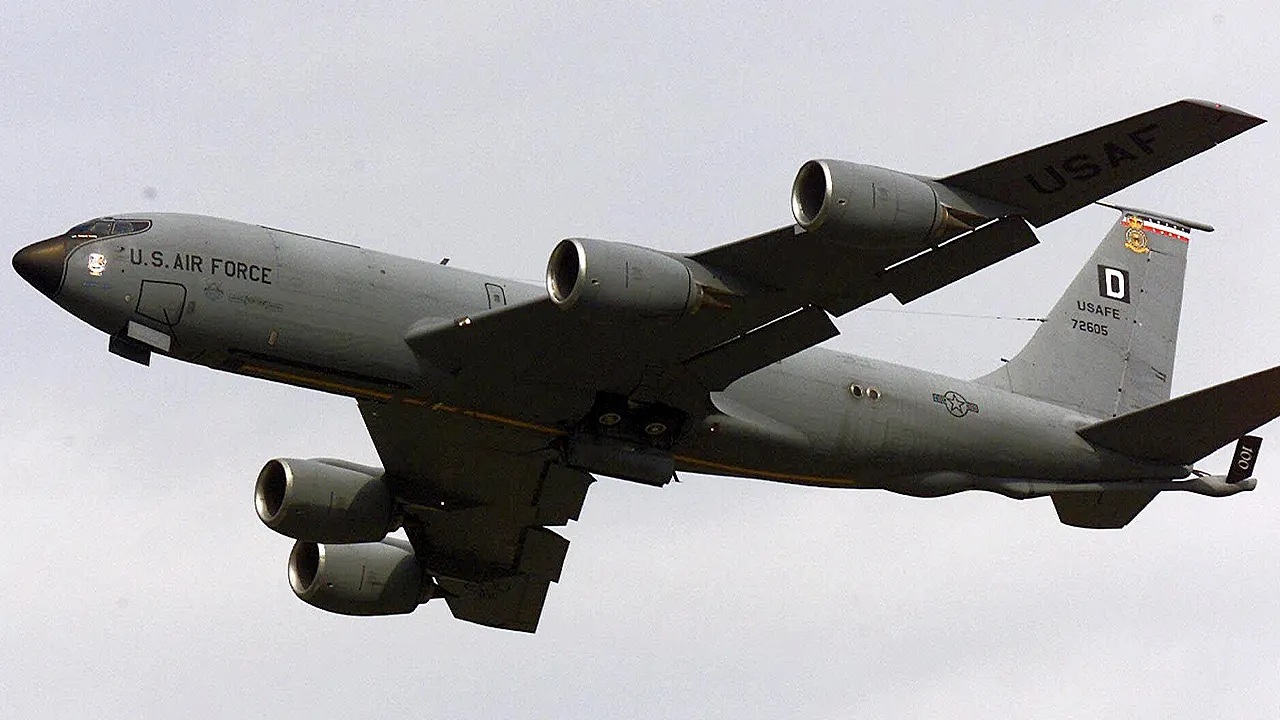
Flight-tracking data quickly painted a picture of an operation unfolding with precision and speed. Open-source analysts with the Military Air Tracking Alliance, as reported by the Associated Press, identified thirteen aircraft leaving RAF Mildenhall late Monday. Nine Boeing KC-135 Stratotankers—the workhorses of aerial refueling—were sent to airfields in Scotland, Germany, and Spain. Three CV-22B Ospreys, the tilt-rotor aircraft that can take off like a helicopter and fly like a plane, were relocated to nearby RAF Lakenheath, a base known for its hardened aircraft shelters designed to protect planes from attack. A U.S. official told the AP that the movements were precautionary, noting that some of the aircraft were on rotational deployments while others were permanently stationed in the United Kingdom. The distinction matters because it speaks to a broader truth: the military’s posture can shift in moments, but the people and the mission stay constant. For those watching from the outside, the sight of tankers lifting off into the night sky was a visual reminder that security is never something you can take for granted. It is something you prepare for, rehearse for, and sometimes act on abruptly, even when it disrupts lives and operations. The base remained operational, but the mood among those who depend on it was understandably tense. When the military raises alert levels and moves assets, it sends a signal that those in charge believe something could happen, and that they would rather be criticized for overreacting than face the alternative.
This latest move did not happen in a vacuum. It comes amid growing U.S. concern about Iranian efforts to target Americans abroad. A U.S. intelligence memo had reportedly warned that Iran has “substantially increased” efforts to target Americans overseas, and recent events seemed to give that warning weight. Iranian-backed operatives have been accused of plotting attacks across Europe, and the shadow of those plots has fallen directly over American military installations in Britain. The threat is not abstract. It involves people with homes, children, and daily routines—people who chose to serve their country and were stationed in a place that felt safe, far from active conflict zones. For them, the sudden relocation of aircraft was a reminder that the threat landscape is broader than battlefields in the Middle East or contested waters in Asia. It includes quiet bases in the English countryside, where the most dramatic event on a typical day might be a delayed flight or a change in the weather. When commanders elevate the alert level to FPCON Charlie, it means every entry point is scrutinized, every vehicle is checked, every unfamiliar face is questioned. It means members of the military community are told to vary their routes, stay vigilant, and report anything odd. It is exhausting, and it is necessary. The threat from Iran, according to officials, is not just about military capabilities—it is about a persistent, adaptive effort to find vulnerabilities and exploit them, often through proxies and operatives who move quietly through civilian life.
This is not the first time in recent memory that American aircraft have been pulled from a British base due to a security scare. Less than two months before the Mildenhall evacuation, the Air Force moved heavy bombers from RAF Fairford in Gloucestershire after British counterterrorism police stopped three suspicious vans headed toward the base on September 27. The incident sent shockwaves through the community. Three vans, apparently part of a plot to harm the base, were intercepted before they could reach their destination. Two men have since been charged under the United Kingdom’s National Security Act, a powerful piece of legislation designed to address threats that fall outside ordinary criminal law. Then, in a coordinated legal move, the Justice Department unsealed indictments against three Iranian-backed operatives accused of involvement in terror plots across Europe, including the plot targeting RAF Fairford. The pattern is unmistakable: the threat to U.S. military personnel in Britain is not hypothetical. It has names, faces, and plans that law enforcement and intelligence agencies have worked intensely to disrupt. For the American service members stationed at these bases, the news was both alarming and validating—alarming because it confirmed that people were actively trying to harm them, and validating because it showed that the vigilance of security forces and the sharing of intelligence between the U.S. and U.K. were preventing tragedies before they happened. The September episode had already forced a hardening of defenses around RAF Fairford, and the new developments only reinforced the sense that these installations are not just logistical hubs but potential targets. The charges and arrests were victories, but they were also warnings that the threat is persistent and evolving.
RAF Mildenhall itself holds a special place in the American military presence in Europe. It is home to the 100th Air Refueling Wing, the only permanently based U.S. tanker wing on the continent. Its KC-135 Stratotankers are essential to allied air operations, providing the fuel that allows fighter jets, bombers, and surveillance aircraft to stay airborne longer, strike farther, and respond quickly to crises. Without these tankers, many missions would be impossible. That makes Mildenhall a high-value target, and helps explain why the Air Force did not hesitate to move its aircraft when a credible threat emerged. The decision to disperse the tankers across Scotland, Germany, and Spain was not random; it was a tactical calculation to ensure that a single attack could not cripple the entire refueling capability. It also reflected the reality that aircraft can be moved, crews can be relocated, and missions can continue even under threat. Secretary of State Marco Rubio addressed the situation Tuesday, offering a calm and measured response. “We are constantly repositioning forces around the world for a variety of reasons,” he told reporters when asked about the evacuation. His words were chosen carefully—neither confirming nor denying details, but making clear that this is part of the normal rhythm of great power competition and security management. Meanwhile, a spokesperson for 10 Downing Street said that British air bases remain secure and that London and Washington continuously share intelligence on potential threats. That commitment to partnership matters, especially in moments like this, when the public is looking for reassurance. The message from both governments was clear: they are taking the threat seriously, they are working together, and they will not let fear dictate their operations.
For the people who live and work near RAF Mildenhall, the evacuation of aircraft was more than a news story. It was a disruption to the familiar hum of engines that sometimes feels like a heartbeat in the community. It was a reminder that the runway lights, the security gates, and the uniformed men and women moving through town are all part of something larger—something that carries risk and responsibility every single day. The base has been part of the local fabric for decades, and the relationship between American personnel and British residents has grown into a bond of shared routines, local pubs, schools, and friendships. But there is also an unspoken awareness that these bases are not just symbols of alliance; they are operational assets in a world that remains dangerous. The relocation of those thirteen aircraft is a snapshot of that reality. The threat from Iran, as outlined by intelligence officials, involves not just missiles or drones but plots that unfold in quiet streets, near ordinary-looking vans, and around bases that have become accustomed to life on the edge of conflict. The actions taken in recent weeks—the arrests, the indictments, the raised alert levels, and the movement of aircraft—are not overreactions. They are prudent steps by people who understand that the cost of being caught off guard is immeasurable. As the tankers settle into their temporary hangars in Scotland, Germany, and Spain, and the Ospreys sit protected behind hardened shelters at Lakenheath, the situation may seem to have stabilized. But the underlying threat remains, and so does the vigilance. The next few weeks will likely bring more questions, more intelligence briefings, and more adjustments. But the people tasked with protecting these forces and their host communities can take some comfort in knowing that the warning signs were recognized, the response was swift, and the alliance between the United States and the United Kingdom remains as strong as ever. In an uncertain world, that is no small thing.