


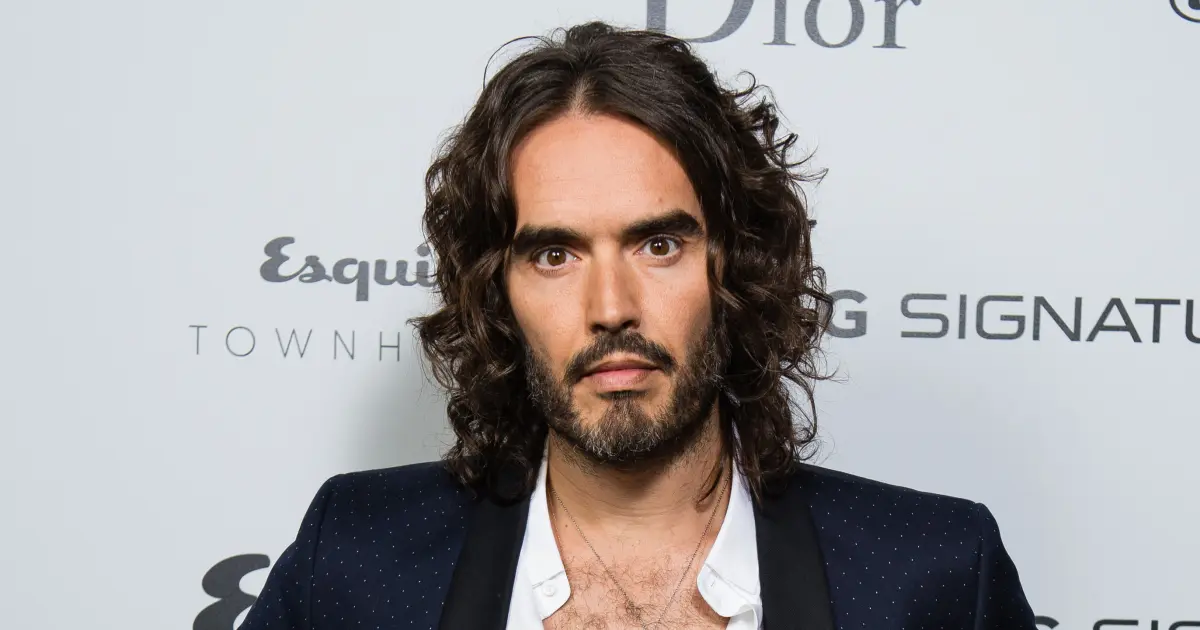
Russell Brand, once one of Britain’s most recognizable and polarizing entertainers, has been taken from the stage and placed behind bars. On Monday, November 9, the 51-year-old returned to a London courtroom to receive his sentence after being convicted of rape and sexual assault. The judge, Joel Bennathan, did not soften the meaning of the moment. “You were clever — and in many people’s eyes, funny and charismatic,” he said. “You had also become a sexual predator.” With those words, the comedian, actor, author, and social media provocateur was ordered to serve ten years and six months in prison. According to reports from inside the courtroom, Brand showed no visible emotion as the sentence was delivered. His face did not flinch; his posture did not crumble. For a man who had spent decades performing, the final act of this legal drama appeared to be played out in a strange stillness. Before being led away, he had a brief, private moment with his wife, Laura Gallacher. The words he chose were not dramatic or defiant, but quietly reassuring: “We’ll be OK.” Then he was gone. It was a scene that would have been unthinkable a decade ago, when Brand seemed to float above consequence on a cloud of fame, wit, and controversy. Yet here was the endpoint of a long fall, and for many observers it was not a cause for celebration, but a moment of heavy, sober reflection—about power, about entitlement, about the damage that can hide behind charm.
The case did not emerge from nowhere. Brand faced accusations from multiple women, and the allegations stretched back over more than a decade, from 1999 to 2013. These were not abstract claims made in passing; they detailed a pattern of rape, sexual assault, and emotional abuse. Some of the stories were explored in the 2023 Channel 4 documentary Russell Brand: In Plain Sight, which brought the allegations into the public eye and helped trigger a police investigation. For many who watched that documentary, the picture that emerged was chilling: a man who used his celebrity status, his quick intelligence, and his ability to make people feel special, only to allegedly turn that charm into a weapon. The women who came forward described feeling manipulated, intimidated, and trapped. Some had been young and vulnerable, looking for connection or opportunity, and instead found themselves in situations they say they never consented to. The sheer span of the alleged offending suggested not a momentary lapse but a pattern—a repeated and calculated use of power. As the prosecution presented its case, the court heard about a man who appeared to collect women, who moved through life with a sense of entitlement, and who seemed to believe that the rules that applied to ordinary people did not apply to him. The defense, of course, insisted that all of the encounters were consensual, that Brand was being unfairly judged for a wild and promiscuous past, and that the accusers were part of a coordinated attempt to destroy him. But the jury ultimately disagreed, convicting Brand on one count of rape and three counts of sexual assault after a trial that laid bare the stark contrast between his public persona and the private harm he was alleged to have inflicted. Seven charges were originally brought; on four of them, the verdict was guilty. It was a result that would permanently alter how Brand’s story is told.
Even as the legal process moved forward, Brand continued to address the accusations directly, speaking to his millions of followers and appearing in media interviews. He did not soften his denials of criminal wrongdoing, but he did acknowledge a darker side to his past behavior—an important distinction that often got lost in the noise. In April 2025, he released a YouTube video in which he said, “I don’t mind the media using my books and my stand-up to talk about my promiscuous, consensual conduct in the past. What I seriously refute are these very, very serious criminal allegations.” He went further, suggesting that witnesses existed whose evidence contradicted the narratives constructed by mainstream media outlets, which he described as a coordinated attack. To his supporters, he was a man being hunted for his past, a victim of a culture war, a truth-teller silenced by the establishment. To his critics, he was using the language of conspiracy to deflect from the voices of women who deserved to be heard. The tension between those two views defined the public conversation around the case for months. Brand has always been a creature of paradox: a spiritual seeker with a history of addiction, a comedian who preached kindness while once recklessly indulging every appetite. That contradiction was central to his appeal, but it also made the allegations against him painfully believable to some and utterly implausible to others. He admitted to being an “exploiter of women” in his own words, but insisted that exploitation was not the same as criminal assault. To many, however, the line he drew was too fine to hold. If he could admit to using women and treating them as objects, how far was he really from the predator the judge described? The jury’s verdict answered that question with a single, devastating word: guilty.
Perhaps the most disturbing moment in the entire saga came before the trial, when Brand voluntarily admitted to sleeping with a 16-year-old girl while he was 30 years old. He offered this admission not in a courtroom, but in an appearance on The Megyn Kelly Show, where he tried to contextualize his behavior by pointing out that the age of consent in the United Kingdom, where he is from, is 16. “I did sleep with a 16-year-old when I was 30,” he said plainly. “When I was 30, I was a very different person. I was a lot younger, and I was an immature 30-year-old.” The words landed awkwardly, even for those who had grown used to Brand’s gift for rhetorical contortion. Calling a 30-year-old man “a lot younger” when comparing himself to a teenager did not sound like accountability; it sounded like someone trying to make the outrageous seem normal. He then spoke about the role of fame and addiction in his behavior, saying, “What fame gave me and what my addiction fueled was the opportunity for endless consent, which led me to be a hedonist and a fool, and an exploiter of women, and that is wrong. And that is something that needs to be redeemed and addressed and atoned for.” Those words had a performative quality, but they also contained a rare flash of real self-awareness. Brand was not denying that he had hurt people, or that his treatment of women was morally indefensible. What he vigorously opposed was the criminal charge that he had crossed the line from exploitation into outright rape and assault. “What I’m obviously not only querying, but violently or aggressively or assertively opposing, is the idea that this is a judicial criminal matter where consent was overridden,” he said. The jury did not accept that argument. To them, the evidence supported the women’s accounts, and the distinction Brand tried to draw between a flawed past and criminal behavior collapsed under the weight of testimony.
The trial itself was intense, emotional, and closely watched. Brand entered a not guilty plea to all seven charges, and his defense team worked to challenge the credibility of the accusers, pointing to inconsistencies in their stories and suggesting that regret had been mistaken for non-consent. But the prosecution painted a different picture: a serial predator who targeted vulnerable women, who chose moments when they were isolated, who used his fame to lower their defenses, and who then moved on without consequence. The jury deliberated for two days before returning its verdict on Thursday, November 5. When the foreperson read the guilty findings, the courtroom was quiet. Brand reportedly mouthed two words to his defense team: “I’m good, I’m good.” It was a curious thing to say in such a moment—a refusal to break, a final act of defiance. Outside the courtroom, his father, Ron Brand, expressed disbelief, telling reporters he was “bemused and shocked” by the verdict. “I just didn’t expect this — it’s wrong. It’s devastating,” he said. For the family, the conviction was a personal tragedy. For the survivors, it was something else entirely: a validation, after years of being disbelieved or ignored, that their stories mattered and their pain was real. The criminal justice system is often slow and imperfect, and many survivors never see their abusers brought to justice. In this case, though, a jury heard the evidence and made a decision that carried weight. Brand’s sentencing on November 9 turned that decision into an unmistakable consequence: ten years and six months in prison. It was a sentence that reflected the severity of the offenses, the abuse of trust, and the lasting harm done to women who had been silenced for too long.
The meaning of this case, however, extends far beyond one man’s fall. Russell Brand’s story is not just about a celebrity who lost his way; it is about how fame can become a shield, how charisma can become a weapon, and how an audience can be seduced into looking away. It is also about the courage of women who came forward at great personal cost, knowing that they would be accused of lying, of chasing money, of trying to tear down someone they once admired. Their testimony, heard and believed in a court of law, is a reminder that behind every headline there are real lives, real scars, and real struggles to heal. For many survivors of sexual violence, watching the case unfold was not simply a spectacle; it was deeply triggering, bringing back memories of their own experiences and fears that they would not be believed. The guilty verdict and the substantial prison sentence may offer some measure of closure, but closure is never complete. The years of alleged abuse cannot be undone, and the emotional wounds may never fully close. Still, there is something important about accountability: it tells the world that predatory behavior has consequences, no matter how powerful or beloved the person who committed it. It tells victims that they are not alone, and that their voices matter. If you have experienced sexual assault, there is help available. The National Sexual Assault Telephone Hotline at 1-800-656-4673 offers confidential support, 24 hours a day, seven days a week. No one should have to face the aftermath alone. In the end, this case is not just a story about a man who lost everything; it is a story about justice, complexity, and the long and difficult road that survivors walk every day. Russell Brand may have been the one sentenced behind bars, but the weight of this reckoning will be carried by everyone who was touched by his actions—and by a society still learning that the joke was never really funny.