


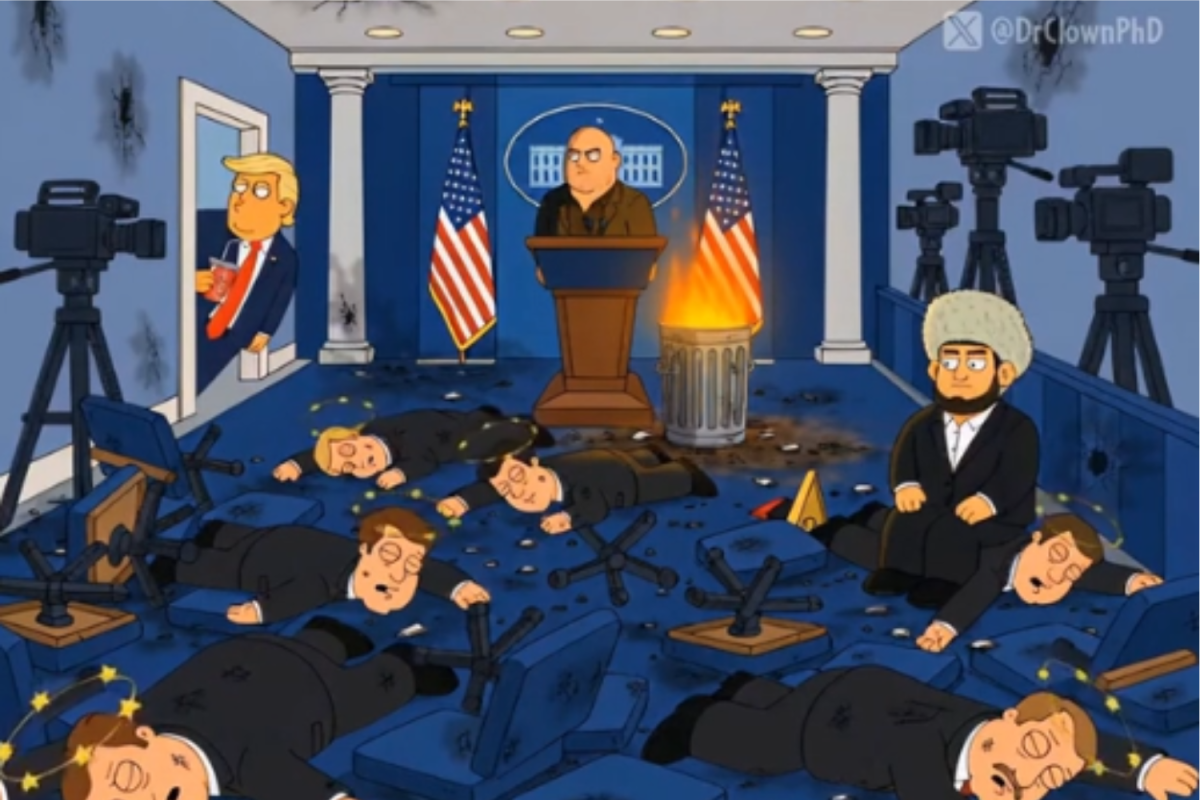
In the chaotic, digital whirlwind that defines American political discourse in the 21st century, there are moments that transcend mere controversial policy or partisan bickering, entering a realm of profound sociological dystopia. On a seemingly ordinary weekend, President Donald Trump stepped into the bizarre arena of artificial intelligence to share a deeply unsettling AI-generated video on his social media platform, Truth Social. The video was conceived as a supposed jest, a comedic nod to his earlier suggestion that Ultimate Fighting Championship (UFC) president Dana White might be the next White House press secretary. But as the reality settled in, what emerged was not a lighthearted punchline, but a chilling preview of a potential future—one where the American press corps is physically assaulted, where truth is systematically dismantled, and where the most powerful person on Earth casually weaponizes deepfake technology to mock democratic institutions. The whiplash was immediate; Trump later claimed he was “joking” about White’s appointment, but the internet is not a place where digital artifacts vanish. The video remained, a testament to a mindset, and a jarring experience for anyone who values the foundational principles of a free press. Imagine waking up to see your nation’s leader gleefully sharing violent imagery of women and men attacking the very professionals tasked with holding him accountable. It is not merely a gaffe; it is a psychological weapon, draped in the thin, transparent veil of satire, designed to desensitize millions of Americans to the idea that crushing dissent through brute force is not just acceptable, but entertaining.
The video itself, created by an X user with the provocative handle @DrClownPhD, is a disturbing pastiche of political violence rendered in a cartoonish, yet deeply aggressive, style. It opens with an animated Dana White announcing, “Trump made me press secretary. I brought help,” signaling a clear intent to replace the traditional press briefing room’s decorum with the brutal, performative violence of the octagon. What follows is a relentless assault on basic journalistic inquiry. When a fictional reporter asks the pressing question, “Is Donald Trump a threat to democracy?”, a cartoon Khabib Nurmagomedov—a retired UFC legend—swiftly pins the reporter to the ground, neutralizing the inquiry with pure physical domination. Another journalist, overwhelmed by the sheer aggression, begins to cry and exclaims, “I don’t feel safe,” only to have a cartoon Islam Makhachev, the current welterweight champion, appear to carry the terrified staffer away, treating the expression of fear as a problem to be physically extracted rather than heard. The assault grows more pointed and personal as the absurdity escalates. A reporter, stereotypically depicted with blue hair and a septum piercing—a visual shorthand for leftist figures in right-wing meme culture—poses a question about the president’s pronouns. In response, two female fighters leap across the room and attack him as he shouts, “This is fascism!” The cartoon White, presiding over this mayhem with a smirk, asks if there are any more questions. One brave soul then inquires about Michelle Obama’s potential 2028 run, to which a cartoon Josh Hokit declares, “Michelle Obama is a man!” This last line is particularly egregious, as it directly echoes the real-life Hokit’s repulsive comment made following his UFC Freedom 250 victory at the White House just months prior. This is not merely random digital trash; it is a meticulously crafted piece of propaganda that fuses violent fantasy with targeted harassment of specific public figures, designed to degrade the national discourse into a spectacle of cruelty.
To fully humanize the gravity of this moment, one must understand the symbiotic relationship that has flourished between Donald Trump and the world of mixed martial arts. The UFC, under Dana White’s leadership, has essentially become an unofficial wing of the MAGA movement. White has appeared at Republican National Conventions, gave a sycophantic speech at the 2024 convention lauding Trump as a “fighter,” and has transformed the UFC into a cultural bastion of hyper-masculine conservatism. For many in this sphere, the octagon is not just a sport; it is a metaphor for politics—a zero-sum gladiatorial combat where there are no rules, only winners and losers, and where weakness is the ultimate sin. By suggesting White as press secretary, even in jest, Trump is communicating a profound message to his base: the press is the enemy, and they should be treated as such. The press conference, in this constructed worldview, is not a democratic forum for accountability but a hostile arena where journalists are the opponents to be subdued. This video taps into a deep well of resentment held by many Americans who feel the media is elitist and out of touch. However, the video transcends political critique; it normalizes violence as a legitimate response to questions. The humanization of this story rests on the shoulders of the actual journalists who work in the White House press corps. They are human beings with families, anxieties, and daily fears. To know that the leader of the free world visualizes them being assaulted by fighters is a profoundly traumatizing thought. It shifts the atmosphere from professional scrutiny to a palpable sense of physical danger, breaking down the psychological contract that protects the fourth estate.
Diving deeper into the nature of this digital creation, we must confront the dangerous implications of artificial intelligence in the political landscape. Unlike a political cartoon or a traditional op-ed, an AI-generated video creates a hyper-realistic (or, in this case, intentionally cartoonish but still deeply pointed) simulation of events that never occurred. This specific video, while animated, blurs the lines between reality and fantasy. It depicts recognizable public figures—UFC champions—performing violent acts against fictional representations of real roles (reporters). The inclusion of the “Michelle Obama is a man” line is a masterclass in misinformation. It drags a real-world transphobic and misogynistic lie (persistently spread by right-wing figures) into a presidential distribution channel, effectively giving it the highest possible platform. When the most prominent leader in the world shares content that falsely labels a highly respected former First Lady as a man, it sends a signal to millions of followers that such hatred is permissible and endorsed. The human element here is the degradation of shield against targeted harassment against public figures. Michelle Obama has not announced any run for 2028, yet the video aims to seed doubt and smear her name in preparation for a hypothetical campaign. This is not a joke; it is the strategic deployment of poisonous narratives through the most advanced tools of digital creation. The reporters themselves are stripped of their humanity in this video, reduced to caricatures—the crying liberal, the pronoun-obsessed social justice warrior—whose function is solely to be bruised and beaten. The goal is to dehumanize the opposition, making it easier for the audience to accept physical violence against them as a plausible and even entertaining outcome.
Perhaps the most insidious element of this entire affair is the “it was just a joke” defense, a strategy Trump has honed to a fine art. The pivot from “Dana White as press secretary” to “I was joking” demonstrates a cynical understanding of how language and media cycles operate. The joke is the vehicle; the violent fantasy is the cargo. By claiming it was all in jest, Trump provides plausible deniability to his base while still delivering the underlying message. The psychological mechanism at play is known as “ironic normalization.” When a figure repeatedly presents violent or authoritarian ideas under the cover of humor, the audience’s critical defenses are lowered. They are not directly told “attack the press,” but they are shown a visual representation of it, which conditions them to accept it as a comic impossibility rather than a real threat. However, for a journalist waking up to see themselves depicted being pinned down by a world-class grappler simply for asking a question, the “joke” is terrifyingly real. It is a reminder that their safety is contingent on the whims of a volatile political climate. This constant erosion of shared reality is exhausting for average citizens as well. We are forced into a state of parsing absurdity for truth, constantly wondering if the latest grotesquery from the commander-in-chief is a laughable distraction or a dire warning. The human cost is high; it breeds a corrosive cynicism and a sense of hopelessness. We are all forced to inhabit a reality where the highest office in the land openly fantasizes about the suppression of dissent, all while tapping its toe to the tune of AI-generated phantasmagoria.
As we conclude this reflection, we must return to the human scale of this story—the jagged edges of fear, anxiety, and estrangement that it leaves behind. This video is not just a footnote in a developing news story; it is a mirror reflecting the crumbling foundations of civil society. For the reporters who occupy the White House briefing room, this video is a violent reminder that their profession—a cornerstone of democracy—is under siege. For women, minorities, and the LGBTQ+ community, seeing caricatures violently attacked for asking about pronouns or witnessing a grotesque lie about Michelle Obama is a reminder that the political climate actively celebrates their humiliation. For the average American, it signals a descent into a media ecosystem where truth is fungible and machine-generated hallucination is shared with the imprimatur of the presidency. The “joke” is a test balloon, a way to gauge public acceptance of increasingly hostile tactics. It is a descent into a world where the difference between a revolutionary statesman and a ruthless strongman is defined not by their policies, but by their ability to make cruelty seem mundane. As this story develops, one must sit with the uncomfortable reality that we have become witnesses to a profound breakdown. The AI video is a ghost in the machine, a digital specter that will outlive the news cycle. It forces us to ask what is left of the democratic experiment when the president, in the pursuit of keeping his audience entertained, willingly sacrifices the dignity of his office and the safety of his critics to the altar of virality. The answer, sadly, may lie in the silent dread we all feel when we realize that the modern presidency no longer speaks to the American people—it merely streams them a nightmare, laughing all the way.