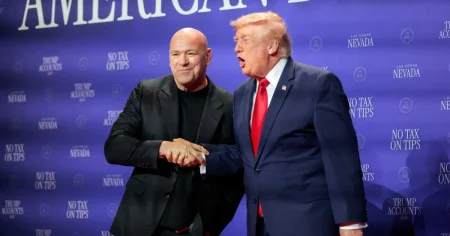
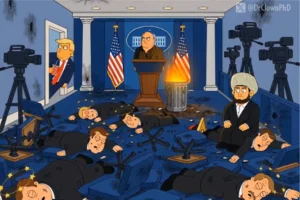


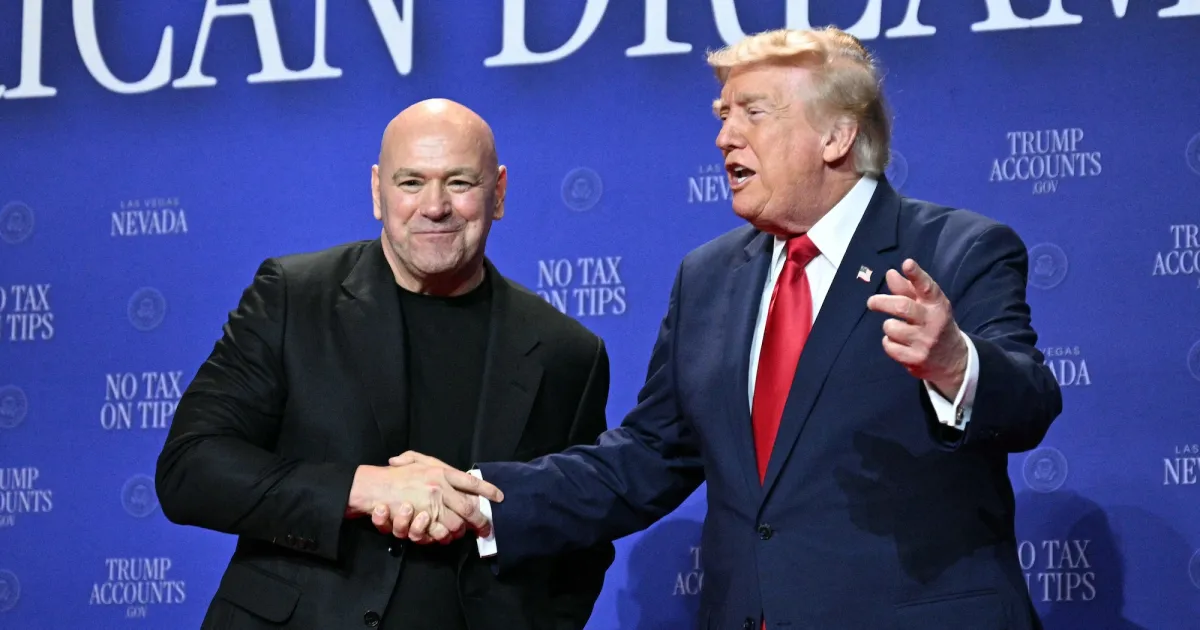
President Donald Trump has once again thrust the world of mixed martial arts into the center of American politics with a characteristically unconventional proposal. In a move that has raised eyebrows across the political spectrum, Trump announced he has offered the position of White House press secretary to Dana White, the CEO of the Ultimate Fighting Championship (UFC) and a close personal friend. To emphasize his seriousness and perhaps to showcase his vision for the role, Trump took to his social media platform, Truth Social, to share an AI-generated cartoon that paints a vivid and chaotic picture of what a White-led press briefing might look like. The cartoon, rendered in a style reminiscent of a prime-time animated sitcom, depicts White standing triumphantly behind the White House podium, but he is not alone—he is flanked by a roster of professional fighters, ready to handle the press corps in a way that is more physical than rhetorical. This spectacle is not just a casual suggestion or a fleeting thought; it is a deliberate and provocative escalation of Trump’s long-standing tendency to blur the lines between political institutions, celebrity culture, and the raw, unfiltered aesthetics of combat sports, signaling a profound shift in how this administration views the role of the media and the nature of political communication.
The AI-generated cartoon unfolds like a fever dream of political confrontation. It begins with the text, “Trump made me press secretary. I brought help,” before showing the cartoon White orchestrating a brutal takedown of the White House press corps. Flanking him are recognizable UFC figures like Khabib Nurmagomedov and Islam Makhachev, who are on hand to “take out” reporters who dare to ask critical questions. The reporters in the cartoon pose standard, yet pointed, questions from the current political climate, such as “Is Trump a threat to democracy?” and “What are Trump’s pronouns?”—queries that have become rhetorical battlegrounds in the culture wars. The scene reaches its most controversial moment when a reporter asks about a potential 2028 presidential run by former First Lady Michelle Obama. In response, the cartoon includes a depiction of UFC heavyweight fighter Josh Hokit, who asserts, “Michelle Obama is a man. Am I right America?” This line is not a random invention of the AI; it is a direct reference to a real and disturbing incident. Just a few months prior, during the UFC Freedom 250 event held on the South Lawn of the White House, Hokit had made the same false and misogynistic statement about Obama. The inclusion of this specific, debunked conspiracy theory is a stark illustration of how Trump’s political messaging often taps into the darkest corners of the internet, giving a presidential platform to baseless and harmful rumors, and turning a niche fighter’s post-fight rant into a cornerstone of a presidential social media post.
This is not the first time Trump has navigated such turbulent waters regarding Dana White. In fact, the president’s public offer on Saturday, November 7th, was notable for its bizarre and detailed description of what he expects from his friend. “I am pleased to announce that the Great Dana White, a violent Fighter and Warrior, has been offered the job of Press Secretary of the United States,” Trump wrote on Truth Social. The president didn’t stop there, requesting that White “bring with him assistants,” and he explicitly named a list of fighters—Islam Makhachev, Khabib Nurmagomedov, Justin Gaethje, Daniel Cormier, Amanda Nunes, and Kayla Harrison—some of whom are not American citizens, to serve as a defensive force against the “Lunatic Left.” The framing of a press secretary’s role as one of violent “defense” rather than communication is a startling departure from the norm, and it underscores Trump’s adversarial relationship with the media. He envisions White not as a spokesperson who articulates policy, but as a warrior who confronts and intimidates journalists. The list of fighters, a mix of global superstars, is presented not as a press team, but as a personal security detail for the administration’s message, a clear departure from any traditional understanding of how a democracy communicates with its citizens.
In the immediate aftermath of the announcement, Dana White confirmed the offer and his willingness to engage with the president on the matter. He informed reporters that he was flying to Washington, D.C., at once to meet with Trump, stating, “I’m flying to Washington, D.C., right now. I’ve got a lot of jobs already.” When pressed for details about the conversations he has had with Trump regarding this position, White remained tight-lipped, simply confirming that a meeting was scheduled for the following Monday. This move demonstrates the unique relationship between the worlds of the White House and the UFC under Trump’s presidency. For years, Trump has been a visible presence at UFC events, often seated cageside, and he has cultivated deep relationships with the organization’s leadership and fighters. White, in turn, has been a vocal supporter and surrogate for Trump, speaking at the Republican National Convention and serving as a bridge to a demographic that often feels alienated from mainstream politics: young, male sports fans. For White, this is not just a job offer; it is the culmination of a long-standing partnership and a validation of his role as a key player in Trump’s political ecosystem. His immediate acceptance of a flight to Washington suggests a serious intent to at least explore this radical career pivot from sports executive to political combatant.
The implications of this proposal are profound and stretch far beyond the immediate shock value. Trump’s decision to offer a press secretary role to a close friend and businessman like Dana White, who has no political experience, is a direct challenge to the traditional gatekeeping of political communication. It signals a desire to completely overhaul the briefing room, transforming it from a venue for information exchange into a spectacle of dominance and entertainment. The inclusion of the Michelle Obama conspiracy theory in the AI cartoon further cements this intent, as it deliberately mainstreams a fringe, sexist, and transphobic narrative for the sake of rallying his base. It is a calculated move to ignore the facts and instead appeal to the emotions and prejudices of his supporters. Furthermore, the very idea of suggesting a press secretary who would use fighters to “take out” reporters is a metaphor for the administration’s broader goal: to delegitimize and dismantle the mainstream media in the eyes of the public, framing them as the enemy rather than as a pillar of democracy. This is not a strategy for clarity or transparency; it is a strategy for control, spectacle, and the solidification of an alternative reality where power is displayed through intimidation and loyalty, not through dialogue and accountability.
Ultimately, the story of Dana White’s potential appointment is a testament to the novel and often chaotic manner in which Donald Trump conducts the highest office in the land. The AI cartoon serves as a perfect artifact of this era—a vulgar, funny, and deeply offensive piece of digital propaganda that blurs the boundaries between reality, fantasy, and political commentary. By publicly floating this idea and framing it with such aggressive rhetoric, Trump is testing the waters of what is acceptable and what can become normalized. The move has certainly energized his base, who see it as a refreshing rebuke of “political correctness” and a continuation of his “fight against the fake news media.” For critics, however, it is an alarming signal of authoritarian tendencies and a deepening erosion of democratic norms. As Dana White flew to Washington to meet with the president, the future of the White House press briefing room remained uncertain. Whether this was a genuine job offer, a loyalty test, or a pre-planned media spectacle, it has successfully dominated the news cycle, forcing the public to confront a question that would have been unthinkable just a decade ago: Could the next face of the White House press corps be an MMA executive with a cadre of fighters at his side, ready to answer questions not with answers, but with force? In the Trump era, the answer seems to be a resounding, and terrifying, “Why not?”