



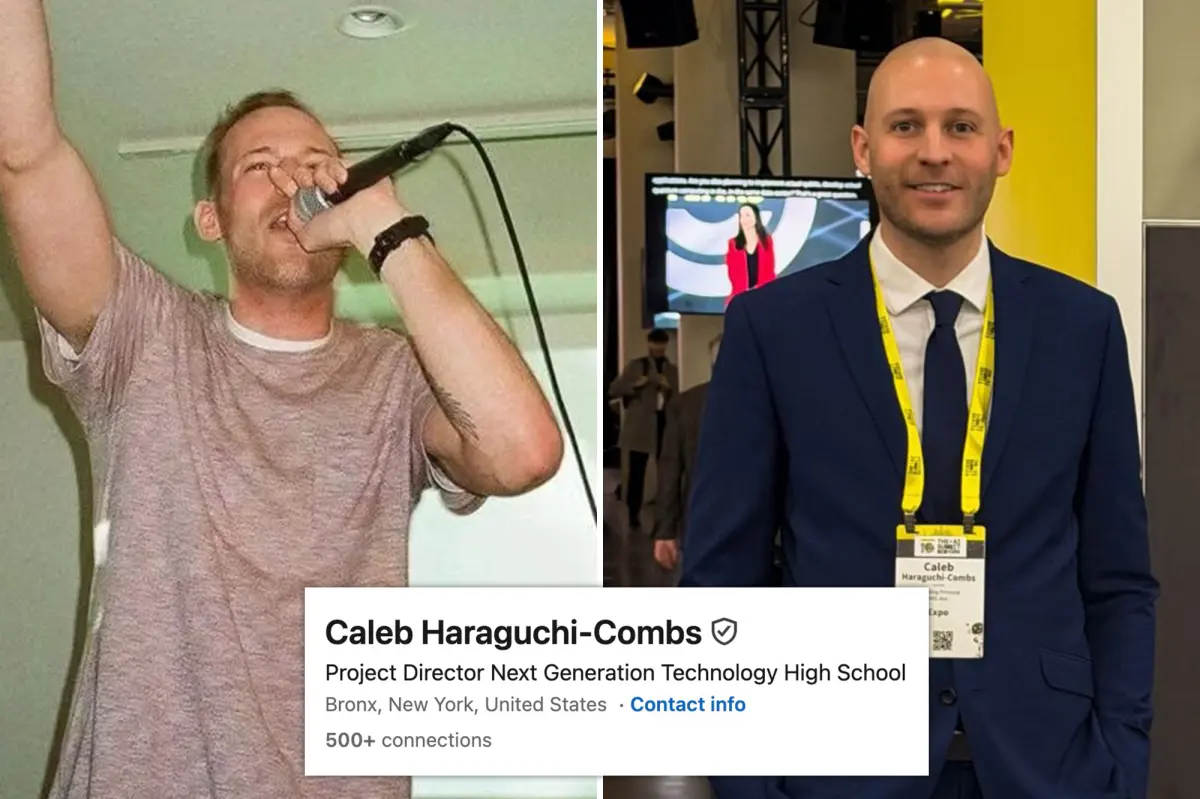
There is a special kind of absurdity that only a city like New York can produce. It involves a public school administrator, a proposed high school that never existed, a six-figure salary, and a rap career. The New York Post opens its story with the line “This is Ludacris”—a deliberate misspelling of “ludicrous” and a wink at the famous rapper of the same name. The pun is fitting, because the central figure in this tale is both an education bureaucrat and a rapper. His name is Caleb Haraguchi-Combs, he is 33 years old, and according to public records, he is being paid $192,374 a year—a principal’s salary—for a job that is not actually a job. In January, he was handpicked to become the project director of a proposed new school called Next Generation Technology High School, a planned institution in the Financial District that would have focused on artificial intelligence and computer technology. The promotion came with a $50,000 raise. There was only one problem: the school was never approved and never opened. In April, Schools Chancellor Kamar Samuels killed the proposal after what The Post describes as “woke backlash” against the school’s merit-based admissions model and a broader fear of AI in classrooms. Yet Haraguchi-Combs continued to collect the windfall. He is reportedly still being paid as if he were running a school, even though there is no school, no students, no teachers, and no building. Imagine being paid nearly $200,000 to do a job that doesn’t exist. That is the situation, and it is not satire. It is a glimpse into how taxpayer money can vanish inside the labyrinth of New York City’s education bureaucracy. The story has all the elements of a dark comedy: a rapper with a government salary, a school killed by politics, and a bureaucrat who refuses to say where he works. But for New Yorkers who pay taxes and send their children to public schools, the punchline is not funny.
To understand how this happened, you need to know the arc of Haraguchi-Combs’s career. Before the appointment, he was an assistant principal at Manhattan Center for Science and Mathematics in East Harlem, earning $141,960 per year, according to public records. A school official confirmed that he is no longer there. In January, he was tapped to lead the planning for Next Generation Technology High School. In the Department of Education, a project director of a planned school usually becomes the new school’s principal once it opens. That is why the promotion came with a raise to principal-level pay. But the school never got off the drawing board. The proposal was controversial from the start. A selective, merit-based admissions model in a district that prizes equity was always going to draw opposition. Add to that a wave of anxiety about artificial intelligence in classrooms—teachers worried about cheating, parents worried about data privacy, activists worried about a tech-driven school siphoning resources from neighborhood schools—and the political math became impossible. Chancellor Samuels pulled the plug in April. In a rational system, Haraguchi-Combs would have been reassigned to an existing school, or his salary would have reverted to the assistant principal level. Instead, the DOE says he is now “developing new proposals and supporting in-progress proposals,” a typical role for project directors whose schools don’t exist. But a DOE source strongly disputes that explanation, saying that unless a principal has tenure, they get bumped back to assistant principal if their school doesn’t open. Haraguchi-Combs never served as a principal, so he could not have applied for tenure. In other words, he appears to be occupying a phantom role with a princely salary. The source’s anger is understandable. The DOE’s official story is that this is normal. The source says it is not. Someone, somewhere, made a decision to keep paying him at the principal level, and so far, no one has explained why.
The human face of this story is uncomfortable. When a reporter from The Post showed up outside his shimmering Downtown Brooklyn high-rise, Haraguchi-Combs did not act like a man with nothing to hide. “You came to my house? Outrageous,” he barked, before refusing to say where he worked. It is easy to understand his defensiveness. How do you explain to a stranger that you are paid nearly $200,000 a year to do a job that no longer exists? But the defensiveness also raises questions. If he is truly working on new proposals, why couldn’t he say so? Why couldn’t he point to a project, a report, a meeting, anything? The DOE’s official response is vague and bureaucratic. The anonymous source inside the DOE is blunter: “Officials never should have named a principal before the school was approved.” That is the crux of the matter. The system promoted someone before the school existed, and when the school died, the promotion didn’t die with it. The DOE could have assigned him to a school that needed a principal. There are always schools with vacancies. Instead, he remains in a limbo that benefits no one—except, perhaps, Haraguchi-Combs himself. The source’s frustration is palpable: “What was the plan? There’s a lot of schools that could use a principal, there’s opportunities to appoint principals since then, it’s a huge waste of resources.” That quote should worry every taxpayer. It means that the people inside the DOE know this is wrong. They know the money is being wasted. They know there are schools without principals. And yet nothing changes. The system is too slow, too cautious, or too broken to fix itself.
This waste did not happen in a vacuum. It came to light because of a letter sent to DOE leadership by a group of anonymous Manhattan high school principals, urging an investigation into Superintendent Gary Beidleman. The October missive ticked off a list of concerns: organizational dysfunction, hiring unqualified candidates, failure to meet class size requirements, and Haraguchi-Combs’s status. The letter suggests that the story of the phantom principal is not an isolated case of bureaucratic bumbling but a symptom of a larger dysfunction. When principals themselves are so alarmed that they write an anonymous letter to the chancellor, something is deeply wrong. The fact that they felt the need to remain anonymous is telling. In a system where principals depend on superintendents for resources, support, and career advancement, speaking publicly against a superintendent can be professional suicide. So they whispered. They documented. They sent a letter. And a newspaper investigation followed. The result is a portrait of an education system that has lost the plot. It is not focused on children or learning. It is focused on titles, salaries, and political survival. A school that never opened still managed to produce a high-paid position. A superintendent facing serious allegations still presides over the district. And the public is left to wonder who, if anyone, is watching the store. The letter’s allegations are serious. If a superintendent is hiring unqualified candidates and failing to meet class size requirements, those are not minor administrative issues. They affect the quality of education that children receive. They affect whether classrooms are overcrowded, whether teachers are supported, whether students are safe. And yet the focus has shifted to a rapper with a principal’s salary, because that is the detail that captures the imagination. The other allegations deserve investigation too, but they are harder to explain in a headline.
Then there is the rapper alter ego. Haraguchi-Combs performs under the name Cal Combs, and he has released two rap albums. He calls himself “half hip-hop artist, half English teacher.” His 2017 album “Carmel”—named after the Indiana city where he once lived—contains lyrics about a drug deal gone wrong and fleeing gunfire: “So now I got a nine hidden in my backpack / I took all the things I learned and put them on backtrack… They said that they would meet us at the spot at seven thirty / we packed a bag and arrived five minutes early.” Another song, “Roundabouts,” includes lines about snorting cocaine and drinking to escape self-loathing: “One more bump on that key / one more drink and I’m free / one more shot to forget / how much I hate me.” These are raw, confessional lyrics, the kind of thing that might be praised in an underground rap scene. But they are jarring when attached to a public school administrator earning a six-figure salary. To be clear, there is no evidence that Haraguchi-Combs actually engaged in drug dealing or violence. Rappers often adopt personas. But the lyrics reveal a fascination with darkness and self-destruction that sits awkwardly with the image of a school leader. They also make him vulnerable to criticism. In an era when every social media post and song lyric can be scrutinized, a principal-level official with lyrics about guns and cocaine is a public relations disaster waiting to happen. The fact that he chose to keep rapping while climbing the education ladder suggests a certain defiance, or perhaps a belief that his two lives could coexist. Maybe they can. But the optics are terrible, especially when the public is being asked to trust him with nearly $200,000 of taxpayer money. The music may be art, but the salary is real.
At the center of this mess is a human being, not a cartoon villain. Haraguchi-Combs took his wife’s last name, according to his LinkedIn. He started his education career as an English teacher in Tokyo in 2015. He has a creative side, a family, and a professional trajectory that once seemed promising. But none of that excuses the waste. Zilvinas Silenas, president of the Empire Center for Public Policy, a good-government think tank, put it bluntly: “This is a new level for New York, when you are getting paid nearly $200,000 for a job you’re not doing, most taxpayers have never even dreamed of making that kind of money.” That is the real scandal. Ordinary New Yorkers work multiple jobs, struggle to pay rent, and send their children to schools that lack basic resources. Meanwhile, a 33-year-old project director collects a principal’s salary for a school that exists only in a PowerPoint presentation. The DOE’s defense—that he is “developing new proposals”—is not good enough. If he is doing valuable work, the public should know what it is. If he is not, the salary should stop. The system needs accountability, transparency, and a dose of common sense. Until then, stories like this will continue to erode public trust. The headline may be a pun on Ludacris, but the joke is on the taxpayers. And it is not funny anymore. The saddest part is that this story distracts from the real work of educating children. Every dollar wasted on a phantom job is a dollar that could have gone to a classroom, a teacher, a counselor, or a student. The city needs to answer for that. Caleb Haraguchi-Combs may not be a villain. But he has become a symbol of everything that is wrong with a bureaucracy that values titles over outcomes. New Yorkers deserve better.