




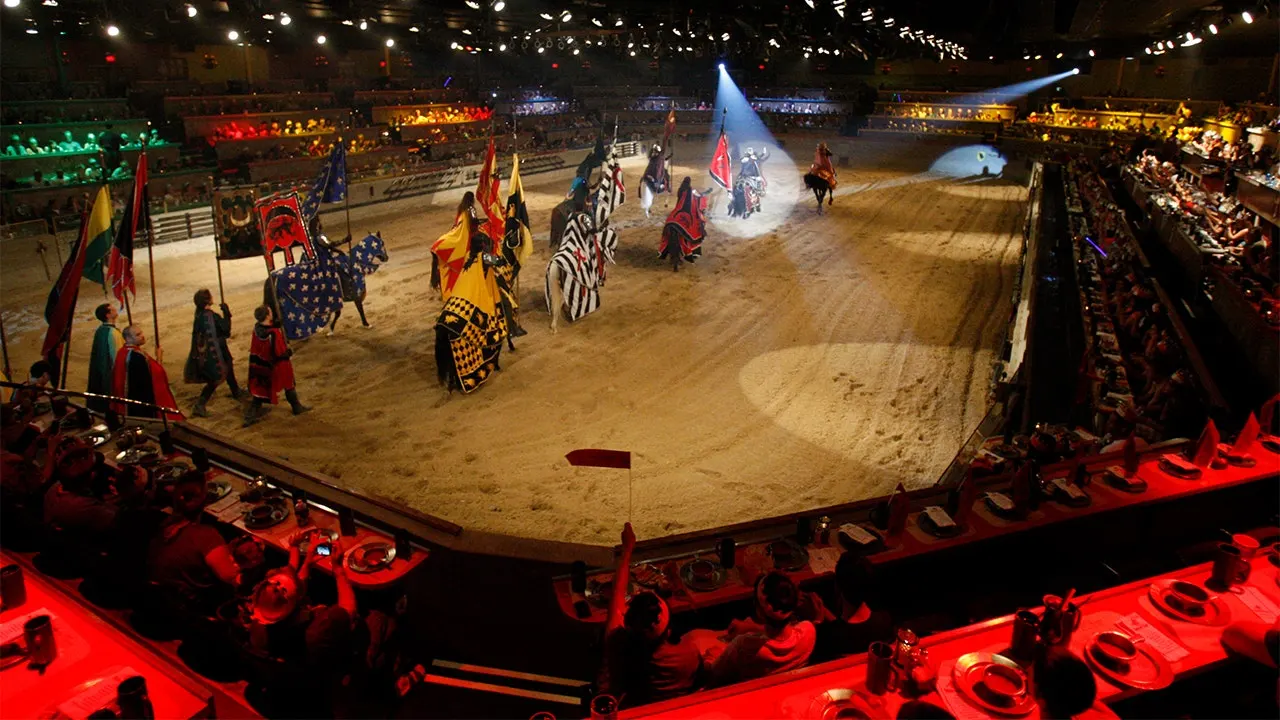
For more than four decades, Medieval Times Dinner & Tournament has invited audiences into a world of banners, banquets, and thundering hooves. Families file into torch-lit arenas, tearing apart roasted chicken with their hands while armored knights tilt their lances and the crowd roars for its favorite champion. It is a fantasy of chivalry, a place where honor seems simple and bravery is worn like armor. But beneath the pageantry, a different story has been unfolding. A growing number of former employees say that the kingdom behind the curtain is not chivalrous at all. They describe a workplace where women are treated as a lesser class, where complaints are ignored, and where speaking up can cost you your career. Others, including the company’s defenders, say these accusations do not reflect the castle they knew. What emerges is a complicated portrait of an American entertainment institution struggling with the divide between its public myth and the private experiences of the people who bring it to life. The first location opened in Kissimmee, Florida, in 1983, and the company now operates ten “castles” across the United States and Canada, employing more than two thousand people. Its performers are athletes, actors, riders, servers, and dreamers who rehearse relentlessly and perform night after night. They are also, according to lawsuits, witnesses to a culture that can turn toxic. The show promises a world where knights protect the helpless and honor women, but the people who live inside that world are telling a more painful story. For every guest who leaves the arena believing in magic, there is a former employee who left wondering whether the castle was ever really safe. This is not just a story about a dinner theater. It is a story about power, loyalty, fear, and the courage it takes to speak the truth when the applause has stopped.
The most recent legal challenge comes from Kaitlyn Farrell, a former “queen” at the Buena Park, California, castle. She joined the company in 2019, full of the same wonder that fills the audience each night, but resigned in February 2024, saying the conditions became intolerable. In a lawsuit filed in Orange County Superior Court, she alleges a hostile work environment rooted in gender discrimination and sexual harassment. She describes a two-tiered workplace in which female cast members are treated as lesser employees, where unwanted sexual advances are normalized, and where complaints are dismissed with indifference. She was not merely a bystander. At one point, she was asked to be a witness in a harassment investigation involving another employee, and after that, she says, she became the target of open retaliation from the very person she had reported. Management, she claims, stood by and did nothing. In one especially disturbing allegation, a manager reportedly ordered someone to remove stitching from her costumes, a kind of calculated sabotage meant to cause wardrobe malfunctions in front of live audiences. Then, after employees at the Buena Park location unionized and she participated in a strike in February 2023, she says the retaliation intensified. Anonymous social media accounts with apparent ties to employees or management began posting about her dating history, along with sexually derogatory captions and photoshopped images of her face on cartoon bodies in simulated sexual positions. The harassment allegedly crossed into physical stalking when fellow Medieval Times employees traveled to another theme park where she worked to intimidate her in person while she was trying to entertain guests. When her lawyers raised the issue, she says, the company’s attorney dismissed the cyberbullying and stalking as “weird allegations.” Her attorney, Charles Ludd Jr., told Fox News Digital, “We look forward to proving these allegations in court.” Farrell’s story is not just a list of legal claims. It is the story of a woman who believed in the magic, who wanted to be part of something beautiful, and who found herself alone, mocked, and hunted by the very people she once called colleagues.
Not everyone who has worked inside the castle agrees with that portrait. Bill Elliot worked at the same Buena Park location as a knight for twelve and a half years, leaving in 2015. He remembers Medieval Times as a company that took care of its people. In a text message, he cited decent pay, full-time hours with overtime, full medical, dental and vision insurance, and a 401(k). He said he had no complaints. He believes that some current lawsuits are driven less by truth than by opportunism. In his view, people making claims against the company are part of a broader cultural movement that wants to punish success. “They have no responsibility in running a company that employs thousands of people and no risk in doing it, but believe they deserve more of the profit,” he said. He also suggested that some female cast members sought attention from knights and then, when things did not go their way, resorted to false claims and buzzwords like “toxic masculinity.” His comments are a reminder that within any workplace, memory is subjective. The same castle that felt magical to one person may have felt menacing to another. Elliot’s experience deserves to be heard, but it does not necessarily contradict the experiences of the women who have come forward. He left more than eight years before the alleged events in Farrell’s lawsuit, and the company has changed. Unionization, pandemic-era labor pressures, and shifting cultural expectations have reshaped many workplaces. What is clear is that Medieval Times remains deeply beloved by many employees and guests, and any honest conversation about its future must include those who found a home there. It is also worth remembering that a person can love a workplace and still recognize that it has flaws. The knights and queens who perform each night are not props in a corporate drama. They are people with families, dreams, and fears. When they speak, whether in praise or in pain, they deserve to be heard.
Farrell’s lawsuit is not the first. In 2019, Bethany Regan sued the company after losing her job at the same Buena Park castle. Her story is harder to read. Regan began working there in 2013 and said she was treated less favorably than male cast members from the start. But her deeper concern was for the horses. According to her lawsuit, the head trainer had a volatile temper and would whip horses unnecessarily, leaving large welts over their bodies. Some horses were trained so harshly that they bled from their mouths and other places. They were overworked, sometimes denied rest until they became dehydrated. She alleged that one horse died as a result. Regan had been warned that the head trainer was a close friend of the company’s owner, and that any complaints would result in retaliation. She raised her concerns anyway. She also reported dangerous and unsafe working conditions for female cast members. In response, she says, the company suspended her for “starting rumors” and later terminated her employment. Her lawsuit was settled in 2020, with the terms kept private. Her attorney did not respond to a request for comment. It is impossible to know exactly what happened inside the stable, and settlements are not admissions of guilt. But Regan’s account, like Farrell’s, follows a familiar pattern: an employee who speaks up is pushed out, while the institution closes ranks. That pattern is all too common in industries that depend on spectacle and loyalty. It is also why whistleblowers often wait years to come forward, knowing they may be branded as troublemakers. Whatever the legal outcome, Regan’s voice added to a growing chorus asking a simple question: at what cost is the show allowed to go on? The horses cannot tell us what they endure. They cannot testify in court or post their stories online. They rely entirely on the humans around them to notice when something is wrong. If the allegations are true, then some of those humans failed them. And the people who tried to help were punished for caring.
Yvonne Barteau knows the dinner theater world from the inside. For six years, she was the principal trainer and director of entertainment operations at Arabian Nights, a horse-themed dinner theater near Medieval Times’ Florida castle. She now runs a horse rescue in Florida called Horses without Humans and has made a documentary about theater horses. She told Fox News Digital that she worked with many Medieval Times performers over the years, as people moved between dinner theater jobs in the Orlando area. She saw good people there, and she saw others who were not so good. In her experience, some young performers got “way too into their role, like they’re really medieval warriors.” That identity, she said, led some men to treat women in a callous way, and management did not always shut it down as it should have. At the same time, Barteau pushed back against the assumption that any horse used in performance is a victim. She said people with little experience with horses sometimes assume that the animals are being abused, when in fact many horses love to perform. “They haven’t seen how some horses really do light up, and they do love to be out there performing,” she said. “They love the attention.” She described a stallion named Papi as “an absolute theater horse—he’s a Brad Pitt.” People see a horse like Papi and remember him, she said, and that makes them love horses. Why wouldn’t we want that, she asked, as horse lovers? Why wouldn’t we want somebody else to fall in love with horses? Her perspective offers a necessary nuance: caring about animal welfare does not mean opposing every form of equine performance. It means insisting that the animals are treated with respect, that their health comes before the show, and that the people who speak up for them are not punished. It also means recognizing that the same world that can bring out the worst in some people can bring out the best in others. There are trainers and riders who spend their lives caring for these animals, who know each horse’s personality, who comfort them in storms and celebrate their victories. They are part of the story too. The goal should not be to tear down the castle, but to make it worthy of the love it asks for.
Taken together, these stories paint a portrait of an institution at a crossroads. Medieval Times has given joy to millions of guests and careers to thousands of performers. Its knights and queens train hard, work nights, weekends, and holidays, and perform dangerous stunts for the delight of families. The horses are powerful, intelligent animals, and many of them clearly thrive in the arena. None of that should be dismissed. But neither should the testimony of people who say they were silenced, demeaned, and endangered. The lawsuits are only allegations, and the company has the right to defend itself. Yet the recurrence of similar themes across multiple legal actions—gender-based mistreatment, retaliation against those who report, and concerns about animal cruelty—suggests a culture in need of scrutiny. The most human response to these allegations is not to choose a side blindly, but to listen. Listen to the women who say they were sexually harassed and then punished for speaking up. Listen to the employees who loved their jobs and felt supported by the company. Listen to the horse trainer who says abuse is unacceptable but that performance itself is not cruelty. And listen to the animals, who cannot speak for themselves. If the castle truly believes in chivalry, it can prove it by taking every accusation seriously, protecting the people who come forward, and ensuring that the horses are cared for with compassion. The show has always been about honor. The greatest honor now would be for the company to live up to its own myth, not just on the arena floor, but in every corner of the kingdom. Because at the end of the day, the people who make the magic happen—human and animal alike—deserve more than applause. They deserve safety, dignity, and truth. And perhaps, if the kingdom can find its way through this darkness, the light of the torches will shine a little brighter for everyone who enters its gates.