



Paragraph 1
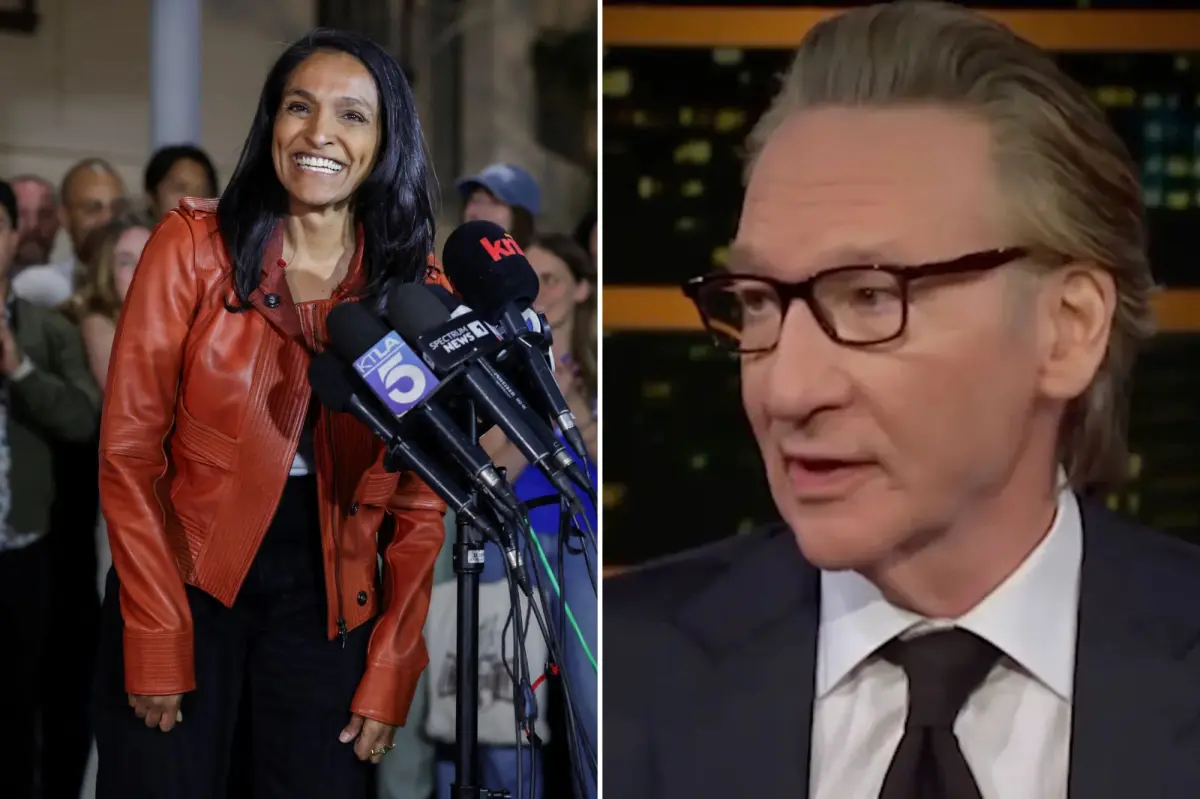
When the votes were counted in Los Angeles’ mayoral race, the result sent a jolt through the city’s political establishment—and no one was more characteristically unimpressed than Bill Maher. On Friday night’s episode of Real Time, the talk-show host delivered one of his signature blunt assessments of the electorate’s choices, drawing knowing laughter from his studio audience. “Yes, we have a new mayor in L.A.,” Maher said, pausing for effect before delivering the punchline: “You get two choices in L.A.: Left or further left.” It was a quip, sure, but it captured a genuine mood among many Angelenos who had watched the campaign unfold with a mixture of fatigue, frustration, and resignation. The race had narrowed to two candidates who were both Democrats—but philosophically distinct enough to reveal a deeper fracture in the city’s liberal identity. City Councilwoman Nithya Raman, a member of the Democratic Socialists of America, had ousted incumbent Karen Bass, a veteran politician with deep institutional ties. The outcome was historic, but also polarizing. For Maher, the takeaway was simple: L.A. had chosen a path, and it wasn’t a moderate one. The audience laughed because they recognized the truth buried in the joke—that in a city as progressive as Los Angeles, the political spectrum has become so narrow at its left end that voters often feel they’re choosing between shades of the same ideology. Maher’s words were less a punchline than a diagnosis, and they set the stage for a lively and contentious conversation about what Raman’s victory actually means for the city’s future.
Paragraph 2
Maher wasn’t alone in his skepticism. His guest that night, Coleman Hughes, an American writer, podcaster, and former fellow at the Manhattan Institute for Policy Research, wasted no time in drilling down into the ideological underpinnings of Raman’s campaign. Hughes acknowledged that both candidates were Democrats, but he made clear that Raman’s membership in the Democratic Socialists of America wasn’t just a label—it was a policy blueprint, and not one he believed would serve Los Angeles well. “Look, my issues are high rents and crime,” Hughes said. “Socialists don’t tend to be good on those issues because they institute policies like rent control, which sounds good but end up increasing the rents in the long run.” That line resonated with a lot of viewers because it cut through the emotional appeal of progressive housing policies and landed on uncomfortable economic realities. Rent control, after all, has long been a politically popular measure in California, but economists across the ideological spectrum have often warned that it constrains supply, discourages investment, and ultimately makes housing more scarce and more expensive for the people it’s meant to help. Hughes’s point wasn’t just about policy, though—it was about generational attitudes. He pushed back against younger Americans who view socialism as a fresh, exciting solution to the country’s problems, arguing that there is nothing new or untested about it. “We got a hundred years of data on socialism,” he said bluntly. “It’s not good for the economy.” He wasn’t interested in giving the ideology the benefit of the doubt, nor was he willing to treat it as a noble experiment. “Hate to break it to you,” he added with a wry smile, “Karl Marx wrote Das Kapital in like, 1860.” The point was clear: socialism isn’t a futuristic innovation—it’s a familiar, deeply flawed playbook that has been tried, failed, and repackaged for a new generation that doesn’t remember the consequences the way older generations do.
Paragraph 3
What made Hughes’s critique feel particularly pointed was the context of Los Angeles itself. This is a city grappling with a homelessness crisis of historic proportions, with rents that have spiraled far beyond the reach of average workers, and with a public that is increasingly concerned about public safety. Those aren’t abstract talking points—they’re daily realities for millions of people. And in that environment, Hughes argued, the last thing the city needs is an ideological experiment that prioritizes theory over outcomes. His skepticism about rent control was shared by many who watched the election results with unease, including landlords, developers, and even some tenants who feared that well-intentioned policies would backfire in the long run. When he spoke about crime, he tapped into another growing anxiety in the city. Los Angeles has seen a rise in certain categories of violent crime in recent years, and police response times have been a persistent complaint in neighborhoods that feel abandoned by city hall. For Hughes, the equation was simple: a socialist mayor, beholden to a powerful progressive base, would likely push policies that weaken law enforcement, constrain the police department, and prioritize criminal justice reform over public safety. That might sound compassionate in theory, but in practice, he suggested, it would make life harder for working-class residents who just want to feel safe walking down their own streets. The audience, largely familiar with the cultural tensions bubbling beneath the surface of California politics, seemed to understand exactly what he meant. His words weren’t just an attack on Raman—they were a warning to the entire progressive movement that has come to dominate city politics in a way that many moderate and independent voters have come to resent.
Paragraph 4
Those fears are not confined to social commentators and policy wonks. Inside the Los Angeles Police Department, Raman’s victory has already triggered alarm bells. The mayor-elect, who campaigned on a promise to fundamentally reimagine public safety, faces intense pressure from Democratic Socialists of America supporters to make sweeping changes to the LAPD—including potentially rolling back its enforcement policies, curtailing its budget, and overhauling its leadership. Officers who spoke after the election expressed deep concern about what her administration could mean for the city. “It’s going to be a nightmare and very, very bad for public safety,” one senior officer said, echoing sentiments that circulated quickly through the ranks. The department is already understaffed, with hiring challenges that predate Raman’s campaign but have worsened in recent years due to a combination of retirements, resignations, and a diminished appetite for the job among younger recruits. Police leaders warn that morale is fragile, and that any perceived hostility from city hall could accelerate an exodus of experienced officers who still have options in other cities and departments. The idea of a civilian mayor with deep skepticism of policing, combined with a city council that includes several vocal defund-the-police advocates, has created a sense of dread among rank-and-file officers who feel they are constantly being second-guessed and scapegoated. They worry that the department’s ability to respond to emergencies, solve crimes, and build trust with communities will be severely compromised under a leader who views the institution with suspicion rather than support.
Paragraph 5
Outgoing Mayor Karen Bass didn’t hold back in her final weeks on the job, warning voters and anyone who would listen that a Raman administration would plunge the city into chaos. “I think four years under Nithya Raman would present a tremendous amount of chaos,” Bass told the press. “It would be chaos from day one.” The incumbent, a seasoned politician with deep ties to Washington and Sacramento, was particularly alarmed by Raman’s pledge to replace LAPD Chief Jim McDonnell. Bass argued that removing the city’s top cop, especially so soon after he took over a department reeling from leadership turmoil, would be a catastrophic mistake. “I don’t think she has a clue what it takes to get a police chief for the nation’s second-largest city,” Bass said, her frustration evident. She painted a dire picture of what would happen if Raman followed through on her promise: officers leaving in droves, confusion settling over the department, and a leadership vacuum at a time when the city can least afford it. “The minute she would initiate that,” Bass warned, “you will have officers leaving the department, and confusion sets in anytime they’re gonna sit around and wait to see who is going to lead them.” Bass also raised another concern that went beyond local policing: the risk of federal intervention. With Los Angeles preparing to host the 2028 Olympics, she argued, the city needs a stable, professional, well-led police force to coordinate with federal agencies and handle the extraordinary security demands of an international event. A disruptive leadership shake-up, in her view, would send a signal of instability that could undermine confidence in the city’s ability to host the world safely.
Paragraph 6
At a deeper level, the clash between Raman and Bass—and the sharp commentary from Maher and Hughes—reflects a broader ideological struggle that is playing out not just in Los Angeles, but across urban America. The Democratic Party’s leftward drift has created a new political fault line, pitting activists who want revolutionary change against pragmatists who worry about preserving institutions, public safety, and basic functions of government. Raman’s victory is a milestone for the democratic socialist movement, which has gained significant traction among younger voters disillusioned with capitalism, inequality, and a political system that often feels rigged against the working class. But as Hughes pointed out, the romantic appeal of socialism often collides with the hard realities of governance. Los Angeles is not a blank canvas—it is a complex, sprawling metropolis with entrenched problems that require competent management, not just impassioned ideology. The city’s next mayor will have to deal with homelessness, housing affordability, transportation, business closures, and the daily delivery of city services. If Raman fails to improve conditions, the backlash could be swift and severe, not just from conservatives, but from the very working-class communities she claims to represent. For now, her supporters are celebrating, her critics are warning, and the rest of the city is bracing for whatever comes next. In L.A., where the weather is warm but the political climate has never been hotter, the future is uncertain. But one thing is clear: the era of business-as-usual in city hall has come to an end, and the experiment has begun. Whether it brings transformation or chaos—or a little of both—only time will tell. And as Bill Maher might say, you can’t say you weren’t warned.