



On a quiet Saturday morning in West Bend, Wisconsin, a close-knit community was shattered by a tragedy that no one saw coming. Just before noon, officers with the West Bend Police Department received a report that multiple people were dead inside a home in the 100 block of East Washington Street. When they arrived, they made a devastating discovery: four people had lost their lives within the walls of that residence. Among the dead were an adult woman, an adult man, and two children—a boy and a girl. The very fact that these lives were cut short in such an ordinary setting, on an ordinary weekend, has left neighbors and residents alike grappling with confusion, sorrow, and a profound sense of grief. As if the scene were not already heartbreaking enough, police also found a girl still alive inside the home. She was rushed to a local hospital and listed in stable condition, her survival offering a fragile sliver of hope amid the darkness. In addition to the human victims, a dog was also found dead at the scene, a detail that underscored the totality of the loss within that household. Authorities recovered a firearm that they believe was connected to the incident, and they moved quickly to reassure the public that there was no known ongoing threat to the wider community.
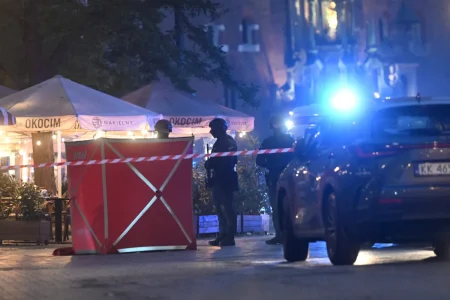
The response to the unfolding emergency was swift and layered. Multiple police units lined Wisconsin Avenue, their presence a stark reminder that something terrible had occurred. Yellow police tape cordoned off the residence and the surrounding area, transforming a familiar street into a crime scene. Investigators from the Wisconsin Division of Criminal Investigation arrived later in the afternoon, joining local officers in a methodical search for answers. That search included a garage on the property, where investigators were seen working carefully, likely looking for evidence that could explain what had happened. Despite the heavy law enforcement presence, Washington Street itself remained open to traffic, and officials asked only that pedestrians avoid the area out of respect for the work being done. The juxtaposition was striking: daily life continuing just a few feet away from a home now marked by tragedy. The sight of police vehicles, forensic teams, and yellow tape against the backdrop of an otherwise peaceful neighborhood created an atmosphere of disbelief. Residents watched from a distance, whispering to one another, trying to process the reality that something so unthinkable had happened so close to home. It was a scene that no amount of training could fully prepare officers for, and it was a scene that the community would not soon forget.
As investigators pieced together the early moments of the response, Lieutenant Brian McAndrews of the West Bend Police Department offered a few carefully chosen words to the public. He revealed what many had feared: everyone who was found inside the home was connected to one another. His statement, while brief, confirmed that this was not a random act or a stranger slipping into a house unseen, but rather a tragedy involving people who shared bonds of family and daily life. McAndrews also explained that the suspected individual responsible for the deaths was believed to have been inside the home at the time officers arrived, and had been found among those who were deceased. That revelation was deeply unsettling in its intimacy. It meant that whatever had taken place had unfolded entirely within the confines of that household, a private horror now exposed to the public eye. Perhaps most importantly, the lieutenant made it clear that there was no need for residents to fear a suspect at large. His words were meant to comfort a nervous community, but they also carried the weight of sorrow, because they meant that the answers to the questions on everyone’s minds already lay within that cordoned-off home. The surviving girl, the family dog, the recovered firearm, and the relationships between the victims all became threads in a story that law enforcement was now trying desperately to untangle.
The fact that four members of the same family could die in a single morning naturally raises questions that go far beyond the mechanics of the investigation. As of Saturday afternoon, authorities had not publicly identified those who died, nor had they specified the exact relationships between them. To respect the family’s privacy and the integrity of the investigation, they withheld those details. They also declined to explain the circumstances that led to the deaths, leaving a vacuum of information that the public tried to fill with grief and speculation. Police did not officially say whether domestic violence played a role in what had occurred, but the presence of a domestic violence support organization’s contact information in their public statement was notable. Friends Inc., a local organization that assists survivors of domestic violence, was included in the police release, with a message that help was available to anyone experiencing such abuse. That detail, small as it might seem, spoke volumes. It suggested that even as officers worked to determine the facts, they were aware that this tragedy might resonate with others living in silence. It was an invitation for anyone in a similar situation to reach out before another household became a statistic, before another quiet neighborhood found itself surrounded by police tape. The inclusion of that resource was not just procedural; it was a human gesture, an acknowledgment that the community might have people in danger who were in need of a lifeline.
In the weeks and days ahead, the full story of what happened inside that West Bend home will likely emerge through medical examiner reports, forensic analysis, and interviews with those who knew the family best. But for the people who live in West Bend, and for anyone who has ever lost a loved one to violence, the pain is already here. This is a community of modest size and strong ties, where people often know their neighbors by name, where children ride bikes along the sidewalks and families gather for summer cookouts. The idea that a home on East Washington Street could become the site of such profound loss is almost too much to bear. Neighbors will remember the family in their own ways—a wave from the porch, a child’s laughter, a familiar car parked in the driveway—and those memories will now carry a different weight. For the first responders who walked through that door, the image of those four bodies, including two young children, will likely remain etched in their minds for years. They responded to a call for help and encountered something far more devastating than they could have imagined. Even after the yellow tape comes down and the last police cruiser pulls away, the emotional residue of that Saturday will linger. The community will need time to heal, and that healing will require patience, compassion, and the willingness of neighbors to look after one another.
There are no words that can fully capture the sorrow of such a loss, nor are there easy explanations for why it happened. What can be said is that the investigation remains active, and authorities are working diligently to provide answers not only for the public but for the grieving loved ones who will spend the rest of their lives trying to understand this moment. Anyone with information has been asked to contact the West Bend Police Department at 262-335-5000, a number that now feels strangely ordinary given the enormity of the case. As the community waits for more details, it is left to hold space for the victims, to support the surviving girl in her recovery, and to remember that every statistic is made up of real people with hopes, dreams, and loved ones. The tragedy in West Bend is a reminder of how fragile life can be, how quickly happiness can turn to heartbreak, and how important it is to reach out to those who may be suffering in silence. No one should have to face such pain alone, and no one should believe that violence is the only way out. The doors of Friends Inc. and other organizations are open to anyone who needs help, and the phone lines are waiting. In the midst of the grief, there is still a chance to prevent another family from being torn apart. As the sun sets over East Washington Street and the community begins the long road toward healing, the hope is that this tragedy will not be in vain, and that the lives lost will be remembered not merely as names in a news report, but as people who mattered.