

A Shifting Landscape: Trump’s Overture and the Miller Enigma
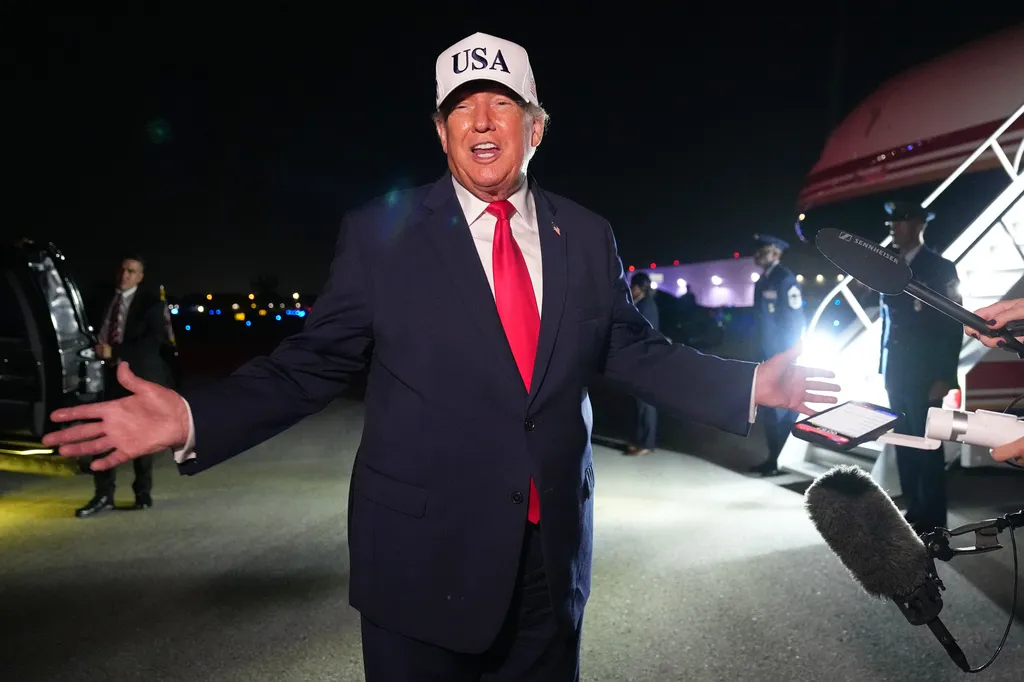
In the wake of a bruising midterm election that swept Democrats back into power on Capitol Hill, President Donald Trump stood before reporters amidst the balmy Florida air near the Kennedy Space Center and projected an air of pragmatism. The setting, a gathering of tech moguls and entrepreneurs at the UP.Summit, seemed an apt metaphor for a president now facing a new political reality, one where the legislative agenda must navigate a divided government. When asked about potential areas of collaboration with the incoming Democratic majority, he didn’t hesitate to name a familiar, contentious topic. “I think a lot,” he said, listing immigration and tax cuts as potential starting points for bipartisan work. “There may be certain things having to do with taxes to make it more convenient and better. A lot of economic development that we can do.” His tone was conciliatory, suggesting a willingness to pivot from the combative stance of the preceding years. He insisted that a range of common-sense solutions could be found through cooperation, painting a picture of a pragmatic leader ready to adapt to a new political reality. It was a striking message, one that seemed to acknowledge the electoral verdict while seeking common ground with those who had just dealt his party a significant blow. Yet, this message of unity was immediately shadowed by the day’s most consequential personnel decision, an announcement that seemed to contradict the very spirit of bipartisan outreach he was attempting to project.
Just hours before his public remarks, the White House confirmed that Stephen Miller, the architect of the administration’s most restrictive and controversial immigration policies, would ascend to the role of White House Chief of Staff, replacing the departing Susie Wiles. The promotion of Miller, a figure synonymous with the president’s hardline “America First” agenda, sent a shockwave through the political landscape, instantly undercutting the narrative of collaboration. Trump’s description of Miller as the “MVP” of his administration and a “great fighter” who has been with him since the very beginning signaled a loyalty-driven choice, meant to reward a stalwart whose influence has been felt across the executive branch. From championing mass deportations and ending birthright citizenship to shaping foreign policy, Miller’s fingerprints are on the most consequential and divisive actions of the second Trump term. The president’s enthusiastic endorsement, calling Miller “very loyal” and “smart,” painted a clear picture: while Trump may be extending an olive branch to Democrats with one hand, he is solidifying the most uncompromising elements of his agenda with the other. The choice was a deliberate signal to his base that the losses would not lead to a moderation of his most defining policies, but rather to their emboldened enforcement from the highest echelons of power.
Democratic leaders, unsurprisingly, reacted with immediate and fierce condemnation, seeing Miller’s elevation not as a move towards the center, but as a reaffirmation of an extremist ideology. Senate Minority Leader Chuck Schumer warned that Democrats would “fight him every step of the way,” framing the appointment as proof that Trump had learned nothing from the electoral repudiation. House Minority Leader Hakeem Jeffries, poised to become Speaker, was even more scathing, labeling Miller a “reckless extremist” and a “dangerous xenophobe” who should have been fired, not promoted. For Democrats, the appointment was a clarion call, confirming their narrative that the administration is doubling down on policies they view as anathema to American values. The clash between Trump’s public overture for cooperation and the reality of Miller’s promotion highlighted a seemingly irreconcilable contradiction. How could the president speak of finding common ground on immigration with the very people who view his chief advisor as the embodiment of a toxic, anti-immigrant philosophy? The answer, perhaps, lies in Trump’s own unique political calculus, a capacity to hold contradictory positions simultaneously, speaking to different audiences with different messages. To the broader public, he offers the promise of government function and problem-solving; to his most fervent supporters, he reinforces the image of a defiant leader who will not retreat from his ideological commitments.
Turning to the root causes of his party’s electoral setback, Trump offered a more detailed postmortem than his initial, brief statements earlier in the week. He laid blame not on the policy agenda itself, but on its execution and external factors, specifically pointing to legislative gridlock in the Senate. “We had a bad election because of a few things,” he explained, citing the chamber’s failure to advance key priority legislation and the persistent issue of high oil prices. He expressed particular frustration at the inability to pass bills, decrying the Senate as a “roadblock” where “nothing is getting passed” and that this inaction was “killing our country.” Trump singled out the SAVE America Act, a Republican-backed bill to impose proof-of-citizenship requirements for voter registration, as a casualty of this gridlock that had political consequences. This analysis subtly shifted the narrative, moving the focus away from the popularity of his own hardline policies and onto the internal mechanics of the party’s inability to govern effectively. While he refrained from personally attacking Senate Majority Leader John Thune, calling him “a good man,” his implicit criticism was clear: the failure to secure legislative wins had demoralized the base and presented a picture of a party that could not deliver on its promises. This explanation, while offering a diagnosis, remained in the confines of his own worldview, attributing the defeat to procedural failures and external economic pressures rather than a rejection of the administration’s ideological direction.
The president also pointed to the financial markets as a stark indicator of the negative reaction to the Democratic victories. “When they heard that the Democrats won that election, the market dropped $3 trillion, the highest amount in history,” he claimed, linking Thursday’s steep sell-off directly to the election results. However, this assertion clashes with the more nuanced reality of the market’s movement. The downturn was overwhelmingly driven by a rout in technology and semiconductor stocks, prompted by investor concerns over inflated valuations in the artificial intelligence sector and massive data-center investments. While the political climate may contribute to an overarching narrative of uncertainty, the immediate trigger was a recalibration of a specific, over-heated market segment. Trump, nevertheless, used the event to bolster his argument that his party’s defeat was having tangible, negative consequences for the nation’s economic well-being. He acknowledged the sell-off but dismissed its longevity, predicting, “It’ll level up and we’ll do great things.” This perspective frames the economic downturn not as a consequence of overvaluation or economic trends, but as a direct punishment from a market that fears Democratic governance, a simple narrative that aligns with his political messaging.
Ultimately, Friday’s events presented a portrait of an administration at a critical juncture, navigating a complex and contradictory political landscape. Trump’s comments reflect an attempt to project strength and flexibility in the face of defeat, speaking of bipartisanship while simultaneously elevating an architect of division. His explanation for the losses, focusing on Senate gridlock and market reactions, serves to deflect blame from his own policies and to maintain his narrative of victimhood and external obstruction. The decision to promote Miller is the defining signal, demonstrating that the president’s most loyal and ideologically rigid allies will remain at the helm, poised to implement an aggressive agenda even with a hostile Congress. The path forward is unclear, given the deep chasm between the president’s stated desire for cooperation and the appointment of an aide who inspires visceral opposition from the other side of the aisle. As the president prepares to navigate a divided government, the only certainty is that the tension between his conciliatory words and his uncompromising actions will continue to define the political struggle ahead, with the specter of Miller’s influence casting a long shadow over any potential deal-making.