

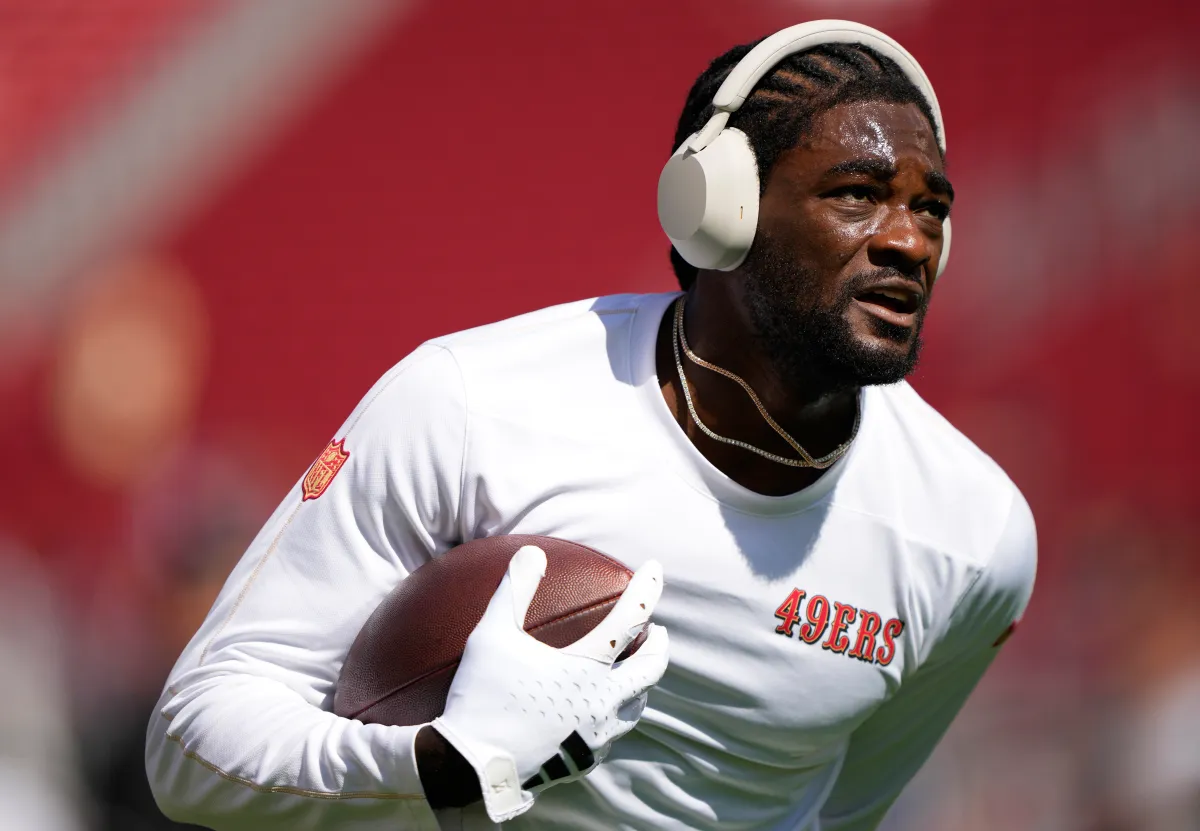
When Brandon Aiyuk stepped outside the San Francisco 49ers’ business offices on Friday, it wasn’t just another business meeting — it was a milestone in a journey that has tested his patience, his body, and his relationship with the team that drafted him. Standing beside his new agent, Drew Rosenhaus, Aiyuk looked and sounded like a man who had been waiting for this moment for a very long time. His voice was calm, his message simple: “Feeling great, feeling healthy. It’s a long recovery process. A long rehab process. But I’m back to 100% and looking to get reinstated in the National Football League.” Those words carried weight. For anyone who had followed the turbulent year, hearing Aiyuk say he was healthy again was both a relief and a reminder of how far he had come. He hasn’t played since October 2024, when his right knee buckled in a game against the Kansas City Chiefs, and the injury turned out to be as serious as it gets: a torn ACL, torn MCL, and torn meniscus. That kind of injury can change the trajectory of a career. It can sit with you in quiet moments, wondering whether you’ll ever be the same. But here was Aiyuk, in front of the franchise’s offices, trying to take the next step toward returning to the game he loves. The optics were undeniable: this was a player ready to move forward. Aiyuk, the former 2020 first-round pick, was not just making a statement to reporters. He was making a statement to the 49ers, to the NFL, and perhaps to himself. He had filed paperwork for reinstatement from the reserve/left-squad list. He had a meeting scheduled with the team. He was not hiding. He was showing up.
To understand what this moment means, you have to go back to the injury and everything that followed. The injury itself was brutal. The recovery from a triple ligament tear is not straightforward. It requires months of grinding rehabilitation, early mornings, ice baths, exercises that feel impossible, and the mental battle of trusting your body again. Aiyuk went through that process, but it wasn’t clean. Tensions arose between him and the 49ers over his missed mandatory rehab sessions, and those tensions spilled into the public sphere in a way that neither side could fully control. For a team that had invested a first-round pick in Aiyuk in 2020, and then signed him to a four-year, $120 million extension in 2024, the fractured relationship was awkward. For Aiyuk, a proud receiver who had given the team more than 4,000 receiving yards, the frustration was probably personal. It’s never just about a knee. It’s about feeling supported, feeling understood, feeling like the organization has your back when everything goes wrong. Instead, he found himself on the reserve/left-squad list — a roster designation that essentially put his career in limbo. The word “drama” appeared in reports, but that word can be too neat. The reality is a young man trying to protect his future, a front office trying to protect its investment, and both sides failing to see eye to eye. There were questions about whether Aiyuk even wanted to return to San Francisco, whether the trust was broken beyond repair, and whether the 49ers would rather move on. Through it all, the injury and the dispute became tangled. His knee was healing, but the situation was complicated. Healing isn’t linear, and neither is a contract dispute. Aiyuk has now emerged from that fog, at least publicly, with a clear goal: get reinstated, get back on the field, and see what happens next.
The reinstatement process is not just a formality. Aiyuk had to file paperwork, and according to reports, he did. That paperwork triggered a conversation with the team, and on Friday, the two sides sat down to talk. The meeting was described as part of a process that could eventually lead to his return. Exactly what was said behind closed doors is unknown, but the public signals were telling. San Francisco 49ers general manager John Lynch suggested that “everything is possible” when it comes to a reunion between Aiyuk and the team. Head coach Kyle Shanahan reportedly made a very similar remark. That language is carefully chosen — not a full-throated endorsement, but also not a dismissal. In the transactional world of the NFL, “everything is possible” leaves room for a wide range of outcomes. Aiyuk’s agent, Drew Rosenhaus, was similarly measured. He shut down questions about which team his client might play for after reinstatement, saying, “Don’t really have any comment about where he’s going to play. We’ll keep that between us and the Niners, but, obviously, we’re here with all the right intentions.” That last phrase is meaningful. “All the right intentions” suggests that whatever grievances existed, the meeting was not about revenge or escape. It was about trying to figure out a path forward — perhaps with the 49ers, perhaps not, but with open communication. For Aiyuk, simply being in the building was an important step. He was no longer a name in a transactional report; he was a physical presence, a player who had made the effort to show up. That matters in a league built on relationships. The fact that Lynch and Shanahan were willing to entertain the possibility of a reunion signals that the door is at least ajar. It might not swing open easily, but it’s open.
Still, there is an unavoidable obstacle in any reunion, and it has nothing to do with the knee. According to the Associated Press, the NFL told Aiyuk he owes roughly $13 million to the 49ers in bonus forfeitures connected to the extension he signed in 2024. That is an enormous sum, even for a player who has earned tens of millions over his career. The details of these forfeitures are tied to the language of the contract, the conditions of the bonus, and the reasons for his time away from the team. It’s not the kind of thing that gets resolved over a single meeting. The NFL Management Council is reportedly working with Aiyuk and the 49ers to negotiate a resolution or a repayment plan. For Aiyuk, walking back into that building knowing he owes millions might feel heavy. For the 49ers, the money is a business matter, but for Aiyuk, it’s personal. It represents the cost of a season that slipped away, of a relationship that soured, of a contract that was supposed to be a celebration but became a point of contention. Money has a way of complicating even the most heartfelt comebacks. Imagine the emotional toll: You’ve worked your whole life to reach the NFL, you sign a lucrative extension, you suffer a serious injury, and then you find out you owe a significant portion of that money back while you’re still trying to prove you can play again. It would be enough to make anyone walk away. But Aiyuk is not walking away. He is standing in front of the building, talking to reporters, attending meetings, and trying to work through the financial mess with the help of his agent. It might be a long and frustrating process, but it’s part of the reality of professional football. The human side and the business side are always intertwined, and Aiyuk is learning that lesson in the most difficult way possible.
If a reunion doesn’t come together, what happens next? There are really only two viable paths: a trade or a release. A trade would have to happen quickly — the NFL trade deadline is Tuesday, Nov. 10, at 4 p.m. ET. That is a tight window. Teams interested in acquiring a receiver would need to make an offer, negotiate compensation, and sort out the financial implications, all while Aiyuk’s reinstatement and the bonus forfeiture issue remain unresolved. It’s possible, but it’s complicated. If trading Aiyuk proves too difficult, a release becomes the more likely outcome. That would allow Aiyuk to sign with any team, giving him the freedom to choose a new home. It would also allow the 49ers to move on without having to facilitate a trade, though they would lose any potential compensation. But before all of that, it’s worth remembering what Aiyuk has accomplished on the field. He was the 49ers’ No. 25 pick in the 2020 NFL Draft. He has appeared in 69 games with 67 starts. He has tallied 4,305 receiving yards on 294 receptions, and 25 receiving touchdowns. Those are not just stats; they are proof of ability. They represent the player Aiyuk was, and the player he hopes to be again. At his best, Aiyuk is a dynamic, explosive receiver who can create separation with quickness and run after the catch with aggression. He has been the kind of player defenses have to game-plan for. The uncertainty is not about talent — it’s about fit, health, and timing. If released, Aiyuk would immediately become one of the most intriguing wide receivers available. A contender with a need at receiver and a quarterback who can stretch the field would have to be tempted. But the decision will come down to trust: teams will need to trust that his knee is truly 100%, that the missed rehab sessions are in the past, and that he can be a positive presence in a locker room again.
There was one more layer of intrigue to Aiyuk’s comeback story: his own words from earlier this year, suggesting he would like to play for the Washington Commanders next. The connection is obvious and human. Aiyuk played at Arizona State with quarterback Jayden Daniels during the 2019 season. Daniels is now one of the most exciting young quarterbacks in the league, and the idea of reuniting with a familiar teammate is an appealing narrative. It’s the kind of story football fans love: two former college teammates, now in their primes, linking up once again on a bigger stage. But whether that happens is anyone’s guess. The Commanders are one of many teams that could be interested, and Aiyuk’s future depends on factors beyond his personal preference. There are salary cap considerations, trade compensation, the forfeiture issue, and the 49ers’ own desires. It could also be that the meeting with the 49ers changed the calculus. Maybe Aiyuk realized that the organization he was initially upset with is willing to move forward. Maybe Lynch and Shanahan recognized that a healthy, motivated Aiyuk is worth more than anything they could get in a trade. As with most things in life, the truth is probably somewhere in the middle. For now, what matters most is that Aiyuk is back. He is not fully back on the field yet, but he is back in the orbit of professional football. He is being seen, heard, and talked about. And he is saying all the right things. His tone on Friday was neither defiant nor fragile — it was determined. There are no guarantees in the NFL. He could be traded, released, or kept. He could face another setback. He could struggle to reclaim his old form. But on this particular Friday, standing outside the 49ers’ offices, Brandon Aiyuk looked like a man who had been given a second chance. That, in itself, is a victory.