


Paragraph 1: The Impossible Survivor
For any land-dwelling critter, water is life. But for amphibians, the fragility of their existence is often measured against the harshness of salt. Modern amphibians possess skin so permeable that it acts like an open window—they breathe through it, drink through it, and regulate their internal electrolytes through it. When a frog is plopped into the ocean, that same window becomes a death trap. The saline water aggressively pulls moisture from the creature’s cells through osmosis, causing severe dehydration, shriveling, and eventual organ failure. It’s a biological law written into every textbook: amphibians do not do saltwater. That law has just been smashed to bits. Meet Gerrothorax maritimus—a bizarre, flat, armored amphibian that prowled the deep Triassic seas about 237 million years ago. This creature, detailed in a recent issue of Nature Ecology & Evolution, was not just a stranded visitor; it was a full-on resident of the ocean floor. Lead author Ryosuke Motani, a paleobiologist at the University of California, Davis, calls the lifestyle “unimaginable” for an amphibian. Out of the 8,000-plus amphibian species crawling, hopping, and slithering around our planet today, not one lives exclusively in the salty briny deep. Yet G. maritimus appears to have done just that, rewriting the evolutionary playbook and proving that life finds a way, even when the rules say it shouldn’t.
Paragraph 2: A Tank in the Triassic Depths
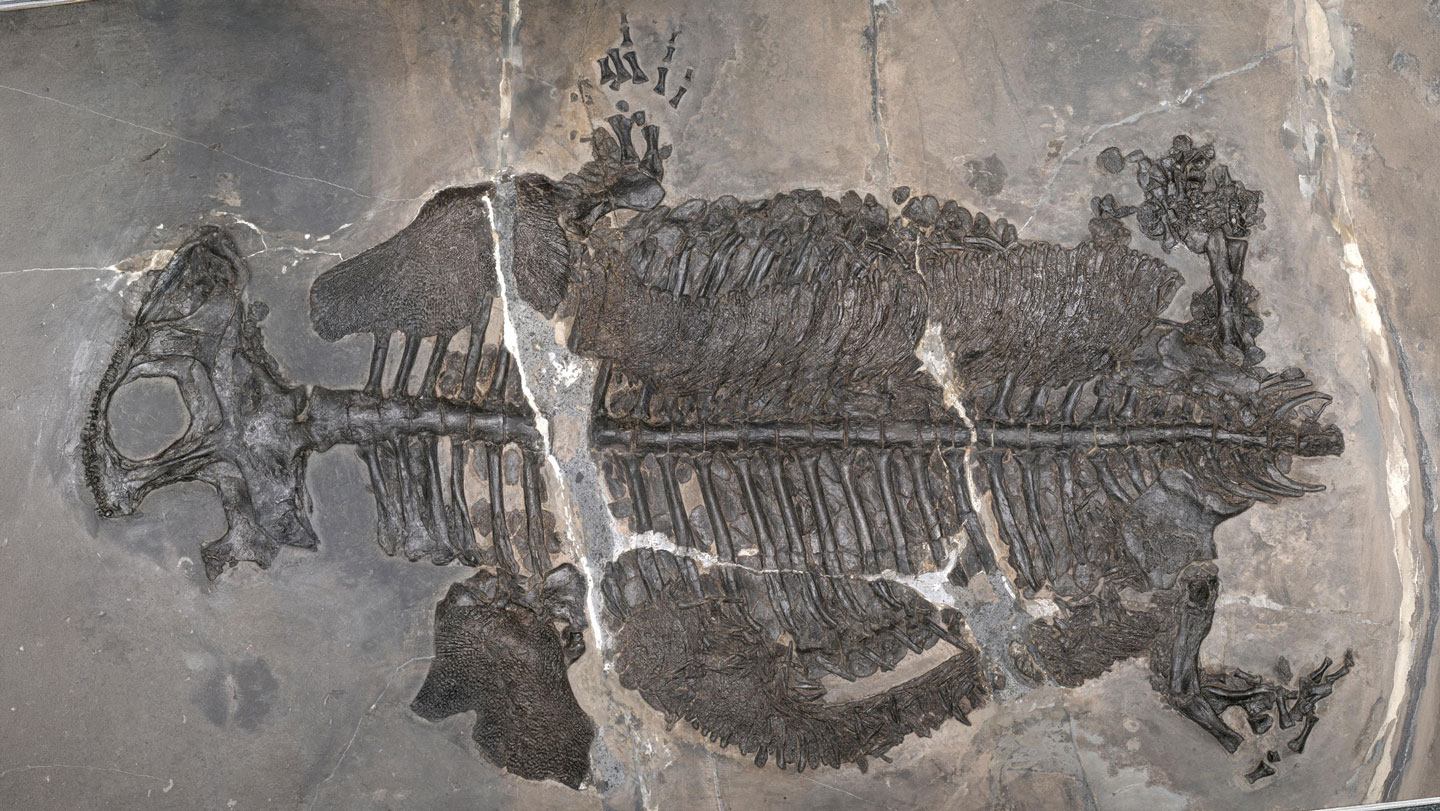
The story begins with two exquisite fossils unearthed from late Triassic rock deposits. Picture a time before dinosaurs truly dominated—a world of harsh tropical heat and vast, shallow seas teeming with strange reptiles and primitive fish. Lying amidst this ancient seabed were the fossilized remains of two creatures, each roughly 70 centimeters long, which is about the length of a modern skateboard. But they didn’t look like a frog or a salamander. They looked like a prehistoric tank. Their bodies were swathed in a heavy mosaic of bony plates, creating an impenetrable suit of armor. The body itself was flat and disc-like, perfectly hydrodynamic for hugging the seabed, and their eyes were situated high on the skull, giving them a permanent upward gaze to spy on the world above. When Motani and his colleagues first laid eyes on them, they saw close relatives of freshwater amphibians known from other deposits—creatures that lived in lakes and rivers. Yet these particular fossils were found in strata that was unmistakably marine, located a heart-stopping 30 kilometers away from the nearest ancient landmass. The immediate scientific dilemma was profound. Had these animals died on land, been swept out to sea by a cataclysmic flood, and simply been buried in the deep? Or was this their actual home, a place where they lived, hunted, and died generation after generation? The bones alone couldn’t tell them. The answer, they realized, lay hidden in the very chemistry of the fossilized tissue.
Paragraph 3: The Chemical Fingerprint of the Sea
To crack this 237-million-year-old mystery, the team employed a geochemical fingerprinting technique that reads the very essence of an animal’s environment. Our bones and teeth record the chemistry of the surroundings in which they grow. When animals drink water and eat food, they incorporate elements like strontium into their skeletal framework. Strontium comes in different isotopic weights, and the precise ratio of these isotopes varies distinctively between the ocean and freshwater sources. Seawater is rich in a specific isotopic signature, while rivers and lakes carry a different one. The team carefully extracted strontium from the skulls and bones of the G. maritimus fossils. When they ran the numbers, the results were staggering. The strontium isotope ratio in the bones matched the open ocean of the Triassic Period with pinpoint accuracy. This was unequivocal proof that the creature wasn’t just a drifter who stumbled into the waves—it was actively imbibing seawater every day of its life, and its diet consisted of marine prey. “That means it lived there,” Motani stated with quiet confidence. Lachlan Hart, a paleobiologist at the University of New South Wales in Sydney, who wasn’t involved in the study, called this the first time we have hard evidence of an amphibian actually adapted for long-term life in the sea. For decades, scientists have hunted for a truly marine amphibian. They had found fragments and suggestions, but never solid chemical proof. This discovery shatters all previous assumptions, offering the smoking gun that G. maritimus was a genuine, lifelong citizen of the deep blue.
Paragraph 4: Cheating the Rules of Biology
So how did this ancient amphibian defeat an enemy that has slayed every one of its modern descendants? The answer lies in a brilliant suite of evolutionary “cheat codes” that essentially closed the pores its relatives rely on. To breathe and absorb water, modern amphibians depend on their skin, which is thin, moist, and heavily vascularized. But this very porousness is a death sentence in saltwater. The armor of G. maritimus solved that problem entirely. Thick, overlapping bony plates encased its body, acting like a sealed casing that prevented any water exchange across the skin. What was likely an adaptation to fend off predatory reptiles and fish accidentally served as the ultimate saltwater shield, preventing the rapid dehydration that would kill a standard frog. But the armor was only half the story. Modern amphibians undergo metamorphosis—they begin life with gills, but as adults, they usually develop lungs and shed their aquatic breathing apparatus. Not G. maritimus. This odd creature clung to its larval traits. It retained fully functional internal gills for its entire life, allowing it to extract dissolved oxygen from the water just like a fish. This dual innovation—an internal water-tight shell and permanent aquatic gills—allowed it to navigate the ocean depths where pressure is high and oxygen can be scarce. It essentially reinvented itself as a walking fish with amphibian ancestry, perfectly equipped to colonize a habitat that was considered biologically off-limits to all amphibians.
Paragraph 5: The Toilet-Seat Ambush
Visualizing the life of G. maritimus is to imagine a creature straight out of a science fiction movie. It was an ambush predator, a true silent hunter of the seafloor. Flattened and still, it would bury itself in the mud or sand, its eyes peeking just above the substrate, scanning the murky water for any sign of movement. But its most extraordinary hunting tool was its mouth. G. maritimus didn’t simply open its jaws like other predators. Instead, its skull was hinged in a bizarre way that allowed the entire upper jaw to swing upward—imagine a toilet seat being lifted. In a fraction of a second, this sudden, massive opening created a powerful vacuum effect in the surrounding water. Fish, crustaceans, and any other small marine organisms unfortunate enough to swim near would be yanked violently into the amphibian’s throat before they could even sense the danger. This strange suction-feeding mechanism is highly efficient in water, which is dense and difficult to move quickly. It allowed the armored amphibian to strike with lightning speed without ever having to move its body, keeping it hidden and safe. The combination of gripping camouflage, impermeable armor, and a lethal toilet-seat jaw made G. maritimus one of the most unique and successful ambush predators of its time, ruling a dark ecological niche that has remained empty ever since.
Paragraph 6: Rewriting the Past, Unlocking the Future
The significance of this find reaches far beyond the peculiar life of one extinct creature. It forces a fundamental reevaluation of amphibian evolution. The fossil record is littered with stories of mammals, reptiles, and birds conquering the seas—whales, ichthyosaurs, and penguins are all iconic examples. But amphibians always remained the stubborn anomaly, the group that evolution just couldn’t push into the marine realm. This discovery proves that barrier was only a lack of imagination. As Hart points out, because we expect amphibians in freshwater, we tend to overlook marine deposits when looking for their fossils. We have been blinding ourselves to the possibilities. This armored, salt-drinking, suction-feeding amphibian opens the door to a tantalizing prospect: there may be other marine amphibians lurking in the fossil record, waiting to be discovered. They may not look like amphibious frogs, but rather like weird, armored sea monsters. The Triassic oceans were wild and diverse, and this discovery shows us that we have only scratched the surface of what they held. It serves as a humbling reminder that Nature is far more creative than our scientific doctrines. Just when we think we have the story of life on Earth mapped out, the past surges forward with a 237-million-year-old curveball, forcing us to redraw the boundaries of what is biologically possible and to marvel at the indomitable spirit of adaptation that defines all living things.