

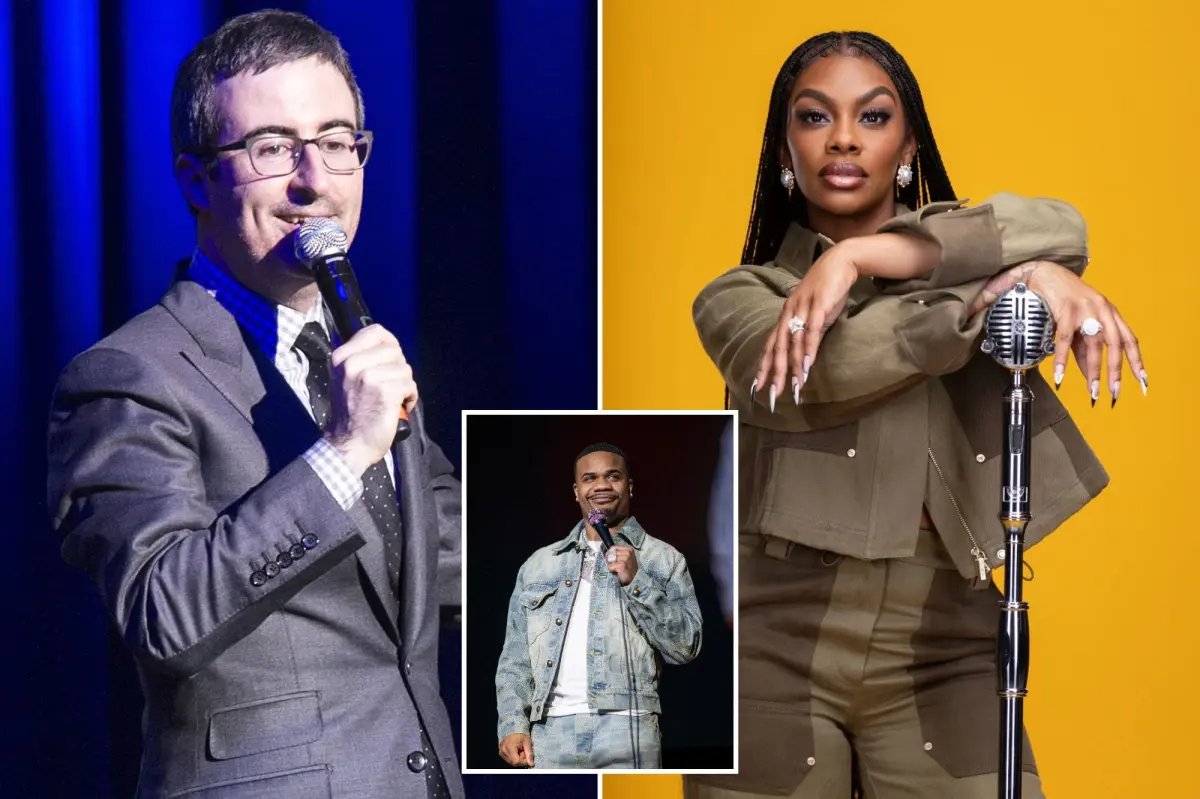
New York City in early November can feel like a pressure cooker. The midterm elections are right around the corner, the cable news chyrons are screaming, and everyone is bracing for the worst. Jordan Klepper, the comedian and Daily Show host, has a simple plea for the American people: please don’t riot. He doesn’t just say that because he wants to protect the American Experiment, although he does. He also has a packed schedule of comedy shows to enjoy. “The New York Comedy Festival has so many shows and I want to go see them and I want to be able to sit back and laugh,” the 47-year-old told The Post. “So come on, America. Let’s all be together so New York can enjoy this week.” Klepper will actually be one of the people onstage, too, performing his caustic current-events sendup “Sh&t Show” at Town Hall on Nov. 14. But his larger point stands: amid all the anxiety and chaos, the festival—the 20th anniversary season of the New York Comedy Festival—is a chance for the city to exhale. From Nov. 6 through Nov. 15, more than 200 comedians will take part in over a hundred shows, ranging from tiny clubs in Brooklyn where you can almost touch the brick walls to the enormity of Madison Square Garden, where Dave Chappelle will kick off the festival with the kind of headlining set that defines a generation. Other major names include Marc Maron, Jordan Jensen, and Daniel Sloss at the Beacon Theatre on the Upper West Side, plus Saturday Night Live’s delightfully deranged Sarah Sherman alongside Patti Harrison at Town Hall in Times Square. It’s a sprawling, messy, glorious panorama of comedy, with room for everyone from the polished veteran to the bold first-timer. And if Klepper has his way, the whole country will behave itself long enough for New Yorkers to enjoy it.
The festival’s founder, Caroline Hirsch, is the Manhattan comedy doyenne who knows what it takes to make audiences laugh. Her original venue, Carolines on Broadway, was the festival’s home base until it closed in 2022, but the festival itself has grown far beyond any single room. “Comedy has just exploded and is bigger than ever,” she says. Louis Faranda, the festival’s talent curator, echoes that disbelief. “If anybody told me 20 years ago that comedy would be as big as it is today, I would say, ‘You’re out of your mind.’” He describes a scene that never stops multiplying: “Every time I think I’m on top of which comedians are breaking out, 50 more appear. It’s unbelievable. I have never seen such an influx.” That embarrassment of riches has shaped the festival’s identity. Hirsch and Faranda see the NYCF as a deliberate foil to the newer, flashier Netflix Is a Joke festival in Los Angeles, which tends to grab headlines with its Hollywood A-list. “That’s about them making content,” Hirsch says, “while our festival is about the nitty-gritty of comedy, of discovering new people and new ways to present comedy. It makes planning a festival harder but it’s also more exciting.” The commitment to new formats has made the festival a trailblazer—it was one of the first to present live podcasts, long before every comedian had one. Today, the lineup includes sketch comedy, improv, clowns, musical acts, game shows, and even performances that incorporate video games. Faranda puts it simply: “Younger kids these days laugh at all different kinds of funny—it’s not just punch lines or jokes.” He is so obsessed with finding the next act that he says, “I get up at four in the morning to look on the internet for new acts.” Still, Hirsch remains partial to the art form that started it all: “It’s the best art form, and getting an hour of great material is the hardest thing to do in the world.” In other words, the festival has widened its net without losing its center.
Of course, with comedy so hot, the fight for talent has become bruising. Faranda finds himself competing not only with streaming giant Netflix, which keeps flexing its muscles from Los Angeles, but also with Live Nation and the enormous corporate touring companies that can offer bigger stage productions, bigger paychecks, and bigger promotion. What keeps the New York festival alive in that landscape, Faranda says, is loyalty. Comedy is a relationship business, and he has spent a lifetime building bonds with comics, many of whom he knew before they were famous. His Dave Chappelle story is the stuff of festival legend: he met Chappelle more than three decades ago, when the comic was a completely unknown teenager, and gave him the chance to take a stage—a moment that led to a friendship and, decades later, Chappelle opening this year’s anniversary installment at Madison Square Garden. That sense of personal investment extends to the rising generation. This year’s festival lineup includes sharp, buzz-worthy comedians such as Jay Jurden, of “The Problem With Jon Stewart”; Olivia Carter, of “The Tonight Show”; and Matthew Broussard, of “The League.” For Hirsch, watching young stand-ups get their big break is “the most exciting part of the festival.” There’s something almost parental in the way she talks about it—the pride in seeing a comic who was once nervous in a small room suddenly own a huge stage. The festival has become a rite of passage for the city’s comedy scene, a place where the next generation gets tested, celebrated, and often discovered. And in a culture where attention spans are shrinking and streaming algorithms dominate, the NYCF remains proudly, stubbornly local: it is about being there, in person, in a room, with a microphone and a crowd.
The festival also holds space for something deeper than satire. For the past two decades, one of its most beloved traditions has been Stand Up for Heroes, a benefit that lives at the intersection of comedy and gratitude. The origin story is heartbreaking: ABC reporter Bob Woodruff was critically injured in 2006 while embedded with U.S. military troops in Iraq. He suffered a traumatic brain injury, and as he slowly recovered, he and his wife, Lee, decided to turn their ordeal into something constructive. They launched the Bob Woodruff Foundation, which supports veterans with the physical, mental, and emotional care they need after returning home. In 2007, the Woodruffs joined forces with Caroline Hirsch and her partner, Andrew Fox, to create Stand Up for Heroes, a comedy fundraiser that has since raised nearly $120 million for American troops and their families. The benefit has become a fixture of the festival, featuring some of the biggest names in comedy over the years: the late Robin Williams, Jerry Seinfeld, John Oliver, and Conan O’Brien have all shared that stage. Jon Stewart is a frequent host, bringing his sharp, compassionate humor; Bruce Springsteen often shows up, offering mildly dirty dad jokes and intimate acoustic renditions of “Dancing in the Dark” and “Born in the USA.” This year’s edition is sold out, but the spirit of the event extends beyond one night—it’s a reminder of how comedy can be both entertaining and meaningful, how a room full of people laughing together can also be a room full of people caring together. And for those who can’t get into that particular show, the festival is filled with other opportunities to experience the same communal magic, from huge arenas to basement clubs. Laughter, the old saying goes, is the best medicine—and here, it also helps fund the treatment.
If you’re hoping to catch the next big comic before the rest of the world does, Faranda has a few recommendations. Two showcases in particular have become reliable talent pipelines: New York’s Funniest and Variety’s Comics to Watch. These are the shows where the city’s top up-and-coming stand-ups prove themselves, and they have an almost eerie track record of predicting future stardom. Past lineups helped launch the careers of Michael Che, Ricky Velez, and Nate Bargatze, all of whom have gone on to become household names in comedy. Faranda promises that this year’s editions will be packed with influential casting directors and industry scouts, all hunting for fresh faces. And he insists that each lineup has been ruthlessly vetted by his team, with an eye toward maximum future star power. But you don’t need a badge or a guide to get lucky. The festival is scattered across the city, and some of the most memorable performances happen in the smallest rooms. You might wander into an unmarked bar in Williamsburg, slide into a chair next to a radiator, and see someone who leaves the crowd speechless with a ten-minute set about nothing in particular. A year later, that same person might be on late-night talk shows or selling out theaters. That’s the thing about the NYCF—the discovery isn’t just for the bookers; it’s for anyone willing to take a chance on a strange venue and a name you’ve never heard. The festival’s true genius is that it makes everyone feel like an insider, if only for a moment. Whether you’re at a glamorous showcase with industry heavyweights or a tiny room with plastic chairs, you’re participating in the same beautiful gamble: that somewhere in a room full of strangers, laughter will erupt and you’ll be part of something special.
Jordan Klepper, for his part, isn’t asking for too much. “The festival is such a great celebration of comedy and New York,” he says. And even if the electoral world goes completely off the rails, even if the political anger spills into the streets and everyone’s doomsday predictions come true, he still wants you to come out to the shows. He has one piece of advice for the apocalypse: “Just leave early,” he jokes, “and have a clear travel plan.” There is something profoundly New York about that attitude—the refusal to cancel your plans at the first sign of doom, the insistence on living your life even when the world feels unhinged, the belief that a good punchline is worth the inconvenience of navigating a chaotic city. Over the last 20 years, the New York Comedy Festival has outlasted economic crashes, cultural upheavals, streaming-era panic, and a pandemic that shuttered every stage in town. It has watched comedy change from a niche art form to a dominating force in pop culture, and it has adapted while staying true to its roots. It has launched careers, raised millions for veterans, and reminded thousands of people why they love to laugh. This year, with all the anxiety of an election week and the ongoing uncertainty of the world, the festival arrives as a welcome act of rebellion. It dares to say: yes, things are chaotic, but we’re still going to gather in rooms, sit too close to strangers, and laugh until our faces hurt. Whether you catch Dave Chappelle at the Garden or an unknown comic in a Brooklyn basement, the message is the same. Come for the comedy. Stay for the joy. And if everything goes sideways, do what Klepper says—get your laugh in early, and make sure you have a safe way home. Because in the end, laughter is the one thing that can make the most absurd reality seem almost bearable. And that’s no joke.