




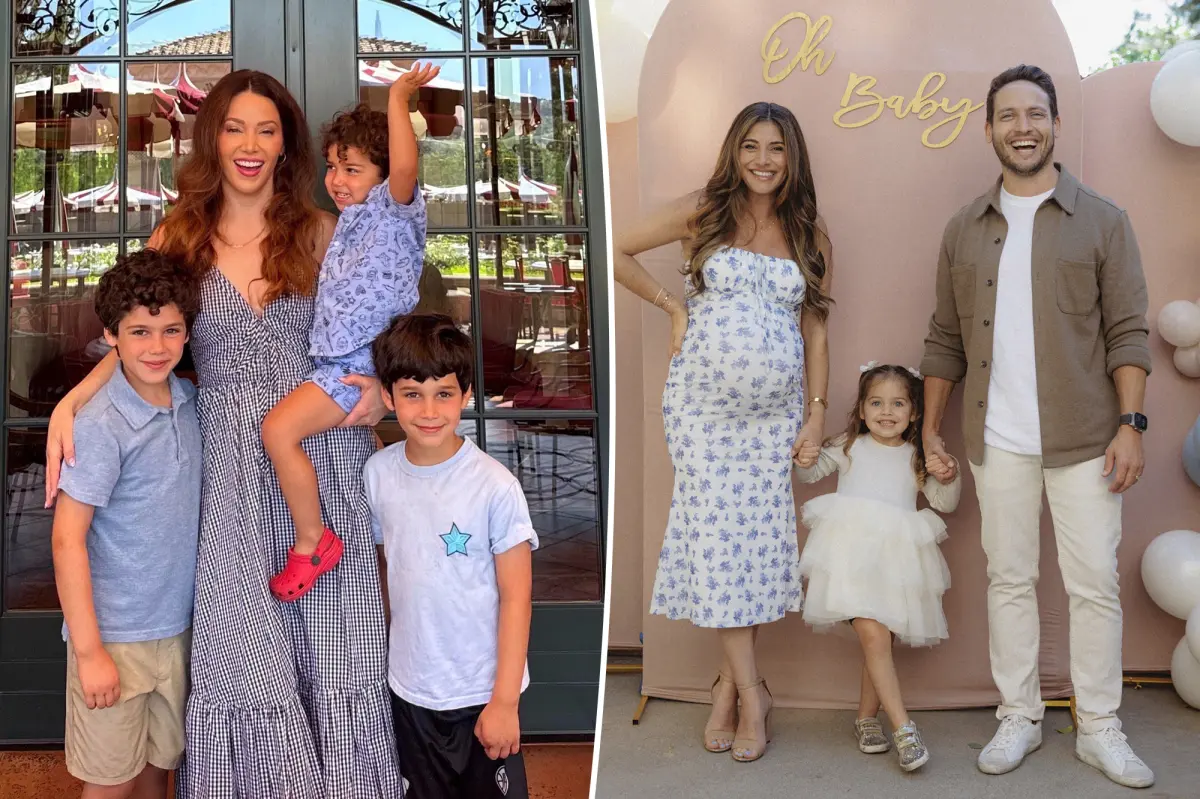
For Stuart Brazell, the dream of a daughter was never abstract. She could almost feel the small hand in hers as she imagined the two of them running through a lavender field together, the purple blooms brushing their legs as the California sun warmed their faces. She had two boys already, and she loved them fiercely, but this third pregnancy was supposed to be the one where the universe finally gave her the little girl she had always pictured: the matching dresses, the inside jokes, the bond she had shared with her own mother, a thread of female connection she desperately wanted to weave into her own life. So when the gender reveal revealed another blue explosion instead of pink, Brazell collapsed into tears. She sobbed on camera, her raw, unfiltered grief witnessed by millions on TikTok, where she joined a growing chorus of parents publicly mourning the sex of their unborn child. It was a confession that felt taboo, an admission that a healthy baby could still bring a broken heart. Three years later, she looks at her youngest son, now three years old, and swears he is the best thing that has ever happened to her. He even bears an uncanny resemblance to the daughter she once dreamed of, a strange cosmic echo that softens the ache. But she will tell you, honestly, that the ache never fully goes away. She mourns the daughter she will never raise, not every day, but many times a day. She cries about it regularly. She feels blessed to have conceived naturally in her forties, grateful for the chaos of her three rambunctious boys, and still, she grieves. It is a contradiction that many parents now recognize: gratitude and grief can live in the same heart, tangled together, neither canceling the other out.
Her story is part of a much larger cultural shift that has quietly upended centuries of gender preference. For most of history, the boy was the coveted child, the heir, the one who would carry the family name into the future. But in recent years, something has changed. The gender-reveal confetti that once promised a son now seems, in certain corners of the internet, to inspire more disappointment than celebration. Viral TikToks show expectant mothers bursting into tears when they learn they are having a boy, and the comments sections fill with sympathy rather than scolding. This reversal has been driven by a tangled web of factors: fraught conversations about masculinity, growing awareness of toxic male behavior, concerns about raising sons in a world that feels hostile to women, and a social-media narrative that often casts boys as harder, louder, more destructive, less emotionally connected. The preference for girls is no longer just a quiet whisper among mothers; it has become visible in data. A 2025 Gallup International survey of nearly 45,000 people across 44 countries found that 19 percent of women preferred a daughter, compared with just 12 percent who preferred a son, even though two-thirds of respondents said they had no preference. The shift has even permeated adoption, where studies show prospective parents favor girls so strongly that the preference is equivalent to a $16,000 difference in adoption costs. Fertility clinics report an uptick in patients seeking daughters through IVF, including international patients traveling to the United States because sex selection is restricted in many other countries. Dr. Brian Levine of CCRM Fertility of New York says he has observed this increase firsthand, anecdotally, in his own practice. The numbers, the viral videos, and the clinical trends all point in the same direction: the age-old longing for a son is fading, replaced by a new and increasingly vocal longing for a daughter.
For some families, that longing is not just about the baby in the crib but about the lifetime of relationships they imagine building. Ruthy Jungreis, a mother of four daughters, remembers a very different era, when friends and relatives would offer condolences every time she welcomed another girl, reassuring her that a son would eventually come along. She never had a son, and she says she wouldn’t have it any other way. Her four daughters grew up sharing movies, vacations, and a closeness that she believes might never have existed if she had raised boys. Her daughter Gayil, now twenty-nine and living in New York City, has an even stronger opinion. She admits she experienced gender disappointment herself when she learned her first child was a son. For Gayil, the preference for daughters is not a matter of fashion or fragility; it is a belief about family structure. Daughters, she argues, are the glue that holds families together. They are the ones who manage the relationships, who keep siblings connected as they grow up and marry, who make navigating in-laws and grandchildren easier, who ensure that no one drifts too far from home. She puts it bluntly: parents need at least one daughter, but they don’t need a son. It is a striking inversion of the old patriarchy, a matriarchal mirror of the very logic that once made boys so prized. But for all the certainty of her words, the reality is more complicated. The longing for a daughter often has less to do with the actual child who might arrive than with the future a parent has already constructed in their imagination. As Giulia P. Davis, a licensed marriage and family therapist, puts it, gender disappointment isn’t really about the baby being a boy or a girl. It’s about letting go of a future you’ve pictured for yourself. The child you imagined, the experiences you dreamed of, the person you hoped to raise and the relationship you hoped to have with that person—all of it evaporates in a single moment of pink or blue.
Heidi Murkoff, author of the beloved What to Expect When You’re Expecting, is not entirely convinced that the anti-boy backlash is as widespread as social media makes it seem. In her community of nearly fifteen million expecting and new moms, she has seen plenty of gender disappointment, but it rarely skews so neatly against boys. Much more often, she explains, the disappointment comes from parents who are expecting another baby of the same gender, the third boy or the fourth girl, or from older siblings who had their hearts set on a baby sister and ended up biting into a blue cupcake. Murkoff is concerned that media-fueled narratives are creating negative perceptions that aren’t grounded in biological reality. Every boy is different, and every girl is different, she insists. Birth order influences personality, so does temperament, so do a thousand small environmental factors that have nothing to do with whether a child has a Y chromosome. She also pushes back against the assumption that women are naturally better at nurturing than men. Men aren’t born to be nurturing, she says, but neither are women. Nurturing is a combination of nature and nurture, and she points to the fascinating biology of new fathers: expecting and new fathers experience a surge in estrogen, a drop in testosterone, and they produce oxytocin just as mothers do when they snuggle their babies skin to skin. That is nature at work. For Murkoff, that hormone-driven bonding is far more powerful than any male-bashing social media narrative. The human body, it seems, is not as committed to the culture wars as the internet is. A father holding his newborn son close is biologically primed to feel love, protection, and tenderness, regardless of the baby’s sex. The question is whether we allow ourselves to embrace that reality or keep repeating the story that boys are somehow harder to love.
Bret Green, a thirty-nine-year-old father in Nashville raising a young son and a daughter, has watched the growing negativity around boys with a mixture of understanding and concern. He understands why women who have been hurt by men might feel apprehensive about raising a son. He has seen the viral videos, he has read the comments, he has heard the jokes about how mothers of daughters are blessed while mothers of sons are martyrs. But he believes that fear misses an opportunity. Rather than dreading what their sons might become, parents have a chance to shape a better generation of men. He sees his son as a chance to course correct, to raise a boy who is kind, emotionally aware, respectful, and strong enough to be gentle. It is his responsibility, and his wife’s responsibility, to make sure their son grows into one of the good ones. Brazell feels that weight of responsibility, too. Her three boys are chaos incarnate. They have accidentally broken her nose during roughhousing and even damaged her surgically corrected eyesight. Life with them sometimes feels like a nightly wrestling match, full of noise, bruises, and mess. But beneath the rough-and-tumble, she insists, her boys are so full of love. She wonders if the current preference for girls is based on a misconception that girls are easier to raise, more convenient, less overwhelming. She disagrees. Her boys are too loud, too much, too intense, and that is precisely why she sees raising them as a bigger challenge. It is a challenge to raise fine young gentlemen, she says, a challenge to bring wonderful men into the world. In her voice is not resentment but pride—a stubborn determination to do the hard work of turning wild boys into honorable men, not despite their energy but because of their potential.
There is no simple answer to the question of whether the world has turned against baby boys. The data suggests a shift in preference, the viral videos suggest a shift in emotion, and the stories of women like Brazell and Gayil suggest a shift in the way mothers imagine their futures. But there are equally powerful voices—Murkoff, Green, Brazell herself—who remind us that gender is not destiny, that a son can be a source of profound joy, and that the imagined daughter who never arrives is not necessarily more real or more precious than the living, breathing, wrestling, laughing little boy who does. What the gender disappointment phenomenon reveals, perhaps, is not a crisis of boys but a crisis of expectation. We build entire futures in our minds before our children are born, and when reality does not match the dream, we grieve. That grief is human. It can coexist with love, with gratitude, with a fierce devotion to the children we actually have. Brazell will never stop mourning the daughter she imagined, but she is also raising three boys who will grow into men because of her. She cries, yes, and she also laughs, and she also wipes away blood from broken noses and ruined eyesight and says, through tears of her own, that her boys are full of love. That is the messy, heartbreaking, beautiful truth of parenthood: we carry both the children we have and the children we dreamed of, and somehow we find a way to love them all. The preference for daughters may be growing, but the deeper need is not for a particular gender; it is for connection, for meaning, for a future that feels safe. And if we can learn to see sons not as the threat that some narratives make them out to be, but as the opportunity they truly are, we might just raise a generation of men who are worthy of everything their mothers have hoped for.