




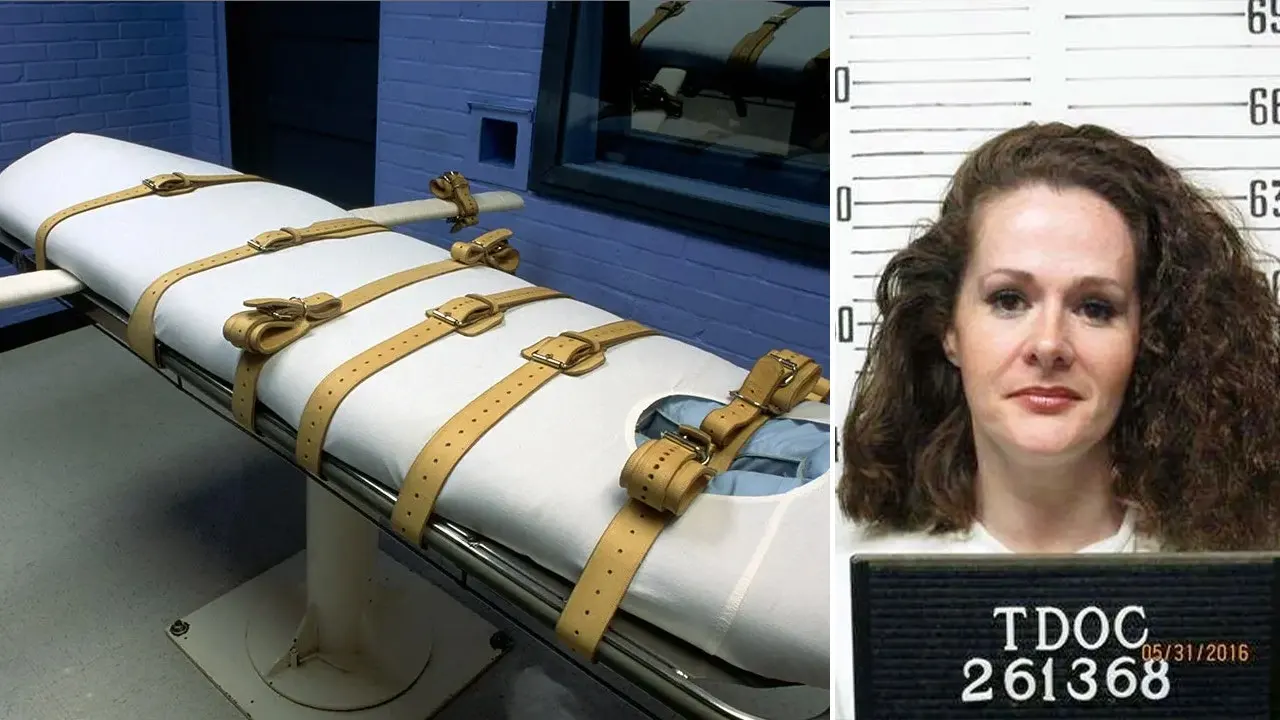
Christa Pike is no longer the menacing figure who once terrorized a Tennessee prison system. Now 50 years old, she is a frail woman lying in an infirmary bed at the Debra K. Johnson Rehabilitation Center in Nashville, still recovering from what should have been her final moment on earth. On September 30, the state of Tennessee attempted to execute her with a lethal injection of pentobarbital. The procedure went catastrophically wrong. Two doses of the drug were administered, and yet her heart kept beating. She did not die. Instead of leaving the prison in a body bag, she survived, and is now the living center of a legal and moral controversy. In the weeks since, as her body slowly mends from the physical trauma of the failed procedure, she has filed an emergency motion in federal court. Her request is not for mercy, not for release, and not even for a cessation of her death sentence. She simply wants to stay where she is for now: in the solitary confinement of the prison infirmary, rather than being returned to the general housing pod she lived in before the execution attempt.
Her fear is raw, immediate, and grounded in lived experience. In the court filing, Pike argues that her current physical weakness leaves her defenseless, and that moving her back to her old unit would amount to placing her in harm’s way. The housing unit in question is not an ordinary cell block. According to the motion, it houses inmates with significant histories of assaults and serious disciplinary problems. Pike says that during the two years she lived there, she witnessed multiple violent attacks—inmates assaulting other inmates, inmates attacking guards, and people suffering acute psychological breakdowns. She describes a volatile, dangerous environment where chaos can erupt at any moment. But now her body cannot respond to threats the way it once might have. “In my current physical condition, I could not defend myself or get away if another inmate attacked me,” she wrote. “I am afraid that I will be seriously hurt if I am moved to that pod while I am this weak.” These are not the words of someone trying to manipulate the system. They are the words of a woman who came terrifyingly close to death, was unexpectedly pulled back from the edge, and now faces the prospect of being thrown back into a world where her survival may depend on strength she no longer possesses.
The motion goes further, painting a grim picture of the conditions that await her. It says that returning to her former housing would expose her to a high risk of infection and further injury, because the environment is unsanitary. She specifically points to a shower that she describes as roach-infested, and explains that she would have to clean it and use it on her own, with no help, while still recovering from the failed execution attempt. For anyone who has ever been weak, sick, or injured, the image is visceral: the thought of standing on unsteady legs under a stream of water in a cramped, bug-filled stall, not knowing if you can even balance long enough to wash yourself. The indignity is compounded by the fear. She is not asking for a hotel room, not asking for special treatment, but for a basic level of safety while her body tries to stitch itself back together. The failed injection left her in a state of profound vulnerability, and the idea of being forced into a hostile environment, where she could be attacked, infected, or simply overwhelmed by the daily demands of survival, feels to her less like punishment and more like a death sentence of a different kind.
It is easy to forget, in the shadow of this human drama, that Christa Pike is on death row because she committed an appalling crime. In 1995, she was a participant in a Job Corps training program in Knoxville, Tennessee, when she and a companion brutally murdered 19-year-old Colleen Slemmer. Slemmer was tortured, beaten, and killed in an act of shocking cruelty that has haunted her family for decades. Pike was convicted of first-degree murder and sentenced to death. Later, in 2001, she added another conviction to her record when she was found guilty of attempting to murder a fellow inmate inside the prison system. That history is not erased by her current condition. She is not a victim of circumstance in the moral sense, and no amount of legal maneuvering should allow us to forget the young woman whose life was taken, or the deep wounds left behind for her loved ones. But the legal system, even while carrying out the ultimate punishment, has always wrestled with the question of how much cruelty is acceptable in the process. The fact that Pike killed and attempted to kill again does not automatically mean she should be placed in a situation where she cannot protect herself from yet another violent assault, particularly while her body is in a weakened state. The challenge is to hold her accountable for her crimes while still acknowledging her baseline humanity—and that is exactly the tension at the heart of her emergency motion.
The execution itself was an extraordinary, traumatic event. For a brief time, Pike was poised to become the first woman executed in Tennessee in more than two centuries. The state had prepared for that historic moment. The drugs were administered. The witnesses were waiting. And then, something went wrong. According to a doctor later quoted in reports, the IV was misplaced, so that the lethal drugs entered her arms instead of her veins, meaning they never reached her bloodstream in the way they were intended to. She did not drift peacefully into death. She woke up. She described the experience as something she never expected to survive. The psychological effect must be enormous—to have said goodbye, to have prepared for the end, to have felt the drugs enter her body, and then to open your eyes in a hospital bed, still alive, still breathing, still facing the same death sentence that just failed to execute you. It is a liminal space, between life and death, between punishment and reprieve. Tennessee Governor Bill Lee subsequently issued a temporary halt on all executions in the state pending an investigation into what went wrong. That investigation is ongoing. Meanwhile, Pike sits in the prison infirmary, caught in a strange legal and medical twilight, her future as uncertain as ever.
As the emergency motion makes its way through federal court, the state has not yet offered a public response. Fox News Digital has reached out to the Tennessee Department of Correction, but no comment has been forthcoming. The case raises difficult questions that go far beyond the particulars of Christa Pike. How do we treat condemned prisoners whose executions have failed? Do they become simply another inmate, or are they marked people, haunted by the botched procedure and resented by officials who must carry out the sentence again? What responsibility does a state have to protect someone it has tried to kill, when that person is now too weak to protect herself? These are not comfortable questions, and they do not have easy answers. At the center of them stands a woman who has done terrible things, but who now finds herself in a uniquely vulnerable position. She is not asking for forgiveness, and no one is offering it. She is asking, quite simply, to be allowed to heal, even if that healing is only temporary—even if her ultimate fate remains the death chamber. The judge must decide whether her fear is valid enough to override the prison’s standard practices, and whether the conditions in her former pod are truly as dangerous as she claims. In the meantime, Christa Pike waits, in a prison bed, between the shadow of her past and the uncertainty of her future.