



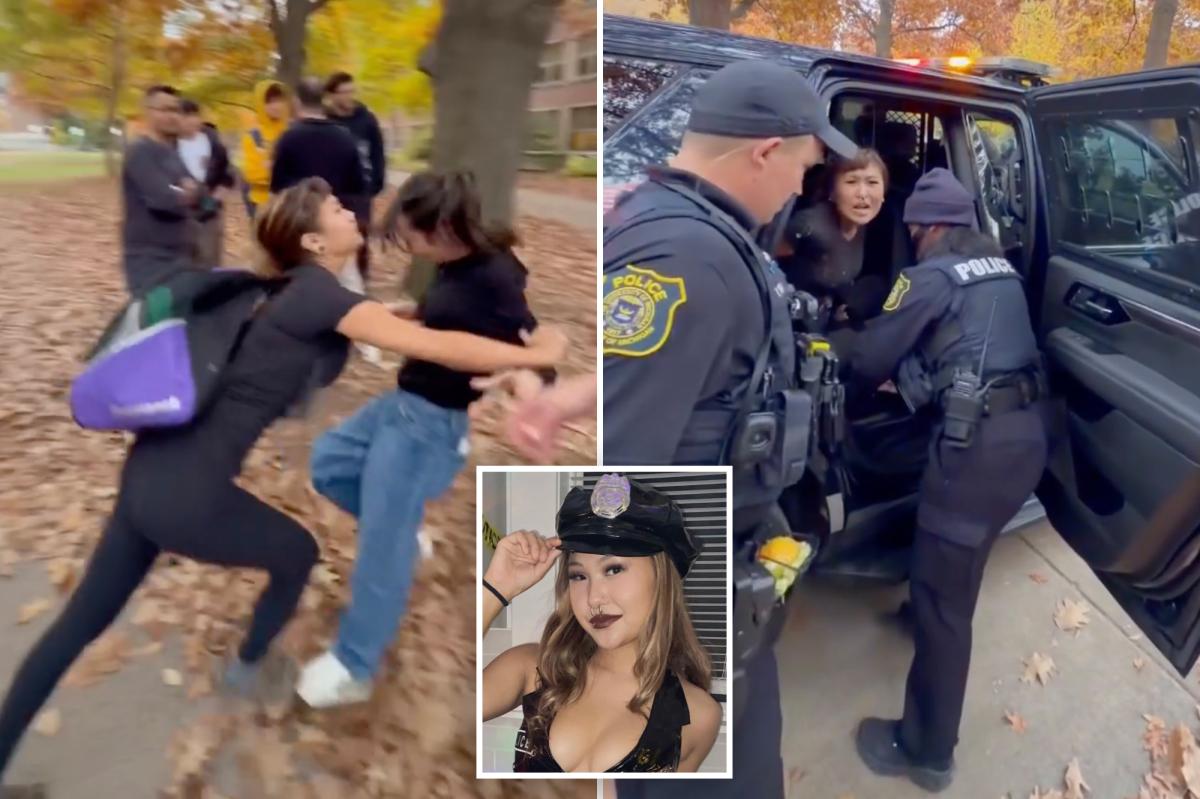
On a Sunday afternoon in Ann Arbor, the University of Michigan campus became the scene of a sudden, violent confrontation during what was supposed to be a free speech event. The Washtenaw County Prosecutor’s Office has authorized criminal charges against Temulun Togochog, a University of Michigan student, after a video surfaced that appeared to show her assaulting a Jewish woman at the event. According to Alyssa Fountain, an administrative assistant at the prosecutor’s office, the case was submitted for review on Monday, and the office said it thoroughly examined the evidence before making a decision. Togochog now faces one count of assaulting, resisting, or obstructing an officer and two counts of assault or assault and battery. Fountain said there is no court date at this time, but a felony warrant for these charges will be issued by the court, and a date will be set once Togochog has been arraigned. The news of the charges came after a weekend that left many students shaken, not only because of the violence captured on camera but because of how quickly a conversation meant to explore ideas had spiraled into something dangerous and deeply personal. The video, which spread rapidly across social media, showed a young woman approaching a table, arguing, and then attacking the people seated there. For those who witnessed it online, the footage was alarming. For those who were present, it was terrifying. What had been advertised as a chance for students to engage with different perspectives had turned into a scene of chaos, fear, and injury. The fact that the victim was a Jewish woman participating in a discussion about Iran and antisemitism added another layer of pain, especially in a time when Jewish communities across the country are increasingly worried about their safety. The charges, while a legal step forward, do not erase the trauma of what happened, nor do they answer the many questions that remain about how this could have occurred on a college campus in broad daylight.
The event was organized by Reawaken USA, a faith-based group that describes its mission as creating spaces for peaceful conversations surrounding faith, ideas, and differing belief systems. On Sunday, the group brought together several voices, including Liz Benichou, who is Jewish, and conservative commentators Cam Higby and Joe Redden. The three sat at a table on campus, talking with students about Iran and about Dr. Abdul El-Sayed, the Democratic nominee for U.S. Senate in Michigan. The Republican Jewish Coalition has called El-Sayed “the most antisemitic US Senate candidate in America,” a statement that made him a natural and sensitive topic for discussion. The conversation was never going to be easy. Questions about Iran, about Israel, about antisemitism, and about American politics are the kind of topics that touch people’s deepest beliefs and loyalties. Reawaken USA’s philosophy is built on the idea that disagreement is a fundamental part of free expression, but that disagreement should never become violence. The group has said it firmly believes that peaceful dialogue is the only meaningful way to confront ideas we oppose. That belief was put to the test on Sunday. The table was open, the setting was public, and students were encouraged to approach and share their views. But one person who approached that day did not come to talk. At least, that is not what the video shows. It shows an escalation from words to physical assault in a matter of moments, leaving the organizers, the commentators, and the students around them to process a situation none of them had anticipated. For Benichou, who had come to the event to share her perspective as a Jewish woman, the presence of security and the open campus setting may have felt like enough protection. The events of Sunday proved otherwise.
The video begins with a young woman, later identified as Togochog, walking up to the table where Redden and Higby were seated. She immediately engages Redden in a heated debate about Islam. The exact words exchanged are hard to hear in the footage, but the body language is tense. Then, in a sudden motion, she uses her phone to slap Redden across the face. The act is so quick that it almost seems surreal, but the sound and the reaction make it clear that this was no accident. Almost as quickly, the woman denies having slapped Redden and accuses the commentators of being “anti-Muslim.” The denial, captured on video, is contradicted by what every viewer can see. But the confrontation did not end there. The same woman then turns her attention to Benichou. At some point, Benichou asks a question about Iran, saying that if the woman “walked around like this in Iran, what would happen to her?” The question appears to have been a rhetorical challenge, a way of pointing out the freedoms that the young woman was exercising in that very moment, freedoms she might not have in a country like Iran. Instead of responding with words, she attacked. The video shows her pushing Benichou to the ground and then jumping on her. The assault is stopped by another student, who pulls the assailant off the victim. The scene is chaotic. People can be heard shouting. The shock on the faces of those standing nearby is visible. For a few terrifying seconds, the idea that a college campus could be a place of safety was shattered. The attack was not a random act of rage; it was aimed at a person who was participating in a protected form of expression. It was directed at someone because she was part of a conversation that the assailant found intolerable. And it was done in full view of other students, many of whom were likely too stunned to intervene quickly enough.
When University of Michigan campus police arrived, Togochog appeared to resist arrest. The footage shows that even after being handcuffed, she continued to shout. According to the video, she yelled, “I should have fing killed you when I fing had the chance,” and added, “I’ve already been to a mental hospital, and I’ll go again if it means killing her.” Those words are deeply disturbing. They are also heartbreaking, because they point to a young person who may have been struggling with mental health issues long before she approached that table. That does not excuse what she did. It does not erase the harm she caused. But it complicates the picture in a way that demands compassion, even as the legal system moves forward. Togochog was processed and released by campus police, and it is unclear whether she remains on campus. That uncertainty has added to the unease felt by many in the university community. Students and faculty are left wondering whether the person who allegedly attacked a Jewish woman is still walking the same hallways, attending the same classes, or living in the same residence halls. The university has not commented on her status, citing federal privacy laws. The lack of information, while legally necessary, has created a vacuum in which fear and speculation can grow. For those who watched the video, the image of a handcuffed student screaming about killing someone is not easily forgotten. It raises hard questions about how universities respond to students in crisis, how they protect the broader community, and how they balance an individual’s right to privacy with the public’s need to feel safe. The arrest was an important step, but it was only the beginning of a long and complicated process.
In the days following the attack, both the university and the organizing group attempted to respond to an incident that no one had expected. Reawaken USA issued a statement reinforcing its commitment to peaceful dialogue. “We firmly believe that disagreement is a fundamental part of free expression, but it never justifies violence,” the group said. The organization also stated that “political violence has no place on our college campuses or anywhere in America.” Those words were clear and strong. But the situation was made more complicated by another development. According to Higby, the university contacted Reawaken USA and asked that the video be removed from social media. The reported reason was to protect Togochog from “negative blowback.” That request has drawn criticism from people who see the video as evidence of a crime, a record of what happened, and a tool for public accountability. They argue that removing the video would protect the person who committed the violence at the expense of the victim and the truth. The university, for its part, issued a public statement on Monday. “Physical violence has no place on our campus,” it said. “The university is firmly committed to protecting freedom of speech and expression, and actions that threaten the safety of others or interfere with their right to express their views will not be tolerated.” The statement then added, “Due to federal privacy laws, the university cannot comment on specific student conduct matters.” That legal disclaimer is necessary, but it also leaves many questions unanswered. Will there be a campus disciplinary process? Will the student face consequences beyond the criminal charges? Will the university do anything to address the safety concerns of Jewish students and other students who may now feel vulnerable? The statement, while strong in its condemnation of violence, cannot provide those answers without violating privacy laws. And so the university finds itself in a difficult position, trying to protect both the victim’s right to safety and the accused’s right to due process. It is not an easy balance, but it is an essential one.
Sunday’s attack was not an isolated outburst; it is part of a broader and deeply troubling pattern in American life. Political discourse has become increasingly harsh, and college campuses, which have always been places for challenging ideas and difficult conversations, are not immune to that harshness. This particular incident also carries a specific and painful resonance. The victim was a Jewish woman participating in an event that discussed antisemitism and U.S. politics. The assault was directed at her while she was engaged in speech, and the video shows that the confrontation began with political debate and ended with physical violence. In an era when antisemitic incidents are rising across the country, this attack has intensified the fear that many Jewish students already feel. It has also forced the wider community to confront uncomfortable questions. How do we respond to political violence when it happens in front of our eyes? How do we punish those who cross the line without losing sight of the humanity of everyone involved? The young woman who allegedly committed the assault was not simply a political opponent who lost her temper. By her own words, she had been in a mental hospital before. That does not reduce her responsibility, but it does complicate the response. A just society must hold people accountable for the harm they cause. It must also recognize that punishment alone will not solve the underlying problems of anger, polarization, and untreated mental illness that can lead to such moments. Universities, in particular, have a unique role to play. They must protect free speech, but they must also ensure that speech does not become a cover for assault. They must care for victims, but they must also support students in crisis. They must be transparent, but they must respect privacy. None of these tasks are easy, and no institution will handle them perfectly. But the events in Ann Arbor are a reminder that the stakes are real. What happened at that table was not just a clash of ideas. It was an attack on a person, on the principle of free expression, and on the hope that people with different beliefs can share a public square without fear. The road back will not be quick, but it begins with accountability, compassion, and a renewed commitment to the values that make conversation possible in the first place.