


Paragraph 1: The Arrival of a National Weather Crisis
A formidable atmospheric system is currently sweeping across the vast expanse of the United States, leaving a trail of disruption, danger, and resilience in its wake. This is not a localized weather event; it is a colossal, coast-to-coast meteorological phenomenon that is rewriting the daily routines, safety plans, and civic participation for over 120 million people spread across more than 35 states. From the sun-scorched, arid landscapes of the Southwest, where desert washes have transformed into raging, deadly rivers, to the drought-parched streets of New England, where the earth is cracking for want of moisture, this storm is a paradoxical force of nature. It brings torrential rain and catastrophic flooding to areas that desperately need it least, while simultaneously offering only a false promise of relief to regions tormented by prolonged dryness. As the nation watches in a mix of awe and trepidation, the storm’s sheer scale underscores our intrinsic vulnerability to the elements. It is a week where the weather forecast is not just background noise; it is the headline, the breaking news, and the dominant subject of conversation around water coolers, in airport lounges, and at kitchen tables. The system’s march eastward is relentless, demanding that communities in its path brace for impact, whether that impact comes in the form of an isolated tornado spinning up from a supercell thunderstorm, a flash flood sweeping through a neighborhood, or a blizzard of wet, heavy snow blanketing the highest mountain passes. This is a storm that refuses to be ignored, a reminder that even in our technologically advanced age, the sky still holds ultimate authority over our plans and ultimately, our safety.
Paragraph 2: The Southwest Underwater and Under Siege
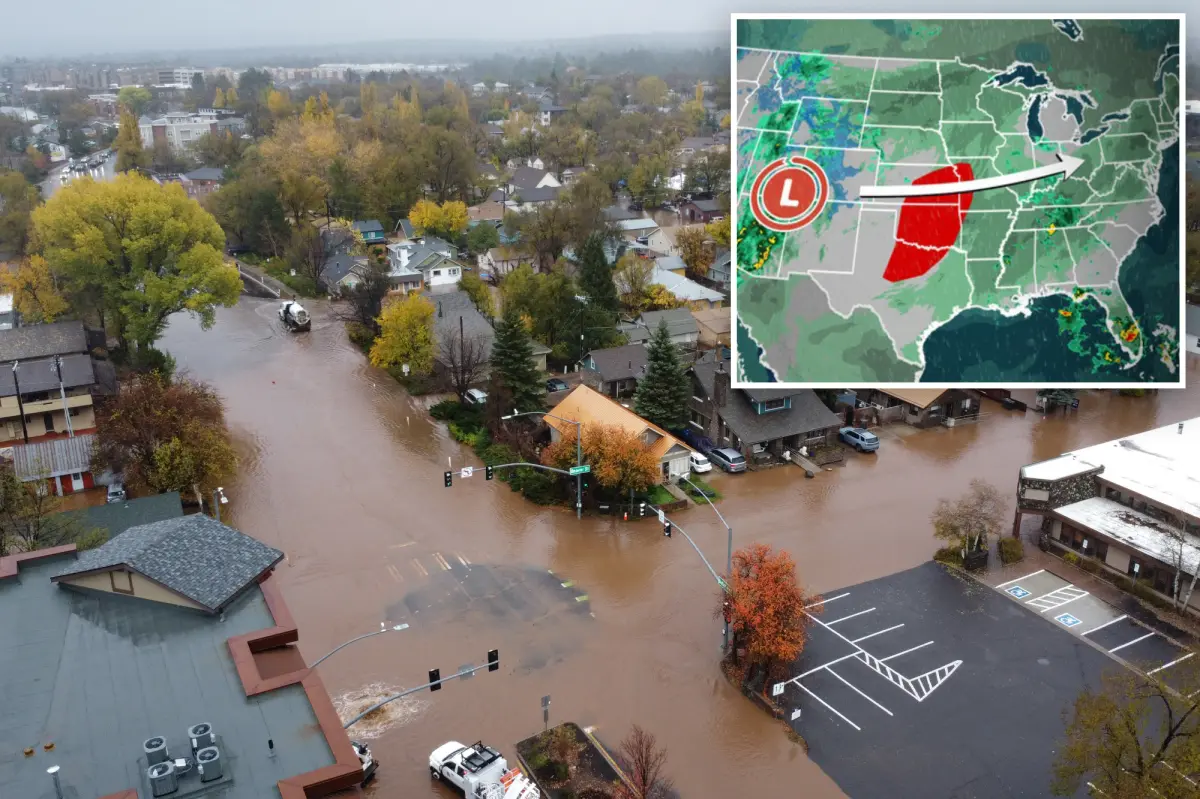
The genesis of this tempestuous saga occurred in the Four Corners region, where the convergence of moisture and atmospheric instability unleashed a deluge of biblical proportions across Arizona, southern Utah, northwestern New Mexico, and southwestern Colorado. The usually brittle, cracked earth of the desert, hardened by months of sun, had no capacity to absorb such relentless rainfall, leading to a nightmare of flash flooding that swept through communities with terrifying speed. In Flagstaff, Arizona, tragedy struck when police confirmed the death of a man who had been swept into a raging flood channel on the weekend; it was a stark, somber reminder that despite all our warnings and weather apps, water remains an implacable and deadly force. The flooding did not merely dampen spirits; it disabled infrastructure, sending several rivers in New Mexico, Colorado, and Arizona to record-high levels, with some rivers still swelling and cresting days after the rain subsided. The impact was so severe and widespread that state governors were forced to act decisively. Arizona’s Governor Katie Hobbs declared a statewide state of emergency, unlocking critical funding and state resources to aid the overwhelmed municipalities digging out from the mud and debris. Similarly, states of emergency were declared in Utah and Colorado, particularly along the San Juan River, where lingering floodwaters posed an ongoing threat to life and property. In these high-elevation communities, the crisis is revealed through the deep human struggle of residents trying to salvage belongings from water-logged basements, compute the cost of ruined vehicles, and navigate roads that have become impassable rivers. The relief efforts are complicated by the fact that while lower elevations contended with torrential rain, the higher altitudes experienced a sudden, jarring return to winter. The highest peaks of the San Juan, Sawatch, Wasatch, and Uinta ranges were buried under more than a foot of dense, wet snow, with mountain passes in southwestern Colorado seeing up to 18 inches. This juxtaposition—snow shovels next to sump pumps—creates a surreal and emotionally exhausting atmosphere for residents who are forced to battle two completely different meteorological extremes simultaneously.
Paragraph 3: Election Day Chaos in the Mid-South
As the week progressed, the storm’s focus shifted dramatically eastward, colliding head-on with one of the most sacred rituals of American democracy: Election Day. Voters in the Mid-South and the Tennessee and Mississippi River valleys braved an onslaught of heavy rain, fearsome wind gusts, and the ominous threat of isolated tornadoes just to cast their ballots. The civic duty that millions of Americans perform was transformed into a logistical gauntlet, testing the patience and resolve of even the most dedicated citizen. Polling sites in parts of the flood-ravaged Southwest, particularly in Utah and Colorado, had to be hastily relocated due to inundated parking lots and inaccessible roadways, forcing voters in those states to track down new addresses at the last minute. In the deep South, the storm system raced across the Southern Plains, slamming Oklahoma with 60 mph wind gusts before pushing into Louisiana, Mississippi, Arkansas, and Alabama by the afternoon. Here, the threat was not just rain, but the real, visceral danger of violent thunderstorms capable of producing damaging winds and a few spin-up tornadoes. Election officials worked frantically to ensure that safety did not compromise suffrage, but the grim reality was that many polling places saw reduced turnout as people wisely chose to shelter in place rather than risk their lives on slick roadways. Forecasters predicted 1 to 2 inches of rain across this region, with isolated spots seeing up to 3 inches in a short period, creating a Level 2 out of 4 flash flood risk that extended through Tuesday night across northern Mississippi and southwestern Tennessee, including the bustling city of Memphis. For the people of this region, the day was marked by a constant, anxious glance at the sky—a communal holding of breath as they grappled with the hope that the storm would not lead to tragedy, and that the democratic process itself would not be washed away.
Paragraph 4: The Midwest Battles Gusts and Ground Soaking
Further north, into the agricultural heartland of Missouri, Iowa, Nebraska, Illinois, Minnesota, and Wisconsin, the storm presented a different, yet equally disruptive, set of challenges on Tuesday. Here, the primary concern was the combination of intense rainfall and treacherous wind gusts. While the total rainfall was expected to be measured in inches—usually one to two—the real danger lay in the powertrain of the storm, which churned out sustained winds of 40 to 50 mph. These winds, gusting across the flat, open farmland, turned hazardous travel conditions into a certainty. For truckers hauling freight along the interstate systems, wind sheer becomes a harrowing test of nerves, and for everyday commuters in cities like Omaha, Des Moines, and Minneapolis, the drive home became a white-knuckle exercise in steering against invisible pushes. The flooding threat was not widespread, but the sheer volume of water coming down in a short period was enough to overwhelm storm drains and low-lying areas, leading to isolated but significant incidents of localized urban flash flooding. This is the kind of flooding that sneaks up on a city—water cresting a curb, spilling into a parking ramp, or backing up into basements, catching residents off guard. Utility companies braced for potential outages as tree limbs, weakened by the saturated soil, snapped under the pressure of the wind. For the residents here, this was a day of disruption rather than catastrophe—a day where cancelled flights, delayed school buses, and soggy commutes reigned supreme. But it also served as a test of patience, reminding us that our daily lives are often at the mercy of systems far beyond our control. The relentless rhythm of rain against the windows provided a somber soundtrack for a region looking to move past the chaos of a general election and get on with the business of daily living, even as the grey skies threatened to upend everything.
Paragraph 5: The East Coast Awakens to a Wet Weekend
As the storm charts its course toward the Great Lakes and Mid-Atlantic, it finally sets its sights on the densely populated I-95 corridor, promising to end a seemingly endless dry streak that has gripped the Northeast. For cities like New York, Boston, and Philadelphia, which have all slogged through more than two weeks without measurable rainfall—their longest dry stretches of the year—the forecast of widespread 1 to 2-inch rainfall totals is the cause of both celebration and concern. The joy is visceral; it is the relief of firefighters who have been battling the specter of brush fires, the sigh of relief from gardeners watching their lawns turn brittle, and the psychological boost of seeing the air washed clean of lingering particulate pollution. However, the human experience is more nuanced, as these same residents harbor a deep anxiety about “minor flooding.” That term, “minor,” is deeply relative to someone whose basement is prone to seepage, whose commute runs through an underpass that rapidly becomes a pond, or whose property lies adjacent to a drainage ditch. The storm promises to bring downpours that could lead to street flooding, snarling the already notorious Northeastern traffic and delaying the commute of millions. Yet, even as rain finally falls, water resource managers and residents of Maine know a bitter truth: this one storm, while heavy, will not fix the region’s deep-seated drought. The entire state of Maine is currently experiencing some level of drought, and the parched, hardened earth can only absorb so much water at once. The storm will saturate the topsoil and perhaps temporarily raise river levels, but it will be a fleeting salve, not a cure, for a long-term hydrological deficit that threatens farming, drinking water reserves, and forest health.
Paragraph 6: Resilience, Reflection, and the Storm’s Wake
Ultimately, this cross-country storm is more than just a collection of weather maps and radar echoes; it is a profound human story of adaptation, resilience, and sacrifice. It is the tale of emergency managers in Arizona working sleepless shifts to evacuate neighborhoods, of National Guardsmen coordinating rescues in flooded canyons in Colorado, and of poll workers in Tennessee who stood by their stations even as thunder rumbled overhead, determined to ensure that every voice could be heard. It highlights the heartbreaking reality that climate change is manifesting in extreme “weather whiplash”—the abrupt oscillation between drought and deluge, between baking heat and paralyzing snow. As the storm moves off the coast, presumably by the end of the week, the assessment begins. Insurance adjusters will trudge through mud-soaked homes in the Southwest, civil engineers will inspect roadbeds undermined by rushing water in Missouri, and municipal planners in Maine will watch the rain gauges with grim hope. For the 120 million people caught in the storm’s wake, the experience is unifying, a shared moment of vulnerability where normal life pauses to glance at the sky. But it is also a testament to the indomitable human spirit. Communities rally, neighbors help neighbors move cherished possessions to higher ground, and the machinery of government and volunteer aid cranks into action to begin the slow, arduous process of healing. This storm will pass, the waters will recede, and the sun will eventually reclaim the sky, but the memories of its power—and the steadfast courage of those who weathered it—will linger for years to come, serving as a powerful reminder of nature’s might and humanity’s boundless capacity to endure.