




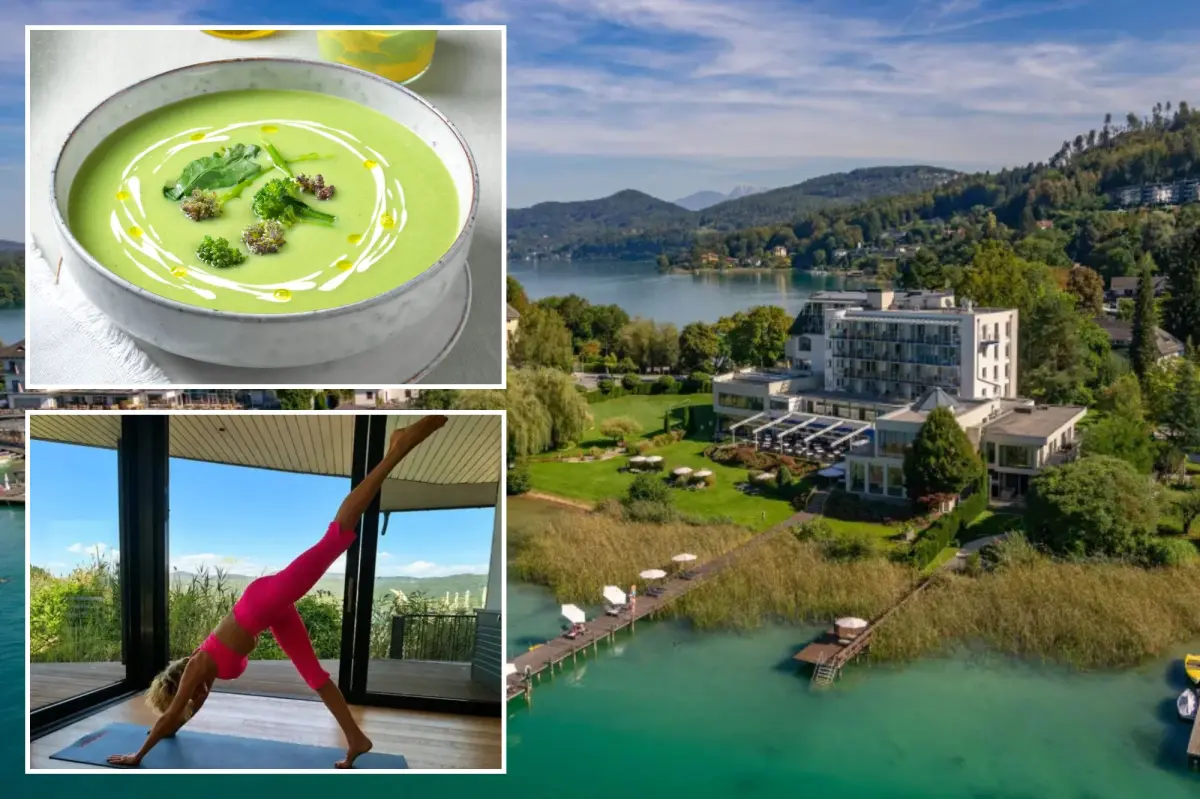
I’d been traveling for about four hours when I finally checked in at Vivamayr, a luxury health spa in Austria where week-long stays start at around $7,000. It sits on an idyllic lake in Maria Wörth, a picture-perfect Austrian town that feels like it was designed for postcards, and the resort itself hums with that expensive sort of calm that makes you think you’re about to be pampered into oblivion. The guest list, I’d been told, includes Bollywood stars and Hollywood celebrities—Elizabeth Hurley and Melanie Griffith have both stayed there—and I was ready to see how the other half lives. But I was also exhausted and battling jet lag, so when the front desk staff asked if I wanted a refreshment, I perked up immediately and eagerly requested a cappuccino. The woman’s expression turned serious in a way I didn’t expect. “I’m so sorry, but we don’t serve coffee at the resort,” she said. I waited for her to laugh, to tell me she was joking, to offer me a cappuccino with a wink. She didn’t. That was the moment I realized this wasn’t going to be a soft, gentle wellness retreat. It was a serious detox program, and I wasn’t sure I was ready for it. I stood there with my suitcase and my caffeine headache already forming in the distance, wondering what exactly I had signed up for.
As a travel journalist, I’ve stayed at my fair share of wellness resorts around the world, and most of them are about relaxation—spa treatments, butlers, shaded cabanas, maybe a green juice before a massage. Vivamayr is different. It’s less about indulgence and more about an internal digestive makeover. The resort is built on Modern Mayr Medicine, a method created by Austrian physician Dr. Franz Xaver Mayr over a hundred years ago. Dr. Sepp Fegerl, the head of the medical department, told me that Mayr observed how closely digestive efficiency and intestinal health are tied to overall well-being. The goal isn’t just weight loss, he explained; it’s about restoring the biological preconditions that make self-regulation and regeneration possible in the first place, by relieving the digestive tract, retraining eating behavior, addressing intolerances, and correcting deficiencies. I’d heard before I arrived that this place was “the real deal” from a couple who had stayed there, and a mother and daughter from New York told me they return every year. The daughter, who was in her late 50s, said, “Every time I leave here, my health is perfect. I go back home, my doctor gets my bloodwork, and everything is normal.” A close friend of mine had also been going for years and swore the Mayr Method healed her chronic gut issues. That was enough to convince me to accept an invitation to try it myself. The method revolves around ten “Golden Rules,” and they are deceptively simple: chew every bite at least 25 to 30 times; don’t drink liquids with meals; eat only when relaxed and skip the meal if there’s no time; don’t snack between meals; avoid raw food after 4 p.m.; stop eating the moment you feel satisfied; breathe through your nose while chewing; pay attention to food source, preparation, combination, and storage; treat daily rhythm as prevention; and never read or use your phone or laptop while eating. Reading them on paper, they sounded like common sense. Living them was another story entirely.
My stay started with a 60-minute consultation, during which Dr. Fegerl reviewed my lab results and asked about my health concerns. I mentioned a recent bout of food poisoning I’d picked up in Costa Rica, and he suggested it could explain possible parasites in my gut. His prescription was magnesium citrate—which has a strong laxative effect—to help clear me out. He advised me to take it easy for the next few days, meaning no gym and no sauna, and he admitted it wouldn’t be pleasant as my body began detoxing. He wasn’t wrong. The first 48 hours were more challenging than I expected. I had a pounding headache and felt extremely lethargic, which left me taking several naps a day. By the second day, I was agitated and irritable, and as a heavy coffee drinker, all I could think about was my morning cappuccino and a hearty meal. It was a far cry from my stay at Italy’s Hotel Hubertus, where I spent my days at my own leisurely pace, drifting between a sauna and steam room and napping on the lawn. I can’t say I hadn’t been warned—even by other guests. On my very first day, one woman assured me, “On day 3 you’ll hit a wall.” I had just woken up from a nap, feeling discombobulated, and she looked at me with the calm certainty of a veteran who had been to the resort countless times. I spent those first two days counting down the hours until bedtime, wondering why anyone would pay thousands of dollars to feel this terrible.
Meals were another test of endurance. They were served three times per day, at least four hours apart, and they got progressively lighter, with dinner usually being vegetable broth. There was no buffet, no room service, no hidden snack stash—no other food available at all. To eat, guests were assigned a table on the outdoor terrace with a colored place card and a number corresponding to your personalized meal plan. Neatly lined bottles of vitamins and medications tailored to your health awaited you at each meal, which sometimes made the resort feel less like a wellness sanctuary and more like an upscale senior living center. I was given bitter drops and selenium pills with a card that read “Yellow #2,” which I later learned was one of the stricter meal plans. I’d often look around in envy as I saw one elderly woman eating yogurt in the morning, even though I couldn’t have dairy, while another guest had a heaping bowl of cooked vegetables and slices of veal for lunch, which felt like a Thanksgiving feast compared to my celery soup and a canapé-sized portion of roasted turkey. At one point, a woman proudly showed off her plate to another guest, who chuckled and said, “Oh, you’re lucky, enjoy that!” Most guests were solo, so meals were often shared in silence with views of the lake. Phones were prohibited while eating to encourage guests to be present. At first, the silence was awkward and almost unbearable. But gradually, it forced me to actually focus on the food in front of me and on chewing. Over time, my hunger subsided, and I started to taste vegetables instead of inhaling them. I realized how often I normally eat without noticing what I’m doing.
Of course, the hefty price tag isn’t just for a limited diet—there are also a ton of treatments and technology involved. My days were filled with customized therapies, including oxygen therapy, an electrolysis footbath, forest walks, cryotherapy, a nutritional consultation, breathwork, an HRV stress test, a sea salt peel, regular abdominal massages administered by the doctor, and even hypnosis. Another session with the doctor involved applied kinesiology, or muscle testing. Dr. Fegerl opened a drawer filled with tiny vials of various substances—coffee grounds, egg whites, and other potential triggers—and, like a mad scientist, he selected one for me to hold between my fingers. I lay down with one knee bent, and he tested my muscle strength by asking me to push against his hand as he applied resistance to my knee, repeating the process with different vials. It all felt a little too woo-woo for my taste. But then, while I held certain vials, my muscles immediately became weak. I was genuinely surprised. After additional testing and abdominal massages, the doctor concluded that I was sensitive to histamines. “Many factors can influence muscle response—allergens, toxins, food intolerances, medications, minerals, trace elements, vitamins, and even emotional factors,” Dr. Fegerl told me. “Once an imbalance is identified, further factors are tested to find what restores a balanced response—this is how the individual therapy plan is built.” I still can’t fully explain why certain vials made my arms go weak, but I stopped pretending I knew better.
Was it worth it? The stay itself may have been torture at times, and I was only there for four days while most people go for a week or two, but I do think this was the most legitimate longevity and medical resort I’ve ever been to. Surprisingly, I would even consider visiting again the next time I need a serious reset. It definitely had its bumps and hunger pangs, but I was shocked by how much of the experience I took home with me, including several of the Mayr Method’s Golden Rules. I felt lighter, I wasn’t bloated, and I even shed a few pounds. My relationship to food has changed, too. I slowly got used to eating only three times per day, my cravings literally went away—really—and I learned to listen to actual hunger cues instead of eating out of habit. I now start my mornings with my largest meal at breakfast and try to focus on the plate in front of me, treating it as a mindful ritual. I also try to stop eating by 7 p.m. most nights to give my body time to digest. If you’re looking for a kick in the pants to get your gut health in check and would prefer to do it amid some pretty gorgeous scenery, this is a great place to do it. But don’t expect to be pampered, and maybe avoid the cold-turkey caffeine shock by weaning yourself off coffee the week before you go.