

At nightfall in Ukraine, the silence was never truly silent. As American voters were preparing to head to the polls for a midterm election that would consume the world’s attention, Ukrainian President Volodymyr Zelenskyy stepped before cameras and microphones with a stark warning. Russia, he said, was preparing another massive strike—what Ukrainian intelligence had assessed as a coordinated assault aimed squarely at the country’s already-battered energy grid and the supply lines that keep cities alive. The timing was anything but accidental. Moscow, he argued, understood the optics of an American election day. It knew that the world’s foreign-policy gaze would be fixed on Washington, on polling stations, on late-night count projections and razor-thin races. And in that brief window, with Ukraine fading into the backdrop of American domestic drama, the Kremlin would try to punch through with missiles and drones. In his nightly address, Zelenskyy did not sound bitter, though he could have. Instead, his voice carried the weariness of a leader who has learned to translate betrayal into strategy. He asked the international community to prove that Ukraine was not invisible. “The assumption,” he said, “is basically that tomorrow the world will be watching the American midterms, and what is happening here in Ukraine, along with our difficulties with air defense and Patriot missiles, will be overlooked.” It was not an accusation aimed at ordinary Americans, who have their own lives and concerns. It was a plea directed to the wider world, a reminder that the cost of a distraction can be measured in burning homes and lost lives.
That warning landed just hours before Russia once again demonstrated what those attacks look like on the ground, away from diplomatic language and strategic analysis. In Komyshuvakha, a small settlement in the southeastern Zaporizhzhia region, a school being used as a hub for humanitarian aid became a slaughterhouse. It was the kind of place where terrified families gathered because there was nowhere else to go—not for education, not for homework, but for flour, medicine, tins of food, and the fragile comfort of being around other people who were also trying to survive. Ukrainian news outlet Ukrainska Pravda reported that at least 26 people were killed in the strike, among them police officers and first responders who had come to help distribute supplies. Another five were injured, and there were reports of people still unaccounted for, buried beneath debris that was once a classroom. The violence was devastating but, in a sense, familiar: this is what modern warfare looks like when armies target infrastructure and then target the people who try to fix it. The rescuers became victims. The volunteers who had set out to feed their neighbors ended up as casualties. In a school, where children once learned to read, there was now only dust, grief, and the slow, dangerous work of digging through ruined concrete. For Zelenskyy, this was the texture of his warning—the concrete, tragic evidence of what Moscow’s “massive attack” means in human terms. It is not some abstract geostrategic operation. It is a convoy of ordinary life disrupted, a teacher’s desk crushed under the weight of war, a line of desperate citizens turned into a target.
In the aftermath, Zelenskyy reached out directly to the United States, and specifically to President Donald Trump and his administration, with a message that was equal parts desperation and defiance. He did not ask for soldiers, and he did not ask for a miracle. He asked for pressure—real, sustained, economic pressure. In a post on X, he insisted that Russia needed to feel that its attacks on Ukraine would bring painful consequences, not just symbolic condemnation. He called for clear signals from the international community that Moscow’s aggression would not pay, that the revenues from its oil and gas could no longer be used to fund missiles aimed at apartment buildings, hospitals, and schools. “We must not play games with Russia’s oil or gas revenues,” he said. “We must put pressure on Russia in such a way that it has no alternative but to end this war. America can do this.” His language was deliberately blunt, and it contained a warning about the fundamental economic machinery that keeps Vladimir Putin’s war machine running. Every tank, every drone, every artillery shell requires money—money made in part through energy deals, trade loopholes, and financial relationships that continue to exist despite sanctions. Zelenskyy’s point was not to blame American consumers or European businesses trying to heat their homes; it was to expose the uncomfortable truth that wars are sustained by economies as much as by armies. If Russia’s oil continued to burn—that is, if the world kept buying it, refining it, and wiring back profits—then there would always be another shipment of weapons, another aerial strike, another school reduced to rubble. He wanted America to lead, not just with military aid packages but with the kind of financial ruthlessness that would force the Kremlin to choose between its war and its survival.
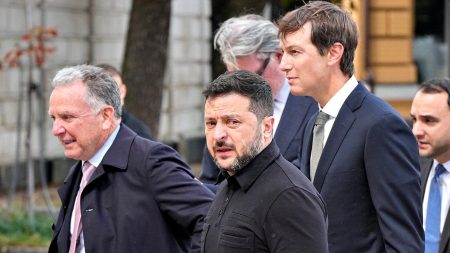
At the same time, on the diplomatic front, Trump was actively trying to bring the conflict toward some kind of negotiated settlement, with the help of special envoy Steve Witkoff and, more quietly, Jared Kushner, both of whom have been involved in sensitive conversations with Moscow. The war has gone on long enough that even the most hardened opponents of Russia have to confront the reality that ceasefires and negotiation tracks can overlap with battlefield operations. Zelenskyy, for his part, has shown surprising flexibility when it comes to tactical compromises, as long as they do not come at the cost of Ukraine’s ultimate security. In a Sunday interview with Fox News, he floated a remarkable proposal: Ukraine would suspend its strikes on Russian oil refineries for one month if the United States would provide Patriot interceptor missiles during that same period. On its face, it sounds like an uneven trade—a pause in offensive operations in exchange for defensive systems. But the logic is grounded in the brutal math of missile defense. Patriot interceptors are the difference between life and death when a Russian hypersonic missile is screaming toward Kyiv or Odesa. They are what allow parents to feel, for a fleeting moment, that the roof over their children’s heads might actually stay intact. By proposing this deal, Zelenskyy signaled that he understood exactly what the American political system values—concrete, measurable progress—and he was willing to use his own leverage to get it. The idea, presumably, was to build trust and create space for more meaningful negotiations, while giving Ukraine the air-defense capacity it so desperately needs. Adding to that hope, the State Department approved the potential sale of 500 Patriot PAC-3 interceptor missiles to Ukraine, a $2.1 billion package that could dramatically strengthen Ukrainian defenses if finalized. But approval is not the same as delivery, and delivery is not the same as installation. The timeline remains uncertain, and uncertainty is perhaps the cruelest luxury in a country where the next missile could be launched at any moment.
Meanwhile, in the southern Kherson region, another quiet drama was unfolding—one that revealed just how fragile any temporary peace can be. A humanitarian ceasefire had been arranged in the town of Oleshky, brokered with the direct involvement of first lady Melania Trump, and during that six-day pause, nearly 800 people were evacuated from the dangerous area. The White House confirmed her role in helping arrange the operation, and for a brief moment, there was a sense that maybe the guns could be silenced long enough for normal life to flicker back. Families climbed onto buses, carrying only what they could fit in their arms, happy to be breathing clean air again. But Ukraine’s General Staff soon issued a far darker assessment of what had happened during those six days. Instead of simply allowing civilians to leave, Russian forces allegedly used the ceasefire to rotate troops, reinforce defensive positions, and improve battlefield logistics. The pause, from Moscow’s perspective, was not just a humanitarian gesture—it was an opportunity to regroup. The Ukrainian statement was careful and measured, noting that the country’s defenders had observed the ceasefire and acted strictly within the framework of the agreements. “The enemy, by contrast, used the humanitarian pause to improve its positions.” This is the maddening reality of a war in which trust is a scarce resource. A humanitarian corridor is supposed to be a sacred thing, a momentary suspension of violence to save lives. But when one side treats it as a chance to reload, it becomes impossible to believe in the next agreement. And yet, what was the alternative? Not to attempt the ceasefire at all, and leave hundreds of civilians trapped in harm’s way? The people of Oleshky may have been saved by the arrangement, even if Russian soldiers also profited from it. That is the terrible ambiguity of war: every gesture is weighed, every negotiation is tested, and human lives get caught in the space between goodwill and opportunism.
Perhaps that is the hardest thing about this conflict to truly grasp from afar—not the politics, not the pipelines, not the battlefield maps, but the accumulated emotional weight of a people who have learned to live with betrayal as a daily administrative detail. Zelenskyy’s warning about a massive strike was not intended to provoke panic; it was intended to prevent it, by giving the world a chance to look before looking away. For more than three years—or nearly five, by the count of some timelines—Ukrainians have woken up every day to the knowledge that their cities can be attacked without warning, that their energy supply can vanish in a single night, that a school can become a morgue in the time it takes to read a headline. They have had to endure the world’s attention drifting in and out, surging when tragedy is fresh and receding when it becomes routine. Zelenskyy wants to keep that attention fixed, not because he wants sympathy, but because attention is a form of protection. When the world is watching, war crimes become harder to commit with impunity. When the world is distracted, the bombs fall heavier. So he makes his appeals—to American voters who are deciding their own leaders, to European officials in their echoing corridors, to everyone who has the power to pressure the Kremlin. He asks for weapons, certainly, and money, and sanctions. But beneath all that, he is asking for something more intuitive: a refusal to accept the normalization of destruction. As the midterms arrive and the United States turns inward, the streets of Ukrainian cities remain lit by the harsh glow of emergency lights. Children still sleep in subway stations during air raids. Ground crews still repair power lines under the threat of drones. And in Komyshuvakha, inside the wreckage of a school, rescue workers still search for the missing. The world may have its eyes on different things, but war does not take a holiday. It does not want a better story. It only wants more ground, more silence, more graves. In the face of that, the only defiant act left is not to look away—and, more importantly, to make sure that Russia, and everyone else, knows that we are not looking away.