

Marvin Willard Jr. has spent his entire life inside Alaska’s vast, quiet embrace, and he carries that deep-rooted sense of place into everything he thinks about—including elections. A Tlingit man from the Chilkat Valley and the village of Klukwan, Willard has been watching the U.S. Senate race “fairly close,” as he puts it, close enough to know that his ballot will carry two men named Dan Sullivan. But unlike the political class in Washington, D.C., and the cable-news pundits who have turned this into a national spectacle, Willard is not losing sleep over the confusing ballot. “I don’t think there should even be an issue on that,” he told Newsweek. What actually keeps him up at night is the price of groceries, the cost of heating his home, and the feeling that politicians are parachuting into Alaska with money and promises, only to disappear after the votes are counted. He asked a simple, pointed question: “Why don’t you raise money to offset our fuel costs in Alaska? Why don’t you raise money to offset all the food prices?” For Willard, the Senate race is not really about who wins or loses—it’s about whether anyone in power is actually going to help ordinary Alaskans survive in a state where everything costs more and the cold waits for no one. He remembers a time when companies in the Lower 48 wouldn’t even ship to Alaska. Now, he says with a wry laugh, “all of a sudden everybody’s interested in Alaska.” To him, that sudden interest feels less like concern and more like opportunism, a gold rush of political attention that will likely leave residents behind once the race is over.
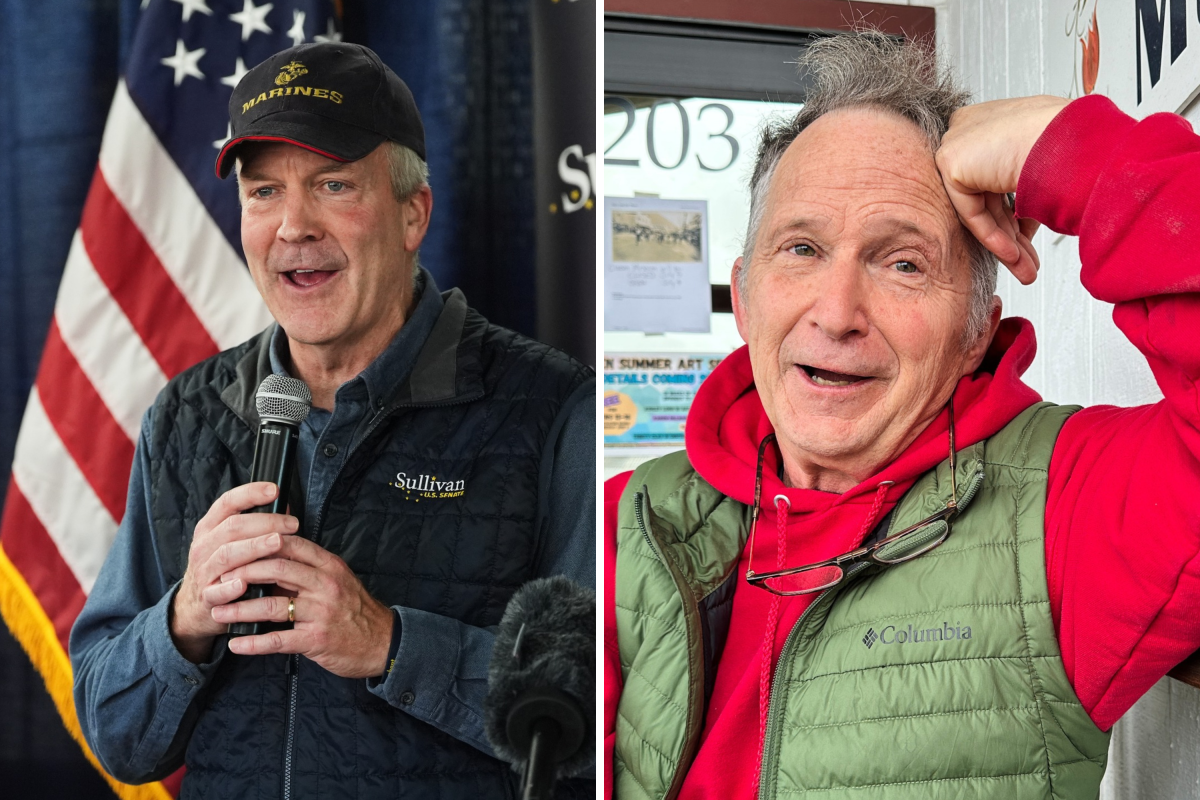
The controversy that has captured the nation’s attention is straightforward on its surface, but tangled underneath. On November’s ballot, Alaska voters see two names that look almost identical: Dan S. Sullivan, the Republican incumbent, and Daniel J. Sullivan Jr., a retired Petersburg schoolteacher who filed to run with no party affiliation and whose name appears below the senator’s. President Donald Trump weighed in, arguing that the ballot should have labeled his endorsed candidate “Senator Dan Sullivan” rather than using the word “incumbent,” because, he said, “a lot of people don’t know what incumbent means.” The state’s elections director initially disqualified the second Sullivan in June, determining that he had filed “with a purpose to confuse or mislead.” But two Alaska courts overruled her, ruling that no state law requires a candidate to run in good faith, and so both names stayed. In August’s primary, Senator Sullivan captured 41.4 percent of the vote, while his namesake received just 2.5 percent—a number that suggests he was never a serious contender, but a number that could still matter in a race as tight as this one. On Sunday, a federal judge dismissed a Justice Department lawsuit—one Trump said he ordered—that sought to delay certification if the senator lost and the votes cast for the other Sullivan could have changed the result. The department plans to appeal, and federal and state investigators are still looking into the recruitment of the second Sullivan, including allegations that Democrats were involved, which Mary Peltola’s campaign forcefully denies. But while the country has been following this unfolding legal drama, the Alaskans who spoke with Newsweek in the final days of the race were telling a much more human story, one about trust, confusion, and the everyday realities that ballots can’t capture.
That confusion is real for some voters, and it is not hypothetical. In Wasilla, where Trump rallied beside the senator in mid-October, Ronny Johansson gives his neighbors the benefit of the doubt. “Surely the majority of voters have the ability to make out the difference between the two Sullivans,” he said, but he also sees the problem clearly: “Having two similar names on the ballot definitely opens up for mistakes.” In a race forecasters call a toss-up, a single mistake can be the difference between victory and defeat, and Johansson refuses to let either party pretend they have clean hands. “Stacking the ballots isn’t new, and is a tactic that both parties have used before,” he said. “But that doesn’t diminish the seriousness of cheating and being fraudulent in elections. This is something that has to be taken very seriously and must be stopped.” Henry Symons, who lives in Kenai, says the confusion Johansson worries about is not just a possibility—it happened to someone he knows. “Yes, total confusion!” he said. Symons described voting early with a friend who realized they had marked the wrong Dan Sullivan. Election workers destroyed the ballot and issued a new one, and Symons says he would have made the same mistake himself if his friend hadn’t warned the group. He believes the situation was deliberately engineered. “Totally a setup!” he said, even though investigators have not publicly named any targets and the Peltola campaign denies any involvement. Innokenty Lestenkof has heard the same worries from older voters, who are often the most affected by ballot design. Several of his elderly friends asked him how they could be sure they were voting for the right Sullivan. His answer was simple: “I said the one with incumbent next to him.” For these Alaskans, the ballot isn’t a political talking point—it’s a real hurdle placed between them and their voice.
But not everyone sees it that way. Christy O’Brien rejects the premise outright. “No one is confused,” she said, with the confidence of someone who has been watching the story unfold for months. “Everyone knows there are two Dan Sullivans on the ballot. It has been on the news forever and is a non-issue.” She points to the August primary as evidence: if voters were truly baffled, she argues, the split would have been much closer. Instead, the senator won in a landslide against his own name. “If people were confused, there would have been a more even split in the primary,” she said, “but there wasn’t an even split or anywhere even close to it.” The general election will test that theory with a much larger electorate, since only about a quarter of Alaska’s registered voters participated in August, but O’Brien is not worried. Michelle Chase, an undeclared voter who prizes independence over partisanship, agrees. “It’s not a real concern,” she said. “It was easy to distinguish between the two Dans on the ballot. The issue was already addressed by the courts in AK.” She believes the whole matter has been blown out of proportion by people who have nothing better to do than stir up division. “It’s just political theater at this point,” she said. For Chase and others like her, the real questions in this election are about policy, not process—about which candidate will actually deliver for Alaska’s communities, whether that means resource development, infrastructure, or addressing the high cost of living. The constant focus on the confusing names, she argues, is a distraction from the issues that matter, a way for politicians and pundits to avoid talking about substance.
Willard’s perspective goes even deeper, rooted in his heritage and his relationship to the land. He traces his lineage to the Eagle Nest House in Sitka, a connection that gives him a long view of Alaska’s history and its future. “All of our resources took thousands of years to get this plush,” he said. “We should be protecting it, because the longer you sit on plush real estate like Alaska, the more it’s going to be worth in the future.” He is deeply skeptical of resource development, including the proposed natural-gas project that has become a major issue in the race. Its backers argue it will bring jobs and revenue to the state, but Willard wonders how much of that wealth would actually stay in Alaska. “If you want to benefit us,” he said, “then give us 51% of the profits.” That blunt math reflects a broader frustration with a political system that he feels takes from Alaska without giving back. He is just as skeptical of the national attention now focused on the state, seeing the fight over the ballot as an attempt to sway votes rather than a genuine concern for election integrity. He directs that criticism both at national figures and at Alaska’s own officeholders, who he believes are too quick to point fingers instead of offering real solutions. “There’s candidates that tell you what they’re going to do for Alaska,” he said, “and there’s candidates that point the other finger.” Too many politicians, he believes, avoid specifics for a reason: “They don’t want to be held accountable.” His advice for voters is as no-nonsense as his worldview: “Stay off social media. Don’t believe everything you see.” He is tired of campaign emails that tell him how much his children are worth—a rhetorical device that rings hollow to a man who has always known his family’s value. “Well, my kids should have been worth that much to begin with,” he said dryly.
In the end, the Alaskans who spoke with Newsweek are divided on the narrow question of the ballot, but united on something larger: they want honest elections and a government that actually serves them. O’Brien, Chase, and Willard say Alaskans can tell the two Dans apart. Symons and Lestenkof say some cannot, especially the elderly and those voting early. Johansson says most can, but the ballot leaves too much room for mistakes, and that is enough to undermine confidence in the result. That division mirrors the larger national conversation about election integrity, where trust is fragile and every procedural flaw becomes ammunition for accusation. But beneath the arguments about names and labels, there is a quieter, more human thread running through the story. Willard’s question—why isn’t the money pouring into the race going toward fuel and food costs?—captures the fundamental disconnect between political spectacle and everyday life. For him, an election is not a game to be gamed or a strategy to be exploited; it is a chance for people to choose leaders who will protect Alaska’s beauty, share its wealth, and honor its people. Asked what people outside Alaska might be missing, he answered in three words: “Yeah, the truth.” That truth is not about a single ballot line or a court decision; it is about a state full of people trying to live their lives, heat their homes, and feed their families in one of the most stunning and challenging places on earth. The politicians will come and go, the ads will flood the airwaves, and the names on the ballot will be debated for months. But Willard’s patience is not infinite. He has lived in Alaska his whole life, and he knows that the land and its people deserve more than confusion and theater. They deserve leaders who will listen, who will be honest, and who will fight for the future of a place that has given so much to so many. As the votes are counted and the legal battles continue, that is the real challenge facing Alaska—not just a choice between two men with the same name, but a reckoning with what its people truly need.