

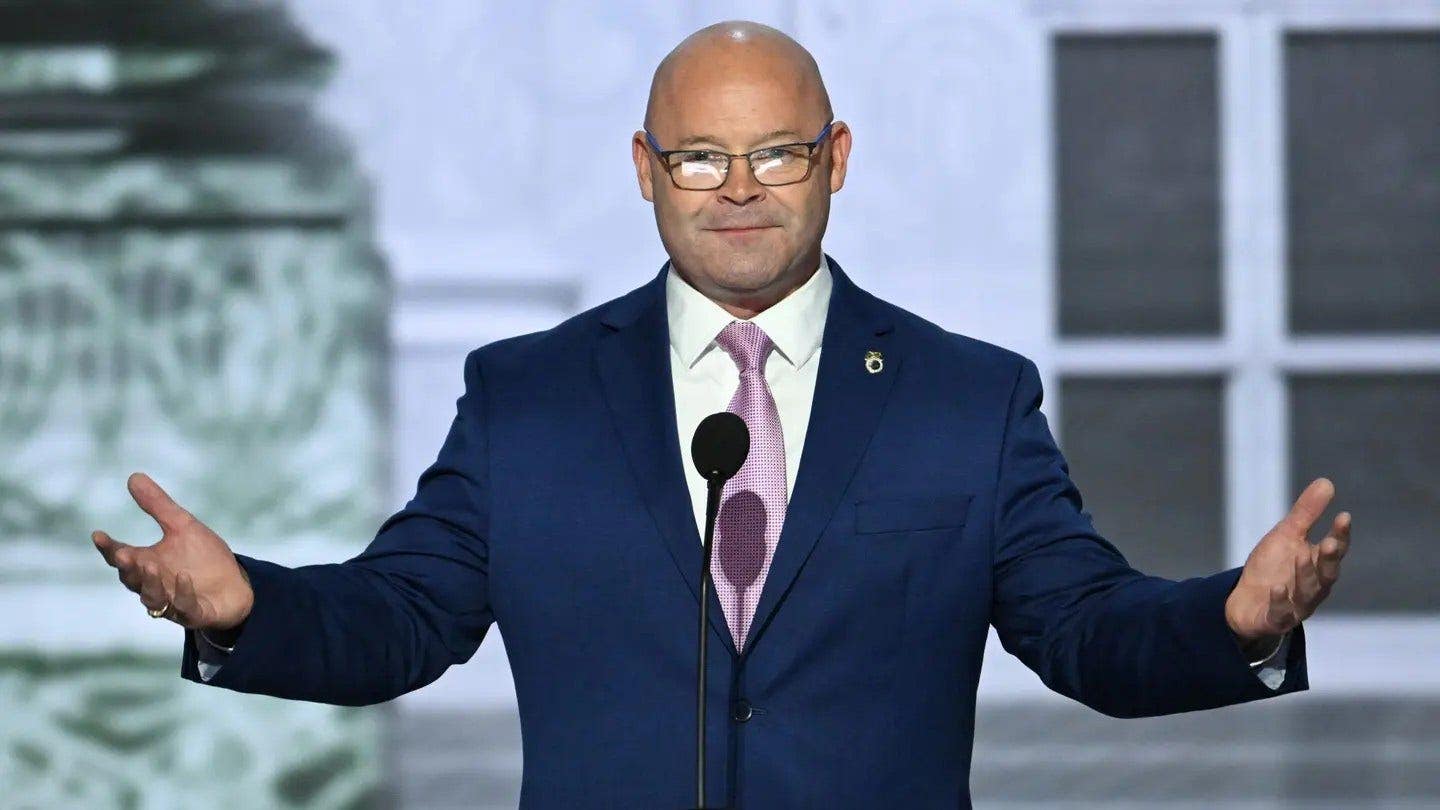
The recent announcement by Sean O’Brien, the general president of the International Brotherhood of Teamsters, has sent a jolt through the world of American labor politics. On a quiet Sunday morning, O’Brien—who leads a union of roughly 1.3 million working men and women, one of the oldest and largest in the country—declared that he had cast his first-ever ballot in Florida for Senator Ashley Moody, a Republican. For a self-described “lifelong Democrat” who had grown up in Boston, a bastion of union strength, this was not just a vote. It was a symbolic and deeply personal crossing of lines that have defined American politics for generations. O’Brien’s endorsement was not a lukewarm nod of politeness; it was a ringing, enthusiastic endorsement of a Republican senator who has been a reliable vote for conservative causes. He praised Moody for her work on protecting worker pensions, defending good-paying jobs, and supporting union apprenticeship programs—issues that supposedly sit at the heart of the labor movement’s agenda. Yet the political implications stretch far beyond a single Senate race. O’Brien’s action signals a broader realignment of working-class voters who feel abandoned by the Democratic Party’s progressive drift, and it raises uncomfortable questions about the future of labor unions in an era of intense polarization. It also injects a personal, almost theatrical element into the Florida Senate campaign, forcing Democrats and Republicans alike to reconsider their assumptions about who truly represents the American worker.
To understand the weight of O’Brien’s endorsement, one must first understand the man behind the title. Sean O’Brien grew up in a working-class Irish Catholic family in Dorchester, Massachusetts, where union membership was as natural as breathing. He joined the Teamsters in 1979 at age 20, starting as a truck driver and eventually rising through the ranks of Local 25 in Boston. His rise was marked by a combative, no-nonsense style that endeared him to rank-and-file members but often alarmed both corporate executives and party elites. O’Brien has long been critical of both parties, but he never hid his Democratic affiliation, even as he grew increasingly frustrated with the party’s leadership. That frustration boiled over in 2024 when he was invited to speak at the Republican National Convention—an unprecedented appearance for a major union president. At the time, he made clear that his presence was not an endorsement of Donald Trump or the Republican Party, but rather a protest against the Democratic National Committee’s refusal to allow him to speak at their convention. “If the far-left want to criticize me and attack me, that’s OK. If the far-right wants to do the same, that’s great. I represent 1.3 million hardworking men and women,” he said then. That same defiant, independent streak is on full display now, but this time it has gone further. By actually voting for a Republican—and announcing it with pride—O’Brien has crossed a threshold that many viewed as unthinkable for a man of his lineage and position. He has also chosen a particularly telling venue: Florida, a state that has become a symbol of Republican dominance and, in the eyes of many progressives, a hostile environment for organized labor. But O’Brien sees it differently. He appears to be embracing the idea that the old rules no longer apply, and that workers’ interests supersede party loyalty.
What exactly has Senator Ashley Moody done to earn this endorsement? Moody, a former state attorney general who was appointed to the Senate by Governor Ron DeSantis to fill the seat vacated by Marco Rubio, is not a typical champion of union causes by any partisan measure. She has a solidly conservative voting record, supporting tax cuts, deregulation, and strict immigration enforcement. Yet O’Brien claims she has been “extremely helpful” to the Teamsters on specific issues, particularly in protecting workers’ pensions and supporting apprenticeship programs. He specifically mentioned her role on the Senate Committee on Health, Education, Labor, and Pensions (HELP), where she has apparently been receptive to the union’s push for the Faster Labor Contracts Act—a piece of legislation that would streamline collective bargaining procedures and reduce delays in contract negotiations. For O’Brien, this transactional approach to politics is not hypocrisy; it’s pragmatism. “The Teamsters look forward to working with Sen. Moody in her role on the Senate HELP Committee to pass the Faster Labor Contracts Act and get this critical legislation signed into law to protect American workers,” he said. In his view, a Republican who helps pass pro-worker legislation is better than a Democrat who offers only rhetorical support. This is a philosophy that has gained traction among some union leaders, particularly in building trades and industrial unions, who are tired of being taken for granted by Democrats who court their votes but deliver little in terms of concrete outcomes. Moody, for her part, responded with a warmly worded statement praising her new ally. “I’ll always fight to protect hardworking Americans, strengthen good-paying jobs, and ensure resources are available to train our next generation. It’s been great to deliver for Florida’s working families,” she said. The mutual admiration is striking, and it underscores a growing alignment between the GOP and a segment of the labor movement that has historically been wedded to the Democratic platform.
But not everyone is celebrating. Reaction to O’Brien’s endorsement was swift and sharp, and perhaps none more telling than that of his own rank-and-file members who remain loyal to the Democratic Party. The Democratic nominee in the Florida Senate race, State Rep. Angie Nixon, who is running as a DSA-aligned progressive, responded to the news by posting a photo of herself with O’Brien from what appeared to be a happier, more politically aligned moment. “Ashley Moody never walked the line with you,” she wrote, referencing the picket lines that unions use to pressure employers. “But ok brother. Shout out to all the rank and file Teamsters that are voting for me. I will always stand with you.” Her jab was aimed directly at O’Brien’s credibility as a workers’ advocate, implying that he had abandoned the movement in favor of personal ambition or political expediency. The reaction from social media and the broader labor activist community was even harsher. A top commenter on O’Brien’s own post wrote, “Be union leader — move to a famously anti-union state — vote for a famously anti-union candidate — Brag about it — really cool stuff man.” Others used the word “scab,” a term from union vocabulary that describes a worker who crosses a strike picket line, thereby betraying the collective effort. To many, O’Brien’s endorsement is a betrayal of the labor movement’s core ethos, even if he frames it as a pragmatic calculation. Furthermore, the fact that O’Brien voted in Florida, having reportedly moved from Boston, struck a nerve. Florida has a “right-to-work” law that weakens union influence, and many see Moody as an opponent of labor interests, despite her claims to the contrary. The optics of a union leader moving to a state with such anti-union policies and then voting for a conservative Republican appear self-serving and disconnected from the struggles of the workers he represents. Yet O’Brien appears unfazed by the criticism, perhaps even enjoying the backlash as a sign that he is speaking truth to power.
This endorsement is not merely a footnote in a Florida Senate race; it is a microcosm of a seismic shift in American politics. The working-class electorate, once a reliable Democratic bloc, has been drifting toward Republicans for years, a trend that Donald Trump accelerated with his populist message on trade, immigration, and manufacturing. Labor unions have struggled to adapt, caught between their historical party affiliation and the changing loyalties of their members. O’Brien’s decision to publicly endorse a Republican is a dramatic and conscious break from the institutional stance of the AFL-CIO and other major unions, which continue to back Democrats almost exclusively. It highlights the growing tension between two competing visions of the labor movement: one that sees the Democratic Party as the natural ally of workers, and another that argues for a more independent, issue-based approach, willing to work with whichever party can deliver tangible benefits. O’Brien has positioned himself in the latter camp, using his high-profile role as a megaphone for this philosophy. He has also forged personal connections with Republican leaders, such as becoming acquaintances with Senator Markwayne Mullin after a famous 2023 Senate hearing where the two nearly came to blows before reconciling. This ability to build bridges across party lines is rare in today’s hyperpartisan environment, and it may be exactly what the labor movement needs to remain relevant. Critics argue that such alliances come at too high a price, legitimizing parties and politicians who are actively hostile to workers’ rights. But O’Brien’s message is clear: the workers’ interests come first, even if that means supporting a Republican from a red state.
As the Florida Senate election looms, the immediate impact of O’Brien’s endorsement remains to be seen. Florida is a Republican-leaning state, and Moody is heavily favored to defeat Nixon, who may be too far left for the general electorate. Thus, O’Brien’s endorsement may be more symbolic than consequential in terms of the race’s outcome. But its symbolic power is immense. It sends a message to national Democrats that they can no longer take union support for granted, and it gives Republicans a talking point to argue that they are the true party of the working class. For the Teamsters, it reinforces O’Brien’s image as a leader who is willing to defy expectations and shake up the status quo, even at the risk of alienating some of his own members. Whether this gamble will strengthen or weaken the union remains an open question. Some rank-and-file workers will applaud his courage, while others will see it as a betrayal. The comments on social media reflect this divide, with some praising O’Brien for his willingness to work across the aisle and others accusing him of selling out. Meanwhile, Angie Nixon will likely use this incident to rally progressive voters, portraying herself as the true labor ally versus a corporate pawn. The race is set to become a test case for whether unions can adapt to a new political landscape, where old loyalties are fraying and new alliances are possible. Ultimately, O’Brien’s vote for Moody is a reminder that in an era of political upheaval, even the most traditional institutions are not immune to change. It humanizes the struggle within labor—the tug between pragmatism and principle, between loyalty and effectiveness—and it provides a moment of reflection for all who care about the future of workers’ voices in American democracy. As the nation heads to the polls, the story of a Boston-born union leader casting his first vote in Florida for a Republican will resonate far beyond the Sunshine State, because it is a story about identity, belonging, and the ever-shifting ground of political allegiance.