

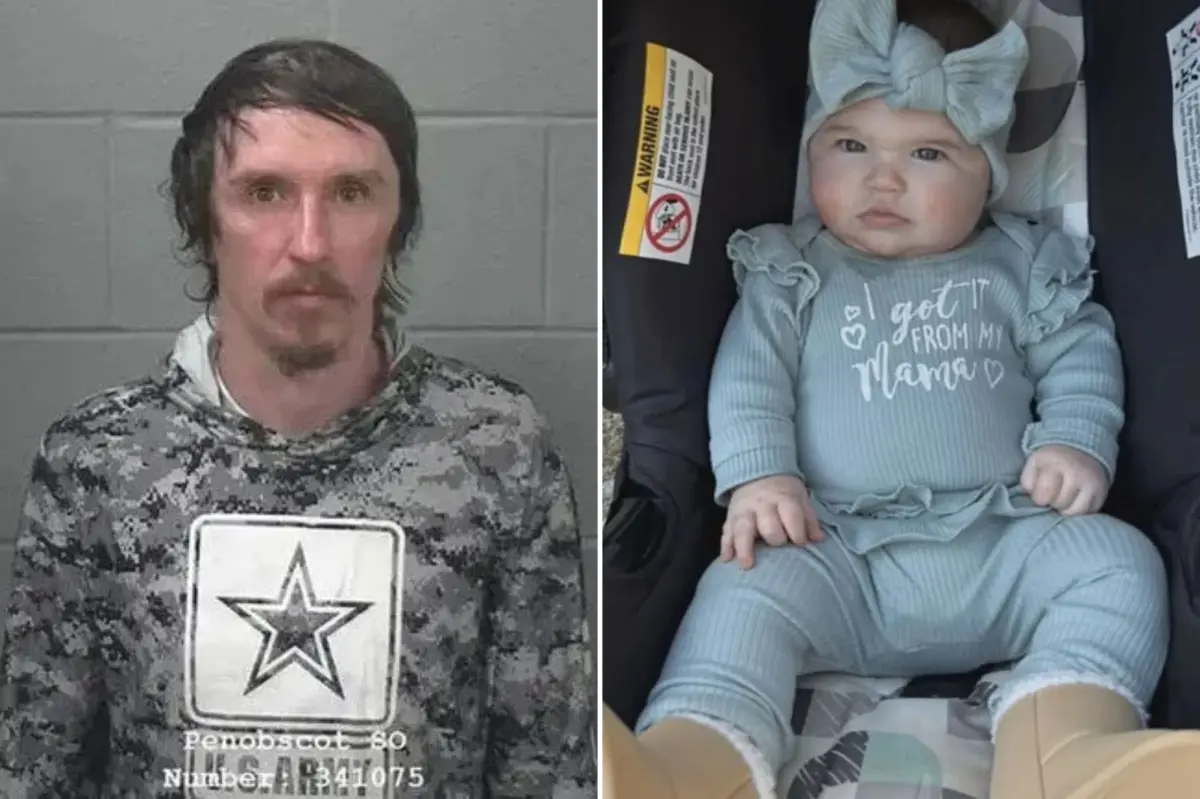
A little girl who had barely begun to live is at the center of a criminal case that has shaken a small Maine community. Thirteen-month-old Eleanora Ray McLaughlin died last December in a freezing room in her own Milford home, and now her father, Shane McLaughlin, has been arrested and charged with manslaughter. The Maine Department of Public Safety announced that the medical examiner determined the cause of death to be hypothermia, a clinical finding that turned a private family tragedy into a legal reckoning. McLaughlin, 37, was arrested on Wednesday, and the charge carries the weight of a community’s grief, confusion, and anger. The exact circumstances surrounding the baby’s death have not been fully detailed by officials, but the fragments that have emerged paint a haunting picture of a cold winter morning and a father who says he discovered his daughter after an ordinary routine went terribly wrong. For those who knew the family, the news has been heartbreaking and infuriating, especially because the couple had been on the radar of child welfare authorities before. The case raises difficult questions about how a vulnerable infant could be left in a dangerously cold room, and whether earlier interventions could have made a difference. As the legal system begins to process the charge, Eleanora’s brief life has become a symbol of the hidden dangers that can exist inside even the most familiar spaces, and of the profound responsibility that comes with caring for a child.
The first account of what happened came from McLaughlin himself, who spoke to NEWS CENTER Maine not long after his daughter’s death. He described a chilling discovery in the room where he and his children had been sleeping. The room was warmed by a space heater, but at some point a pet left the door open, allowing the harsh winter air to pour in. When McLaughlin woke, he could see his own breath, a stark sign of just how cold the room had become. He got up, grabbed a package of Pop-Tarts, and went to wake little Eleanora. That is when he found her dead. His words are haunting in their simplicity: a father expecting to begin a normal day with breakfast, only to meet the unthinkable. There is no way to hear that story without feeling the shock that must have washed over him in that moment. The space heater had apparently been unable to keep the room safe once the door was open, and the bitter Maine cold became a silent, invisible enemy. The image of a toaster pastry in his hand while his daughter lay motionless is one that will stay with anyone who hears it. It underscores how suddenly tragedy can enter a home, and how ordinary objects and routines can become forever marked by loss. Whether McLaughlin’s account will be accepted by prosecutors, and whether his actions rise to the level of criminal negligence, will be decided in court. But for now, his own words offer a window into a morning that changed everything, and into the fragile line between a normal day and a devastating one.
The baby’s mother, Erika Dupuis, was not in Maine at the time of her daughter’s death. She and McLaughlin were estranged, and Dupuis had moved to West Virginia in the summer of 2025, leaving behind her children. That separation adds another layer of pain to an already tangled family situation. In the aftermath of Eleanora’s death, Dupuis spoke to NEWS CENTER Maine and did not hide her emotions. She said she was angry and upset that her husband had not been charged for their daughter’s death, and she made it clear that she had been waiting for accountability. She hoped to see manslaughter charges filed against McLaughlin, and her words reflected the anguish of a mother who was far away when her baby died, forced to follow the investigation from a distance while trying to process an unbearable loss. The distance between West Virginia and Maine must have made her grief even harder to carry, leaving her to wait for updates and autopsy results while wondering how such a thing could have happened. The couple’s estrangement means that the family was already fractured before this tragedy, and the investigation now has to consider not only what happened in that freezing room, but also the broader pattern of care, supervision, and communication that led to that moment. Dupuis’s anger is understandable. For any parent, the death of a child is an injustice that words cannot capture, and the slow pace of the legal process can feel like a second injury. Her public call for charges was not just about punishment. It was about acknowledging that Eleanora’s life mattered, and that someone should have to answer for her death.
This was not the first time the couple had come to the attention of state authorities. According to Maine State Sen. Jeff Timberlake, a Republican, records he obtained indicated that officials from the Maine Department of Health and Human Services had been investigating the couple before Eleanora’s death. McLaughlin himself confirmed that he and Dupuis had been investigated several times since 2017, though he disputed the conclusions that investigators had reached. The fact that the family was already known to child welfare agencies makes this case especially troubling. It raises the possibility that there were warning signs, missed opportunities, or interventions that did not go far enough. It also complicates the story, because an investigation is not the same as a finding of wrongdoing, and McLaughlin has pushed back against any suggestion that the earlier inquiries proved neglect. Still, for lawmakers like Timberlake, the history was impossible to ignore. He pointed to the records as evidence that the system had seen this family before, and he questioned why more was not done to protect Eleanora. The DHHS involvement dates back years, covering a period that included multiple children and a mother’s move out of state. How those investigations were resolved, what services were offered, and why the family remained in a situation that ultimately proved fatal are questions that may never be fully answered. But they are central to any attempt to understand the tragedy, and they point to the difficult balance that child welfare agencies face between respecting family privacy and intervening early enough to save lives. For now, the revelation adds another layer of sorrow to the case, and it suggests that Eleanora’s death was not an isolated incident but the end of a longer story of struggle, missed chances, and quiet warning signs.
The legal process now begins in earnest. After his arrest, Shane McLaughlin was taken to the Penobscot County Jail, and he is expected to appear in court at the Penobscot Judicial Center. Attorney information for him was not immediately available, meaning it is not yet known how he plans to plead or what defense he will offer. Manslaughter charges in Maine can stem from reckless or criminally negligent conduct that causes another person’s death. In this case, prosecutors will likely have to show that McLaughlin knew or should have known that leaving his infant daughter in a freezing room, or failing to keep her warm, created a substantial risk of serious harm. The medical examiner’s finding of hypothermia provides a clear physical cause of death, but the question of criminal responsibility is more complicated. A jury may be asked to consider whether this was a tragic accident, a moment of neglect, or something more culpable. The father’s own description of waking to a cold room and discovering his daughter after getting a snack suggests that he did not intend for her to die, but intent is not always required for a manslaughter conviction. The state must prove that his actions fell far below what a reasonable parent would do. While the case moves through the courts, the community is left to wonder why it took so long for charges to be filed. Sen. Timberlake put it bluntly, saying the charge was “about time” and adding, “I don’t know what took so long.” His words captured the frustration of those who had been waiting for accountability, and they underscored a feeling that the system had moved too slowly for a child who could not wait at all.
Ultimately, no charge can undo the loss of Eleanora Ray McLaughlin. She was a 13-month-old child, old enough to smile, to babble, to reach for the people who loved her, but too young to understand the danger of a cold room. Her death is a reminder of how fragile life is, especially for babies who depend entirely on the adults around them for safety and warmth. The details of this case are difficult to hear, and they invite a range of emotions: grief for the little girl, anger at the circumstances, and sympathy for everyone touched by the tragedy. It is also a moment for communities and families to reflect on what it means to protect children, to support parents who are struggling, and to take seriously the signs that a child may be at risk. The fact that state investigators had been involved with the family before the death makes the story even more sobering, because it suggests that this was not a case that came out of nowhere. Whatever the courts decide, the memory of Eleanora will remain, carried by her mother, her siblings, and all those who heard her name and felt their hearts break. For the father, the coming months will be a time of legal reckoning, but also a time of personal reckoning, as he must live with the knowledge that his daughter died in a room that should never have been allowed to become so cold. In the end, the true measure of justice may not be a verdict, but whether this loss finally prompts the kind of care, vigilance, and compassion that keeps other children from suffering a similar fate.