



Back in 2018, Lithuania’s capital Vilnius made a bold, cheeky claim: it was the “G-spot of Europe,” a place nobody could quite locate, but once you found it, you’d be amazed. That slogan was always more playful than precise, and while I can’t offer any commentary on whether sex education has improved since then, I can say this: more and more travelers are finally finding their way to the Baltics, drawn by the rise of “coolcations” — trips to cooler destinations that offer culture, history, and charm without the sweltering summer crowds. I spent time in Latvia and Estonia last summer, and this past October, after a quick return to Riga and a lovely detour to Sigulda, Latvia’s autumn capital, I finally made it down to Vilnius. Was it amazing? Honestly, yes. With its UNESCO-listed baroque Old Town, a food scene that feels both inventive and deeply rooted, and museums that don’t shy away from difficult history, Vilnius has a quiet, layered appeal that rewards even a short visit. If you only have 24 hours in the city, you can still get a real sense of its character — you just have to know where to go, what to see, and what to eat along the way. The city is compact enough to explore on foot, and every corner seems to hold a story, whether it’s a church with a Napoleonic legend, a neighborhood that declared itself a republic, or a tower that has watched over the city for centuries. Vilnius doesn’t shout for attention; it waits, patiently, for you to discover it — and once you do, it’s hard not to fall a little bit in love.
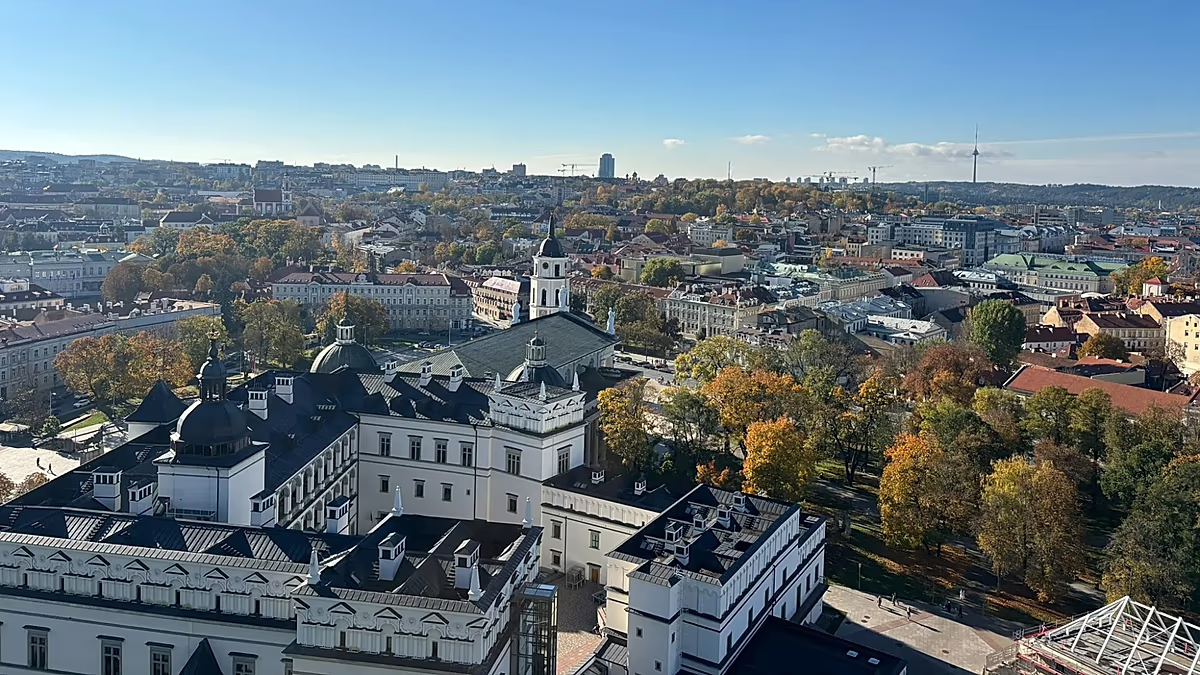
The best way to start any visit is from above, and there’s no better vantage point than Gediminas Tower. Perched at the top of Gediminas Hill, the tower is the surviving remnant of the Upper Castle, and it has long been a symbol of the city. Inside, you’ll find displays that trace the castle’s many lives, from its earliest days under Gediminas, the Grand Duke of Lithuania who founded Vilnius, through centuries of fires, rebuilds, and changing rulers. The tower also holds deep emotional significance for Lithuanians: it was here that the tricolor flag was first hoisted in 1919, during the brief window of independence between the two World Wars, and again in 1988, when the independence movement was gathering strength during the Soviet era. That story is explored in the Frequency of Freedom exhibition inside, which adds a moving layer to what could otherwise be just a scenic lookout. After you’ve absorbed the history, you’re rewarded with an incredible view from the rooftop — red-tiled roofs, church spires, and the winding Neris River all spread out beneath you. If you happen to visit during warmer months, you can take things even higher by booking a hot air balloon ride over the city, which sounds like the stuff of fairy tales. Just down the road from the castle complex stands Vilnius Cathedral and its bell tower. The cathedral’s current form is neoclassical, but it has been rebuilt many times after fires, and parts of its catacombs date back to the 13th century. It was once the site where Grand Dukes of Lithuania were inaugurated, and it houses the Chapel of Saint Casimir, the patron saint of Lithuania, a royal-born figure known for his deep devotion and recognized by the Pope in 1602. Not far away is the Church of St. Anne, one of the most beautiful churches in the country, built in a late Gothic style in the 15th century. Legend has it that Napoleon, upon seeing it, said he wanted to carry it back to Paris “in the palm of his hand.” That story is probably more myth than fact, but standing in front of its intricate brick facade, you can understand why someone might say such a thing.
Behind the Church of St. Anne and the adjoining Bernardine Monastery lie the Bernardine Gardens, a peaceful green space that was once a swampy area cultivated by Bernardine monks in the 15th century. Over time, it was transformed into a collection of planted gardens with several ponds, and it even includes a botanical garden. Located right next to the river, it’s the kind of place where you can slow down, breathe, and watch the autumn light filter through the trees — a gentle counterpoint to the city’s more monumental sights. From there, cross the Vilnelė River, and you’ll find yourself in Užupis, a neighborhood that declared itself an independent republic in 1997. Yes, really. Užupis has its own flag, a national day that falls on April Fools’ Day, and a list of embassies that includes “among Canadian cats,” “in cheese,” “in pencils,” and “in rock music.” Its 41-point constitution is posted on a wall and translated into nearly two dozen languages, and it includes such essential rights as “everyone has the right to love and take care of the cat,” while “a cat is not obliged to love its owner, but must help in times of need.” It’s whimsical, irreverent, and utterly charming — exactly what you’d expect from a republic founded by artists. You can explore the creative spirit further at the Užupis Art Incubator, which supports local artists and keeps the neighborhood’s bohemian energy alive. Just a short stroll away is Literatai Street, once home to the poet Adomas Mickevičius. Today, the street is lined with plaques paying tribute to more than 200 notable Lithuanian writers, a public art project commissioned by the Modern Art Centre in 2008 ahead of Vilnius’s time as European Capital of Culture. It’s a small street, but it’s packed with meaning, and it’s the kind of place that makes you want to slow down and read every single plaque.
Of course, no visit to Vilnius would be complete without exploring its museums, and there are plenty to choose from — the Toys Museum, the Railway Museum, the House of Signatories, and the Energy and Technology Museum, to name just a few. But if you have limited time, two stand out. The first is the Museum of Occupations and Freedom Fights, housed in the former KGB headquarters. This is not an easy museum to visit. It covers the history of Soviet repression in Lithuania, including deportations, interrogations, and executions, and it also touches briefly on the country’s Nazi occupation. Walking through those rooms, you can feel the weight of history pressing down on you, and it’s a stark reminder of how recently Lithuania had to fight for its freedom. It’s heavy, but it’s essential — a place that helps you understand the resilience of the Lithuanian people and why symbols like the flag at Gediminas Tower mean so much. The second is Castellan’s House, which is part of the National Museum of Lithuania. This one takes a different approach, exploring Lithuanian identity through themes like religion, tradition, and daily life. It’s more reflective than confrontational, and together, the two museums offer a balanced picture of a nation shaped by both suffering and pride. If you’re short on time, these are the two that will leave the deepest impression. They’ll also give you plenty to think about as you wander back out into the bright, bustling streets and see the city with new eyes — not just as a beautiful destination, but as a place with a profound and complicated story.
When hunger strikes, Vilnius has you covered. The oldest market in the city, Halės, is an obvious starting point, with dozens of stalls offering everything from pastries and soups to tacos and Korean plates. It’s the kind of place where you can graze your way through lunch, sampling a little bit of everything and watching locals go about their daily shopping. For something a bit more unusual, I was a big fan of Beigelistai, a spot that serves up Vilnius-style bagels. I honestly couldn’t tell you the exact difference between a Vilnius bagel and a New York one, but I can tell you that the bagel of the month for October — topped with fig jam, camembert, walnuts, and cream cheese — was absolutely fantastic. It’s the kind of creative, slightly unexpected combination that sums up Vilnius’s food scene: rooted in tradition, but not afraid to play. For a more modern option, head to Paupys Market, a newer food hall with a wide range of restaurants under one roof. Again, you’ll find plenty of choices, but the potato pancakes and bao buns are real winners. There’s something wonderfully eclectic about sitting in a sleek market hall, eating a Lithuanian classic alongside a soft, pillowy bao bun, and realizing that Vilnius is a city that knows how to blend the old and the new without losing its identity. The food alone is worth the trip, and it’s a reminder that the city’s “amazing” claim isn’t just about sights — it’s about the everyday pleasures of eating well, lingering over coffee, and enjoying the company of the people around you.
If I’d had more time in Vilnius, I would have taken the advice of a friend who visited in April and headed to Trakai Castle. Located on an island, the castle is about a 35-minute train journey from the city, followed by a short bus ride or a 40-minute walk. Just be aware that the trains aren’t super regular, so it’s worth planning ahead. Trakai looks like something out of a storybook, with its red brick towers rising out of the water, and it’s apparently just as beautiful in the spring as it must be in the autumn. Getting to Vilnius itself is fairly easy: Vilnius International Airport is less than six kilometers from the city center, and you can reach it by bus in around 15 or 20 minutes. There’s also a train that takes under 10 minutes, though it runs less frequently than the bus. The biggest airlines operating from the airport are airBaltic, Ryanair, and Wizz Air, with direct flights from cities including Amsterdam, Barcelona, London, Rome, and Paris. Alternatively, if you’re already exploring the Baltics, Vilnius is around a four-hour bus ride from Riga, which makes it easy to combine with a trip through Latvia and Estonia. As I stood on the roof of Gediminas Tower, watching the sun dip behind the city’s spires, I understood why Vilnius had made that bold claim all those years ago. It’s not the kind of place that reveals itself instantly. It takes a little effort, a little curiosity, and a willingness to wander. But once you find it — once you’ve climbed the tower, walked the gardens, read the constitution of Užupis, and eaten a bagel with fig jam and camembert — you’ll know exactly what they meant. It really is amazing.