



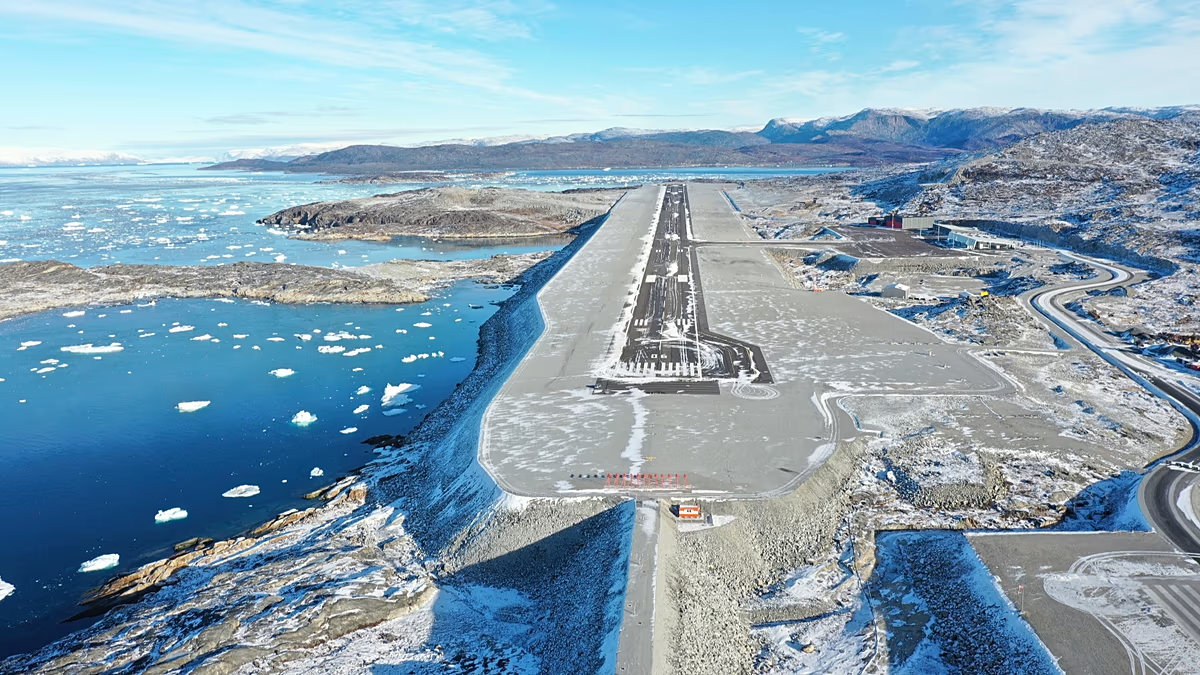
On the morning of Thursday, 30 October 2026, a new era arrived in Greenland on the wings of a landing aircraft. In Ilulissat, the country’s third-largest town, a new international airport officially opened its doors, following formal approval from the Danish Civil Aviation and Railway Authority. To the outside world, this might sound like a routine infrastructure announcement, but for the people of Greenland, it is far more personal. For generations, life on the vast Arctic island has been shaped by remoteness, by the whim of weather and sea ice, by schedules that depend on helicopters and small planes, and by journeys that can take days rather than hours. The opening of Ilulissat Airport is a powerful symbol of change. Situated on Greenland’s west coast, about 250 kilometres north of the Arctic Circle, Ilulissat is already a place of extraordinary natural beauty, sitting beside Disko Bay, where enormous icebergs drift silently past the town’s colourful houses. Now, it is also a place with a runway long enough to welcome large jet aircraft from Europe, a threshold that connects this small Arctic community to the wider world in a way that once seemed impossible. The operator, Greenland Airports, called the opening the “final piece in place” in the country’s “historic airport expansion,” and for those who live there, the moment is deeply emotional. The new airport is not just concrete and steel; it is a promise of visits from family abroad, of medical supplies arriving more quickly, of tourists coming to marvel at the UNESCO-listed icefjord, of young people staying and building futures instead of leaving for distant cities. It is, in every sense, a gateway.
The significance of Ilulissat becomes even clearer when viewed alongside the rest of Greenland’s ambitious airport programme. This is the third new airport to open in the Danish autonomous territory since 2024, following Nuuk in November 2024 and Qaqortoq in April 2026. Together, these three airports form what the operator describes as a “new backbone” for the country’s infrastructure, linking communities that have long been disconnected by geography and climate. Greenland is one of the most sparsely populated places on Earth, and its towns have traditionally relied on sea travel and small aircraft to stay connected. But those connections were fragile, often delayed by fog, storms, and seasonal ice. The new airports change that reality in fundamental ways. For the first time, larger aircraft can land directly in multiple regions of the country, making it possible to travel between major towns without the need for complex transfers. Jens Lauridsen, CEO of Greenland Airports, captured the mood of the day when he said, “The opening is a historic milestone for Ilulissat, for North Greenland, and for all of Greenland.” His words speak to a broader transformation. “The three new airports in Ilulissat, Nuuk, and Qaqortoq fundamentally change how the country is connected internally and how Greenland is connected to the rest of the world.” This is not just about convenience; it is about identity and opportunity. For decades, Greenlanders have had to adapt to the limitations of their geography, planning their lives around schedules dictated by weather and technology. With these airports, the balance shifts. The island is still vast, still wild, still challenging, but it is no longer quite so untouchable. The new infrastructure creates a web of connections that strengthens communities, supports businesses, and opens possibilities for education, healthcare, and cultural exchange that were previously much harder to reach.
Beneath the symbolic importance lies a story of practical engineering and carefully planned operations. The new airport at Ilulissat features a 2,200-metre runway, long enough to accommodate larger aircraft, which means international routes can now connect directly to this remote town. Air Greenland, the national carrier, was quick to take advantage of the new facility, operating domestic flights between Ilulissat and destinations such as Nuuk, Aasiaat, Qaarsut, and Upernavik. These routes are lifelines for local communities, allowing people, goods, and services to move more freely across the region. But the most striking development came on the very same day as the airport’s opening, when Air Greenland launched a direct route between Ilulissat and Denmark’s capital, Copenhagen. For the first time, travellers could board a plane in Copenhagen and land in the heart of Arctic Greenland without changing planes or routing through Nuuk. The regular winter schedule is set to begin in November, with the service initially operated by Jettime using a Boeing 737-800. Flights will primarily operate on Wednesdays, with selected additional Monday departures around Christmas and New Year, as well as in March, allowing both residents and visitors to plan their journeys with greater confidence. International connections are also part of the story. Icelandair has announced a seasonal service between Keflavík and Ilulissat, operating from 3 June to 16 October 2027, linking Greenland to Iceland’s well-established transatlantic hub and opening the door to travellers from North America and beyond. Operations at the airport, however, will not reach full capacity overnight. Greenland Airports has stated that activity will “ramp up gradually,” with opening hours and services expanding in phases, and the goal is for the airport to be fully operational by the summer 2027 season. It is a measured, thoughtful approach, one that acknowledges the importance of steady growth in an environment where reliability and careful planning are essential.
The airport project represents more than a transportation upgrade; it is a long-term investment in Greenland’s future, one that has received financial support from Denmark. Infrastructure projects in the Arctic are notoriously difficult and expensive, requiring engineering solutions that can withstand permafrost, extreme cold, and dramatic weather shifts. The decision to build these airports, and the funding that made it possible, reflects a commitment to the region’s development that goes far beyond convenience. Jens Wittrup Willumsen, chairman of the board of Greenland Airports, emphasised this perspective: “Infrastructure is a long-term investment, and its real impact is measured in decades. With the three new airports, Greenland has a foundation that future generations can build on.” His words invite reflection on what such projects truly mean. Airports are often judged by the number of flights they handle or the speed of their connections, but their real value lies in the lives they touch. A runway can carry a child travelling to a specialist hospital, a teacher arriving to serve a remote school, a fisherman transporting a catch to a larger market, or a family reuniting after months apart. Willumsen added, “Now the task is to ensure that the new facilities benefit the entire country, including the towns and settlements around the airports, as part of the future development of business and tourism.” This is a reminder that the airport itself is only the beginning. The surrounding communities must be included in the benefits, through jobs, supply chains, local services, and sustainable tourism. The hope is that the economic activity generated by these airports will spread beyond the runways, into the homes and businesses of North Greenland, creating opportunities that were previously unimaginable and ensuring that the advantages of connectivity are shared equitably across the region.
For travelers, and for the world, Ilulissat’s new airport is perhaps most exciting because of what it offers environmentally and culturally. Ilulissat is not just a random dot on the map; it is one of Greenland’s most spectacular locations, perched at the edge of Disko Bay, home to some of the most enormous and awe-inspiring icebergs in the Northern Hemisphere. The UNESCO-listed Ilulissat Icefjord, a short distance from the town, is a natural wonder that draws scientists, photographers, and nature lovers from around the globe. Watching massive glacial ice break away and tumble into the sea is an experience that stays with a person forever. Before this airport, reaching this wonder required significant time, expense, and flexibility. International visitors often had to fly into Nuuk and then connect onward, with all the uncertainty that entailed. Now, the new direct routes mean that a traveler can experience the icefjord, the midnight sun, the northern lights, and the warm hospitality of Greenlandic communities with far greater ease. But the benefits are not only for tourists. The airport also creates new opportunities for business, cargo, and regional development throughout North Greenland. Local entrepreneurs can ship their products more efficiently, artisans can reach broader markets, and renewable energy projects and scientific research can be supported more effectively. The runway is long enough to handle modern passenger jets, but it also has the capacity for cargo flights, which is vital for an economy that depends on the reliable movement of goods. Groceries, medicine, equipment, and supplies can arrive more quickly and in greater quantities, lowering costs and improving quality of life. In a region where the environment is both a resource and a fragile treasure, the airport must serve as a bridge to a future where economic progress and environmental stewardship can coexist.
As the sun set over Disko Bay on that opening Thursday, the new airport in Ilulissat stood as a testament to what Greenland can achieve when ambition meets determination. The country is still a young nation in many ways, its infrastructure only beginning to catch up with its immense natural wealth and human potential. The completion of the three airports, in Nuuk, Qaqortoq, and now Ilulissat, marks a turning point in the story of this remarkable territory. It brings Greenland closer to Denmark, closer to Iceland, closer to the broader world, and perhaps most importantly, closer to itself. But it also brings responsibility. The people who planned and built these airports understand that true progress is not measured solely by the number of flights or passengers. It is measured by what those connections allow people to do with their lives. It is measured by the child who can pursue an education, the family that can reunite, the entrepreneur who can build a business, the elder who can access proper medical care, and the young adult who can see a future in the land of their ancestors. The words of Jens Lauridsen, Jens Wittrup Willumsen, and the many Greenlanders who celebrated this day will echo in the future: the airports are a foundation, not a finish line. The task now is to build on that foundation, to ensure that the towns and settlements around these airports are not left behind, and to create a sustainable, welcoming, and prosperous future for one of the world’s last great frontiers. On a quiet Arctic morning, the sound of an airplane is no longer just a noise; it is the sound of possibility.