


When Sir Patrick Stewart died in October 2026 at the age of 86, a strange, sad silence fell over the worlds he had inhabited: the Royal Shakespeare Company, the bridge of the Enterprise, Xavier’s School for Gifted Youngsters, and the hearts of millions of fans who had grown up watching him. Among the flood of tributes, one friendship kept resurfacing — the extraordinary, decades-long bond between Stewart and Sir Ian McKellen. For nearly fifty years, they were a pair that seemed to belong together: two classically trained British knights, two actors with Shakespearean roots and superhero fame, two men who could make a simple tea break feel like a quiet masterclass in companionship. They first met in 1977 while working on Tom Stoppard’s Every Good Boy Deserves Favour at the Royal Shakespeare Company, but they did not become close then. They were colleagues, acquaintances, fellow travelers in the theater world. Yet by the time the end came, McKellen’s grief was felt by fans almost as profoundly as the loss of Stewart himself. It was as if their friendship had become a separate, living thing — one that deserved to be remembered, mourned, and celebrated in its own right. This is the story of that friendship: from onscreen foes to real-life friends, from X-Men to tea in trailers, from a wedding officiant to an Avengers reunion. It is a story about what happens when two brilliant, funny, deeply human actors find each other in the strange crucible of fame, and it is the kind of story fans will never forget.
The beginning was not cinematic. In 1977, Patrick Stewart and Ian McKellen were two young actors moving through the British theater ecosystem, both devoted to the craft, both hungry, both already marked with the quiet confidence that Shakespeare could be spoken by anyone with enough truth and courage. Every Good Boy Deserves Favour was not a typical production. It was a Stoppard experiment, a play written to sit inside an orchestra, a hybrid of music and drama that demanded actors trust one another in unfamiliar ways. Stewart and McKellen found themselves cast in the same orbit, sharing rehearsals, listening to the same conductor, learning to be precise with language and emotion. There was no thunderclap of instant friendship. There was likely just professional respect — nods in the green room, a few conversations about directors and performances, the quiet recognition of one another’s talent. They knew each other before they knew each other, the way actors do: knowing the other’s work intimately, watching from the wings, admiring how a difficult scene was handled. It would take a superhero movie, of all things, to turn that professional regard into a lifelong friendship. But maybe the seeds were planted there, in those early days of performance, when they were not yet Sir Patrick and Sir Ian, but Patrick and Ian, two young men in love with the same impossible art. Nearly fifty years later, the roots of that friendship would seem so deep that no one could imagine one without the other, and yet the beginning was exactly what every great friendship needs: two people willing to be present, patient, and open to whatever might grow.
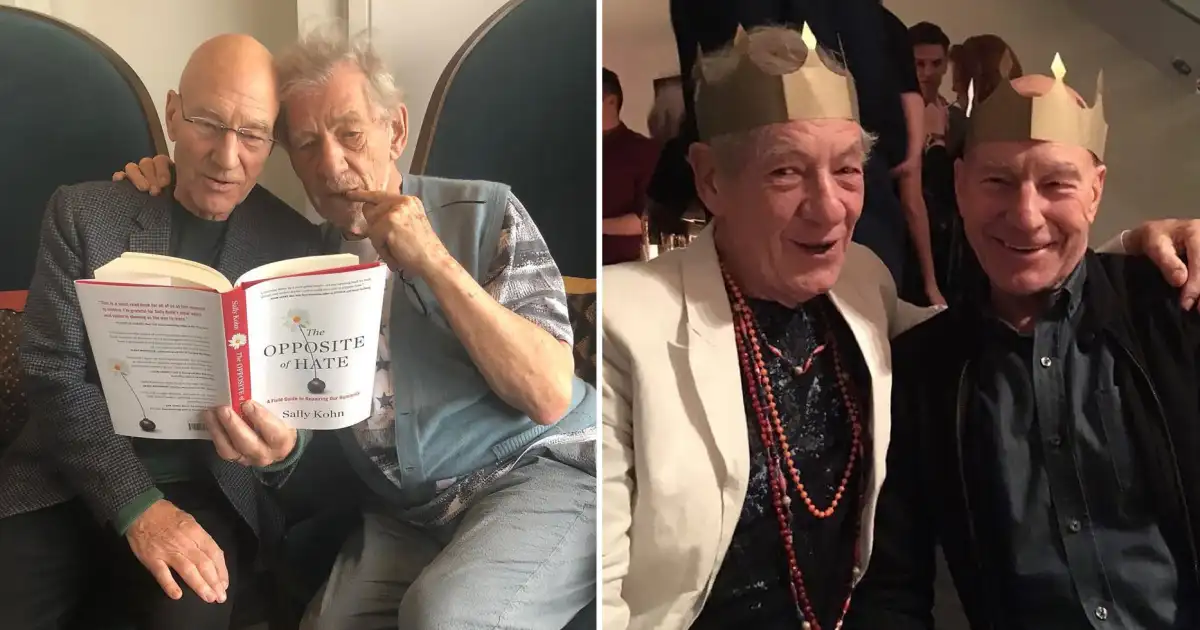
Everything changed in 2000. X-Men was a gamble. Before the Marvel Cinematic Universe, before superheroes became the dominant currency of Hollywood, Bryan Singer’s film brought Marvel’s mutants to the big screen with a serious, melancholic tone. Stewart was Professor Charles Xavier — Professor X — a telepath in a wheelchair, an idealist who dreamed of peace between humans and mutants. McKellen was Erik Lehnsherr — Magneto — a Holocaust survivor who had learned to trust no one and to fight for mutant kind by any means necessary. Onscreen they were philosophical enemies, old friends turned adversaries, two sides of the same tragic coin. But offscreen, something far warmer was happening. The sets of visual-effects-heavy movies are notoriously boring for actors, and Stewart captured it perfectly when he said: “On those kind of movies, you spend more time sitting in your trailer than you do in front of the camera. So, Ian and I hung out together, drinking tea — and maybe in the afternoon, something a little stronger — and we got to know one another.” That sentence became a love letter to friendship. The image of two knights of the British realm, sitting in their trailers, pouring tea and perhaps a little whiskey, talking through their lives, is one of the most charming behind-the-scenes images ever offered. They did not talk about fame or franchise potential. They talked about growing up, about loss, about acting, about fear, about the things that made them laugh. They found a rhythm: McKellen’s dry, mischievous humor balanced Stewart’s intense, earnest warmth; Stewart’s vulnerability opened doors for McKellen’s playful guard. By the time the movie wrapped, they were not just co-stars anymore. They were friends — real friends, the kind who look forward to being stuck in a trailer together, because being stuck is its own gift.
From that moment, their professional paths kept converging, as if the universe wanted to see how beautifully two friends could age in public. They returned as Professor X and Magneto in several X-Men movies, each time adding new layers of grief, dignity, and understanding to their characters. They could play enemies because they trusted each other completely; the tension onscreen was built on a foundation of effortless offscreen affection. They also returned to the stage, joining forces for Two Plays in Rep, a repertory season that allowed audiences to see the two knights in their native element — trading words written half a century earlier, finding new rhythms in ancient texts. Critics wrote about their chemistry as if it were a force of nature. They appeared on talk shows and made each other laugh until they cried. They talked about each other in interviews with a spontaneous, unguarded admiration that cannot be faked. McKellen told stories of Patrick’s generosity as a friend; Stewart told stories of Ian’s courage as an artist. They made aging seem less frightening. They made success seem less lonely. In a business that often encourages competition and jealousy, they were a radical example of mutual celebration. They did not just tolerate each other’s spotlight; they insisted on sharing it. Their friendship became a kind of public property, a story that fans could lean on as proof that kindness and humility are not weaknesses. Wherever they went, together or apart, fans would ask about the other. “How’s Ian?” “How’s Patrick?” And the answers always came back with a grin.
The most personal expression of their bond came in 2013, when Stewart married singer Sunny Ozell. He chose McKellen to officiate the wedding. Not a priest, not a professional officiant, not a celebrity friend for show. Ian. The man who had played his enemy, shared his trailers, listened to his stories, and would now stand before Patrick and Sunny and speak the words that made them married. It was a breathtaking gesture of trust and love. For fans, the photos from that day were everything: McKellen in his formal robes, grinning, presiding over the ceremony with warmth and mischief, while Stewart beamed like a man who had just won the jackpot. Their friendship had crossed over into family. They were brothers in every meaningful sense — by choice and by time. It was no surprise, then, that when the Marvel Cinematic Universe came calling for one final showdown, the two old friends found themselves on the same set again. Their final joint project was 2026’s Avengers: Doomsday, a film that promised to bring together heroes from across generations and universes. By then they were both in their eighties, both nearing half a century of knowing each other, both still clearly delighted to be in each other’s company. There is something deeply fitting about the fact that their last collaboration was another huge, world-saving superhero spectacle. They had started in a theater, in the intimacy of the Royal Shakespeare Company, and ended in the biggest cinematic universe in history. But the set was probably the same: long waits, trailers, tea, stories, and laughter. They had come full circle.
Now, after Stewart’s death, the world feels a little quieter. We cannot know what McKellen is feeling, but we know grief intimately, and for millions of fans his grief is ours. What they will remember is not just the superheroes or the Shakespeare, not just the knighthoods and award speeches. They will remember the way two grown men could look at each other and light up. They will remember that friendship can be a refuge from the loneliness of life. They will remember that age does not have to mean rigidity, that playing enemies can teach you how to love, that tea and conversation are enough to build a bond that lasts fifty years. The legacy of Patrick Stewart and Ian McKellen is vast — theater, film, television, activism, courage. But the most lovable part of that legacy may simply be the example of their friendship. It tells us to find our people and hold on to them. It tells us to be generous, to be present, to show up — to officiate our friends’ weddings, to make them laugh, to be there at the end. In an era of cynicism, they were innocent. In a world of division, they were union. Sir Patrick may be gone, but he lives on in every clip of him laughing with Sir Ian, in every interview where one mentions the other with tenderness, in every fan who learned from them what real friendship looks like. And Sir Ian, left behind, carries that friendship forward. It is not lost; it is simply changed. From onscreen foes to real-life friends, theirs was a love story in the truest sense — not romantic, but perhaps deeper, the kind that asks nothing but gives everything. They proved that even in the strangest, most artificial reaches of show business, something real can bloom. Fans will never forget it. Neither will the world.