



Halloween has a funny way of turning even the most reasonable adults into kids again. The porch lights flicker on, the tiny superheroes and witches appear at the door, and for a few weeks every year, candy becomes a perfectly acceptable part of daily life. But according to one New York City dentist, there’s something lurking in that pillowcase that people never expect: not just cavities, but cracked teeth, pulled-out crowns, and fillings that suddenly go missing. Dr. Marc Lazare, who has spent nearly three decades practicing dentistry with a special focus on biomimetic restoration, says that many popular Halloween treats can do real, immediate harm to adult teeth and dental work. Hard candies can crack a tooth. Sticky caramels can tug at crowns and pull out fillings. Sour candies can bathe enamel in acid. A fun night of trick-or-treating can quickly turn into an expensive, uncomfortable chair in the dentist’s office. But before anyone throws the candy bowl in the trash, Lazare wants to make one thing clear: he is not the fun police. He’s not going to stand on a porch and wag his finger. “I’m never going to be the dentist who says, ‘Don’t enjoy Halloween. Don’t have candy,’” he says. “I love Halloween.” His message is not about deprivation; it’s about moderation and making smarter choices. In his view, every piece of candy has a personality, and dentists can evaluate it by a few simple questions: Can it harm the enamel? Can it contribute to decay? Can it pull out a filling or a crown? Can it crack a tooth? Not every candy is equally dangerous, and not every mouth is equally vulnerable. People with fillings, crowns, bridges, existing cracks, or teeth weakened by years of grinding are particularly at risk, but even perfectly healthy teeth can fall victim to a particularly stubborn jawbreaker.
Hard candy is one of the biggest culprits. It looks harmless enough, a colorful lollipop or a glittering piece of rock candy, but it invites a dangerous instinct: the urge to bite down. You crunch, you crack, and suddenly there’s a rough edge where your tooth used to be. For someone with a large filling or a crown, the risk is even greater, because the natural tooth structure has already been compromised. The force of biting down on something hard is not absorbed gracefully; it travels through the restoration and into the tooth, and often the weakest point gives way. This is not a slow-developing cavity that gives you months of warning. It is a sudden, sharp pain, often followed by a frantic call to the dentist on a holiday weekend. Dr. Lazare puts it simply: “Anything where you have to force a crunch is not good.” That includes jawbreakers, hard caramels, and even those old-fashioned candies that seem nostalgic but might as well be tiny rocks. The mouth is not designed to break down glass-like substances. Teeth are strong, but they are not unbreakable. A tooth with a crack, whether from a previous accident, a night of grinding, or simply years of wear, is especially vulnerable. And once a crack appears, it can deepen over time, sometimes requiring a crown, a root canal, or even extraction. The irony is that a single piece of hard candy, meant to be a treat, can cause thousands of dollars in dental work. That’s not to say every person who eats a hard candy will break a tooth, but the risk is real and unnecessary. A few simple decisions, like choosing chocolate over jawbreakers, can save both pain and money.
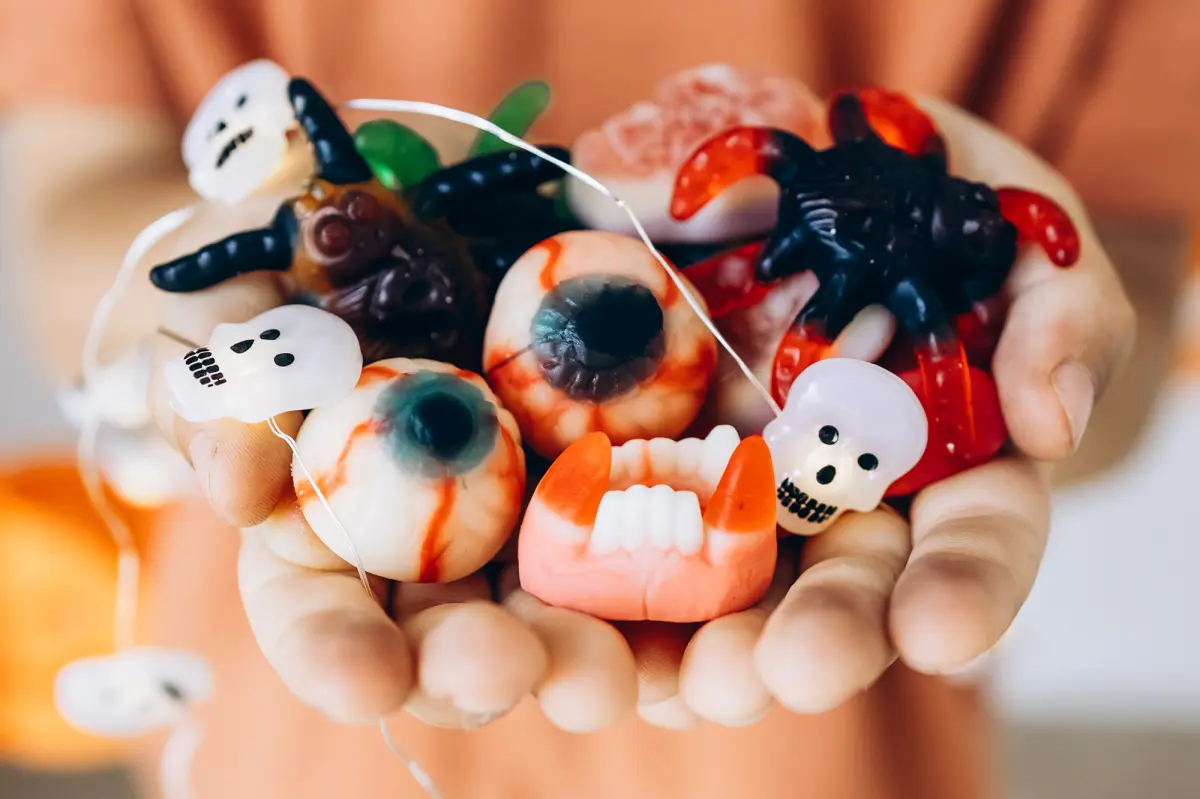
The other major offenders are the sticky, chewy, gooey treats that seem to love your teeth a little too much. Taffy, caramels, gummy worms, gumdrops, and those sticky fruit snacks can cling to the crevices between teeth and around fillings and crowns with surprising determination. When you bite into a piece of caramel, it doesn’t just slide off; it pulls, and that pulling force can be strong enough to dislodge a crown that may have already been slightly loose, yank out a filling that was holding on by a thread, or create enough tension to weaken a tooth. Once a crown comes off, the exposed tooth underneath is often sensitive to air, food, and temperature, and if the crown is lost or damaged, it may not be reusable. Sticky candies also have a second, more subtle danger: they get stuck. That means sugar stays in contact with teeth for a prolonged period, feeding the bacteria in plaque and producing acid that eats away at enamel. Dr. Lazare calls this an “acid attack,” and it doesn’t just happen in the moment; it continues as long as the sugary residue remains. Chewy candies that lodge between teeth are particularly problematic because brushing and rinsing may not dislodge them completely. And sour candy, despite its tangy appeal, is often even worse, because it combines sugar with acid, exposing enamel to a direct chemical assault. The bright colors and sour coatings are fun, but they are essentially bathing teeth in a low-pH environment that can soften and erode enamel over time. What about the healthier-looking alternatives? Dried fruit, especially raisins, is often offered as a natural, wholesome treat, but Dr. Lazare cautions that raisins are actually one of the worst things you can have for your teeth. They are sticky, high in sugar, and cling to the teeth like glue, causing the same prolonged acid exposure as caramel, without any of the supposed nutritional benefit. This doesn’t mean one raisin will ruin your mouth, but the idea of them as a dental-safe snack is a myth.
So, what should you reach for if you want to enjoy Halloween without putting your smile at risk? Dr. Lazare’s pick is chocolate. It may come as a welcome surprise, but chocolate has a unique advantage: it melts and dissolves quickly. Unlike caramel or taffy, chocolate doesn’t cling to teeth for long, so it doesn’t create the same sustained sugar bath. The faster a treat clears the mouth, the less time it has to do damage. Among chocolates, dark chocolate is the best choice, because it tends to be lower in sugar than milk chocolate or white chocolate, and it melts even more quickly. It also contains less of the dairy that can add to the sticky, coating feeling. Of course, not all chocolate is equal. A chocolate bar with caramel, toffee, nougat, or raisins is back to the same problem, because those fillings are sticky and hard. A chocolate bar with nuts can also be risky if it encourages crunching, though nuts are not as dangerous as hard candy if eaten carefully. But a plain chocolate bar, or a chocolate with soft, non-sticky fillings, is a far better option for your teeth. The larger point is that moderation and mindfulness matter. You don’t have to survive Halloween on celery sticks. You can have a few pieces of chocolate, savor them, enjoy them, and move on. The danger comes from constant grazing, eating candy all day long, or mindlessly snacking while watching a movie. Each time you eat sugar, your mouth becomes acidic for a period of time, and if you are snacking continuously, the acid never has a chance to be neutralized. Your saliva is the body’s natural defense, but even it has limits. The best approach is to choose a few treats, enjoy them as part of a meal or right after brushing, and then give your mouth time to recover.
If you do indulge, there are simple, practical ways to minimize the damage. One of the most important tips, according to Dr. Lazare, is to rinse your mouth with water after eating candy. This helps wash away sugar and acid, reduces the sticky residue, and gives your teeth a head start on recovery. But there is a surprising nuance: wait about an hour before brushing. It may seem intuitive to brush immediately after eating something sweet, but acid temporarily softens tooth enamel. Brushing during this softened state can actually increase wear and even scrub away enamel. Waiting an hour allows your saliva to remineralize the enamel and restore the mouth to a safer balance. In the meantime, you can swish with water or chew sugar-free gum. Sugar-free gum is particularly helpful because it stimulates saliva production, which naturally cleans the mouth and neutralizes acid. It also helps dislodge food particles from between teeth. After that hour has passed, you can brush and floss normally, restoring your regular routine. If you have braces, retainers, or other dental appliances, extra care is important. And if a crown or restoration does come out, do not panic. The scenario is frightening, but there is a protocol. Stop chewing on that side immediately. Carefully save the crown or restoration. Contact your dentist as soon as possible. Do not try to reattach it yourself with household glue, superglue, or any over-the-counter products. Not only are these adhesives toxic and entirely inappropriate for the mouth, but they can ruin the crown so that it can never be re-cemented. Depending on its condition, the original restoration may be reusable, and your dentist can determine whether it was damaged or simply loosened. Severe pain, swelling, or significant bleeding is a different category entirely, and that requires urgent dental care rather than waiting for an appointment. But for a loose crown, a calm response can make all the difference.
At the heart of all of this is a larger philosophy. Dr. Lazare practices biomimetic dentistry, an approach that focuses on preserving as much natural tooth structure as possible, rather than aggressively repairing and replacing enamel and dentin with synthetic materials. The goal is to support the natural tooth, strengthen it, and prevent problems before they start. As he says, “We want to prevent damage rather than have to repair it.” That philosophy applies directly to Halloween. It’s not about being afraid of candy or treating every treat as a poison; it’s about understanding how different foods interact with your teeth and making choices that keep your smile healthy for the long term. Halloween is a celebration, not a dental emergency waiting to happen. With a little bit of thought and a few small habits, you can absolutely enjoy the season and protect your teeth at the same time. Rinse your mouth, wait before you brush, choose chocolate when you can, avoid the extremely sticky and extremely hard stuff, and don’t let a candy bowl turn into a source of anxiety. Dr. Lazare loves Halloween, and he wants you to love it too. He just wants you to love it with your teeth intact. The real treat is not just a bag of candy, but the ability to wake up on November first, smile in the mirror, and feel no regret. With moderation, mindfulness, and a bit of dental wisdom, you can have your candy and enjoy it too, no haunted dental chair required. So go ahead, hand out the treats, steal a little chocolate, and remember that the scariest part of Halloween should be the costumes, not the consequences.