




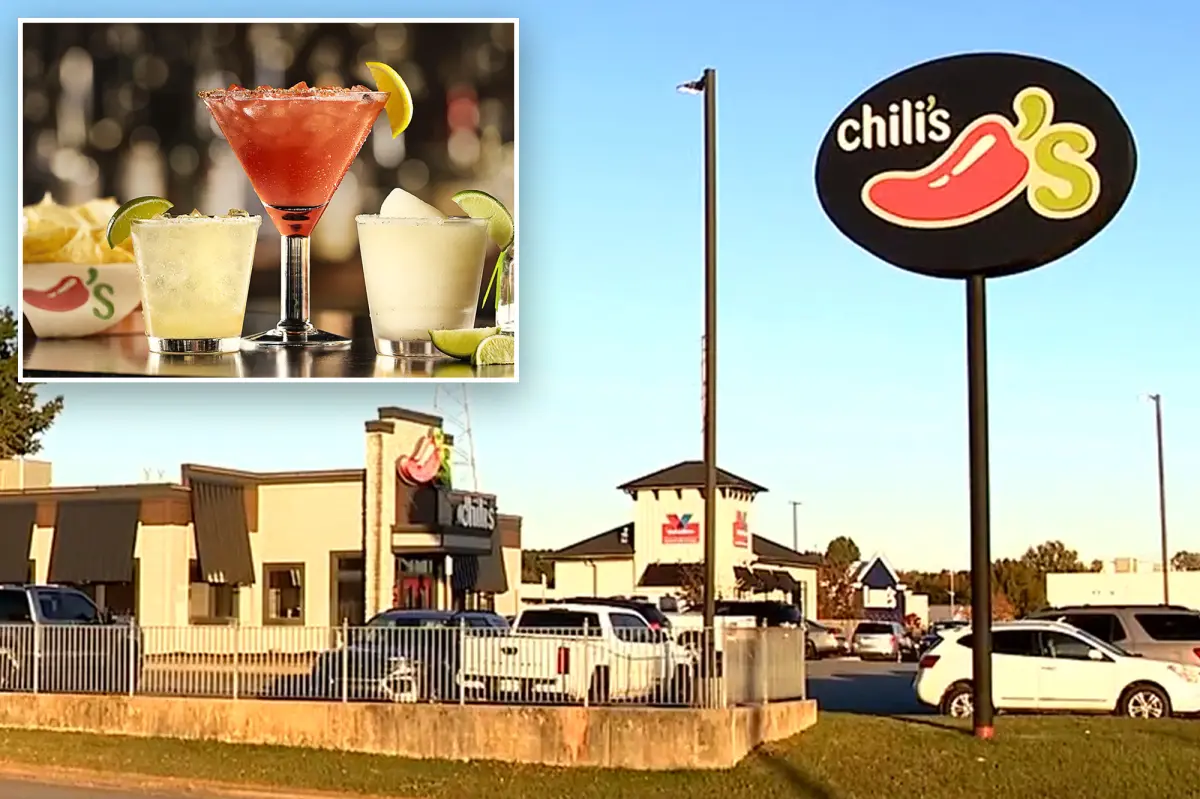
It was supposed to be an ordinary Wednesday afternoon at a Chili’s in Forest City, North Carolina—the kind of moment when the day’s work is finally behind you, and a round of icy margaritas sounds like the perfect punctuation to the afternoon. Three customers walked in, sat down at the bar, and ordered their drinks with the easy expectation that a familiar restaurant chain would serve them something safe, something delicious, something to lift their spirits. Instead, that simple ritual turned into a nightmare. Within moments of sipping their margaritas, the customers felt an intense, burning discomfort in and around their mouths. What should have been a relaxing treat had become a medical emergency. They had unknowingly consumed a diluted chemical mixture containing a granulated degreaser, a powerful cleaning product that had been mistaken for sugar during the drink preparation. The pain was immediate and alarming, and the three patrons had no choice but to rush out, leaving their half-finished drinks behind, and head straight to urgent care. The thought is chilling: in the middle of an ordinary afternoon, a relaxing cocktail became a source of chemical burns—an injury that no one expects from a restaurant visit.
The deeper story behind this alarming incident is one of small mistakes stacking into a serious hazard. According to the Foothills Health District, the chain of events began two days before the margaritas were served, when a contractor who was power-washing the building’s exterior handed an employee a granulated degreaser. The substance was then placed into a container that had no label—no words, no warnings, no identification to signal the danger inside. That unlabeled container was left in the bar area, sitting quietly in the bustle of a restaurant staff preparing for another day of service. On Wednesday, an employee who was setting up for lunch found the container and, seeing a white, powdery substance that looked exactly like sugar, used it to make the margarita mix. It was a tragic mix-up that could have happened to almost anyone in a busy kitchen. The degreaser did not look like poison; it looked like an everyday pantry staple. There was no malice, no intentional harm—only the ordinary chaos of restaurant life colliding with the absence of basic safety practices. But the consequences were devastating, and the whole scene serves as a stark reminder that in a professional kitchen, even the simplest oversight can have life-altering effects.
For the three customers, the experience was horrifying. The health agency reported that they “immediately experienced discomfort” after taking sips of their cocktails, and that discomfort grew into chemical burns in and around their mouths. Imagine the shock of that first taste—the wrong flavor, then the burning, then the panic. They alerted the restaurant staff and left to seek medical attention, leaving behind the normalcy of a happy hour that had twisted into something frightening. What followed was likely a painful and confusing visit to urgent care, with doctors trying to assess the extent of damage to delicate oral tissues. The exact severity of their injuries has not been disclosed, but the words “chemical burns” are enough to make anyone wince. Foothills Health District spokesperson Megan Rollins told ABC News13, “I’m not sure what degree of chemical burns they had, but they went to urgent care and were treated there.” But the harm did not stop with the original customers. At some point after the patrons were taken to seek treatment, two employees tasted the mystery substance themselves—perhaps in disbelief, perhaps trying to understand what had gone wrong—and they too developed similar symptoms and needed medical attention. That detail makes the tragedy even more intimate: it is one thing to be a victim of an accident, but another to be an employee who realizes too late that the substance you trusted was never food at all.
The event has shaken more than just the people directly affected; it has rippled through the surrounding community, leaving even regular customers uneasy. Levonne Baker, a frequent diner at the restaurant, described his reaction to the news as pure shock and fear. “I was beyond surprised and almost scared,” he said. Baker compared the experience to something out of a horror movie, and his voice carries the anxiety of someone who has always considered this Chili’s a familiar, comforting place. Now, that comfort is gone. “It has made me a little nervous about going back to the bar,” he admitted, “because it’s like what’s in there next? I mean, am I going to be the next person who’s going next door? And not for an oil change.” The bitter irony of his words is that an urgent care facility and a mechanic sit right next door to the restaurant, a coincidence that makes the danger feel even closer and more tangible. Baker’s reaction reflects a deeper truth about dining out: people are placing their health and trust in the hands of strangers. We assume that kitchen staff know what they are doing, that bottles are labeled, that safety rules are followed, and that the food and drinks placed before us will nourish rather than hurt us. When that trust is broken, the psychological damage lingers long after physical wounds begin to heal. People begin to question every unlabeled container, every unfamiliar smell, every tiny particle in their glass. The simple joy of sitting at a bar and ordering a margarita becomes shadowed by the thought: could this happen again?
Thankfully, the response from the Foothills Health District was swift and serious. Investigators immediately launched an inquiry into the incident and suspended the restaurant’s food service permit, requiring staff to thoroughly wash and sanitize all affected food preparation areas, equipment, and surfaces. The suspension was a necessary step, not just as a punishment, but as a protective measure to ensure that no other contaminated substance remained in the kitchen. Environmental health specialists then conducted a thorough inspection, tracing the steps of the mistake, removing hazardous materials, and verifying that the restaurant was once again safe to serve the public. By Thursday morning, the permit was reinstated, with the health district stating that the restaurant had met all applicable food safety requirements. Foothills Health District Director Jason Masters emphasized the seriousness of the situation, saying, “This incident highlights the importance of proper chemical labeling, storage, and handling in food service establishments, as required by the North Carolina Food Code, to prevent chemical contamination and protect public health.” His statement is a formal acknowledgment of what the victims have learned in the most painful way: the line between safe and unsafe can be as thin as an unlabeled container. It is also a reminder that health inspectors play a vital role in guarding the public, often discovering hazards that are invisible to the untrained eye. Their work—investigating, sanitizing, questioning, and certifying—helps restore a fragile sense of safety after an event like this.
At its core, this strange and frightening incident is a tragic failure of something we often take for granted: the unspoken contract between a restaurant and its guests. We trust that the person behind the bar knows the difference between sugar and degreaser, that cleaning supplies are kept far away from food, and that every ingredient that goes into our bodies has been handled with care. The reality is that mistakes happen, especially when procedures are not followed. The degreaser should have been labeled immediately, stored away from the bar area, and never allowed to sit in a container that could be confused with a food ingredient. This story is not just about a single restaurant in North Carolina; it is a powerful lesson for every food service establishment, from small diners to national chains. Chemicals must be clearly labeled, stored in their original containers or properly marked secondary containers, and kept completely separate from food, utensils, and preparation areas. Employees need regular training on these rules, and managers need to create an atmosphere where safety is taken seriously every day, not just after an accident. For the three customers and two employees who suffered chemical burns, this lesson came at an unimaginable cost. Their pain should not be in vain. As the restaurant reopens and the investigation closes, the hope is that the people inside that Chili’s—and everyone else who reads this story—will carry a new awareness of how important it is to look carefully at everything that happens behind the counter. The simple act of labeling a container can save someone from a world of hurt. And the next time someone orders a margarita, they will likely give it a cautious first sip, suddenly aware that even the most ordinary drink is an act of trust.