


Paragraph 1
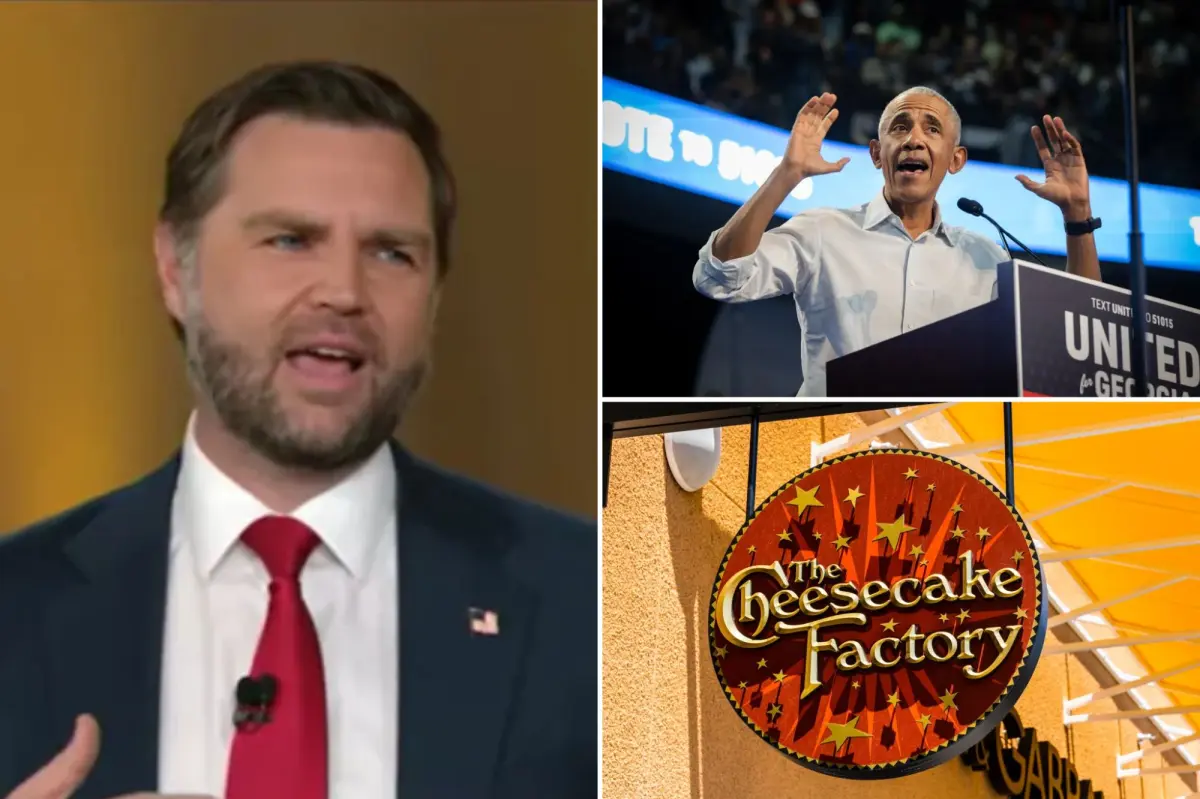
There are some political arguments that are destined to be remembered not for their policy depth, but for their sheer, glorious weirdness. This week, former President Barack Obama served up one of those moments when he decided to take a swing at Donald Trump’s White House redecorating choices by comparing the place to a Cheesecake Factory run by Saddam Hussein. It was a peculiar, vivid, and undeniably memorable image—part late-night comedy, part architectural critique, part cultural commentary. And it didn’t take long for Vice President JD Vance to fire back in a way that felt just as human, just as conversational, and perhaps just as telling. Speaking at a Fox News town hall hosted by Jesse Watters in Texas, Vance admitted he didn’t fully understand the insult. “I didn’t fully get it. I kind of like the Cheesecake Factory,” he said with a shrug that must have resonated with millions of Americans who have happily eaten their way through that enormous menu. It was a simple, disarming response—not a furious counterattack, not a carefully worded statement from a press aide, but the kind of genuine reaction you might hear from a friend at a barbecue. Vance took the opportunity to gently reframe the whole exchange, suggesting that Obama’s jab revealed more about the former president than it ever could about Trump’s taste in crown molding or gold-plated fixtures. What might have been a throwaway joke about interior design quickly became a proxy battle over class, culture, and the way America’s political elites see the people they claim to represent. And at the center of it all stood the Cheesecake Factory—beloved by some, mocked by others, and now unexpectedly elevated to the status of a political symbol.
Paragraph 2
Vance didn’t stop at defending the restaurant. He immediately connected Obama’s joke to a much broader pattern of condescension that he believes defines the Democratic establishment. “I think it’s like a good example of how Obama, without even trying to be, just can’t help himself from being super elitist,” the vice president argued. That word—elitist—has become a powerful charge in modern American politics, and Vance used it with precision. To make his case, he reached back to one of the most infamous moments of Obama’s political career: the 2008 remark in which Obama, speaking to donors in San Francisco, suggested that working-class voters in Pennsylvania and the Rust Belt were bitter and had turned to faith and firearms because of economic hardship. “They cling to guns or religion,” Obama had said, and the words never quite faded from political memory. Vance quoted it directly, and with a touch of righteous frustration: “Remember, this is the guy who said that people who wanted good jobs were ‘clinging to their guns and their religion,’ as if God and the Second Amendment were something to be ashamed of.” The reminder was not accidental. Vance was drawing a straight line from that old dismissive phrase to the new Cheesecake Factory joke, arguing that both are symptoms of the same condition: a chronic inability among certain coastal elites to understand, or even respect, the tastes and values of ordinary Americans. In Vance’s telling, Obama didn’t simply make a bad joke; he revealed an entire worldview. It is a worldview that treats working-class culture as something to be analyzed from a distance, gently pitied, or occasionally mocked in the name of cleverness. The Cheesecake Factory, with its endless menu, its oversized portions, and its cheerful, family-friendly chaos, was just the latest victim of that snobbery.
Paragraph 3
Let’s take a moment to revisit the original remark in its full context, because context matters. Obama unleashed his decor diss on Saturday while stumping for Democrats in Ohio, a state that has drifted away from the Democratic Party in recent elections but still carries deep symbolic importance in American politics. He was trying to fire up a crowd, draw a contrast with Trump, and remind voters that the former president spends his time on aesthetic vanity projects rather than the hard work of governing. “I mean, I don’t know if you’ve noticed, but he seems very focused on home renovations,” Obama said. “He should be on HGTV.” That line probably landed well with a Democratic audience. But then came the kicker: “He’s got the White House looking like Saddam Hussein opened a Cheesecake Factory.” The joke was layered, perhaps too layered. It conjured an image of a tacky, gaudy, over-the-top dictator’s palace fused with a chain restaurant known for its eclectic, slightly overwhelming décor and enormous menu. For many listeners, it was funny precisely because it captured something about the sheer excess of Trump’s aesthetic—the gold curtains, the marble, the overall vibe of a hotel lobby designed by someone who never met a surface he didn’t want to gild. But for others, especially those who genuinely enjoy a night at the Cheesecake Factory, the joke felt a little cheap. It mocked a place that millions of Americans genuinely love, a place where you can get anything from a Thai lettuce wrap to a plate of fried mac and cheese balls to a slice of iconic cheesecake. It was a joke aimed at both the former president and the people who might unironically enjoy the restaurant’s endless menu. And perhaps Obama himself sensed that he might have gone too far, because a few days later, at a rally in Atlanta, he seemed to backpedal—not exactly apologizing, but insisting that he had no particular beef with the restaurant chain. “As the father of two daughters,” he explained, the Cheesecake Factory was “my jam for about a decade.” It was a classic political walk-back: not quite retracting the insult, but softening it, making it clear that he did not intend to look down on the millions of Americans who might choose the Cheesecake Factory for a birthday dinner.
Paragraph 4
Vance seized on that backpedal with obvious delight. “See, that’s exactly the point, though… he realized, ‘Oh, a lot of the people we want to vote for us actually like the Cheesecake Factory,’” Vance explained during the town hall. It was a sharp observation wrapped in a folksy, conversational delivery. Obama, in Vance’s telling, had accidentally stumbled into his own condescension again. First he makes a joke that mocks a beloved American restaurant, then he realizes that the very people he needs to persuade might love that restaurant, so he pivots to claim he has loved it all along. The implication was clear: Obama’s politics are not born from shared experience but from calculated, almost anthropological attempts to connect with voters by appearing relatable. Vance then went further, defending the restaurant itself with a kind of affectionate absurdity. “The establishment is the weirdest restaurant to hate on,” he said. “The menu is like 75 pages long, so there’s something for everybody.” It was hard to argue with that logic. The Cheesecake Factory is, if nothing else, a monument to variety. You can bring your vegetarian aunt, your carnivorous uncle, your picky child, and your adventurous friend to the same table, and everyone will find something to eat. It is not a quiet, minimalist, tasting-menu kind of place. It is not a reservation-only, dress-code-required, celebrity-chef-ambitious kind of place. It is a place with bread, lots of bread, and portions so generous that you almost always leave with a box. Vance’s defense was not gourmet, but it was genuinely human. “I just don’t understand. Like, there are restaurants I can imagine beating up on—not the Cheesecake Factory,” he said. And then, with a grin, he delivered the line that perfectly captured the tone of the evening: “Leave us alone, Barack!” The crowd loved it. Watters, ever the showman, joked that the network’s next town hall would be held inside a Cheesecake Factory, and for a moment it felt like everyone was in on the joke—except this time, the joke was not at anyone’s expense.
Paragraph 5
Of course, there is something much larger hidden beneath this strange exchange about cheesecake and Saddam Hussein. The fight over the Cheesecake Factory is, in a very real sense, a fight over what kind of America should be celebrated and who gets to define taste. For decades, the dominant cultural institutions of the country—Hollywood, the media, elite universities, and many political leaders—have tended to look down their noses at the tastes of middle America. Chain restaurants were mocked as corporate and soulless. Suburbs were dismissed as spiritually empty. Religion was treated as a crutch. Gun ownership was viewed as a sign of backwardness. And the people who participated in these supposedly unsophisticated traditions were often lumped together as resentful, angry, and in need of saving from themselves. In response, a powerful populist backlash has developed, and figures like Donald Trump and JD Vance have made a career out of channeling that resentment back into politics. When Vance calls Obama an elitist, he is not making a purely partisan argument. He is tapping into a genuine cultural wound, a feeling that many Americans have been laughed at for generations by people who think they are smarter, better, and more refined. The Cheesecake Factory, strangely enough, has become a symbol of that divide. It is bright, loud, enormous, and unapologetically commercial. It does not try to be subtle. It does not care about the Michelin guide. It simply wants to serve you a ten-page menu of options and keep the bread coming. To mock it is to mock a certain vision of American comfort and abundance. To defend it is to defend the idea that pleasure does not need to be aristocratic to be valid. In that sense, Vance’s defense of the restaurant was more than a punchline. It was a small act of cultural warfare, a declaration that ordinary Americans do not need to apologize for liking what they like.
Paragraph 6
In the end, the entire episode feels almost like a fable for modern American politics. A former president makes a clever joke that is meant to land on his opponent but ends up landing on millions of his fellow citizens. A sitting vice president responds with a folksy, genuine defense of a chain restaurant, turning a lighthearted insult into a reminder of how out of touch the establishment can be. Neither man is entirely wrong, and neither is entirely right. Obama is certainly allowed to think the White House décor under Trump is gaudy; he is even allowed to use an exaggerated image of a dictator opening a restaurant to make his point. But Vance is also allowed to hear that joke and recognize, in it, a familiar sneer that has been directed at people like him for a very long time. And perhaps the most human part of the whole affair is that Obama himself seemed to realize, almost immediately, that his joke had missed the mark with a significant portion of the audience. His quick turn to “it was my jam for about a decade” felt less like a proud defense of the restaurant and more like a politician trying to avoid an unnecessary cultural stumble. The whole exchange tells us something important: in America, food is never just food, taste is never just taste, and the choices we make about where to eat are deeply tied to who we are and how we want to be seen. A place like the Cheesecake Factory sits at the intersection of all these forces—beloved by many, mocked by some, and now immortalized in the strange, ever-shifting conversation about what it means to be an American. If we are fortunate, perhaps this moment will fade quickly, and we can get back to the real business of governing. But until then, there is something almost comforting about the fact that our political leaders are arguing over cheesecake rather than conspiracy theories or constitutional crises. It is silly, yes. But it is also deeply, unmistakably human. And maybe, just maybe, we can all find a little common ground over a shared slice of cheesecake—provided we can agree on the flavor.